Vanagon – bumper build – fixing the endcap connection
Posted by albell in metal working, metalworking, vanagon, vanagon mods on August 7, 2013
I really didn’t think through the bumper to endcap transition did I? Here is what my doodling around resulted in.
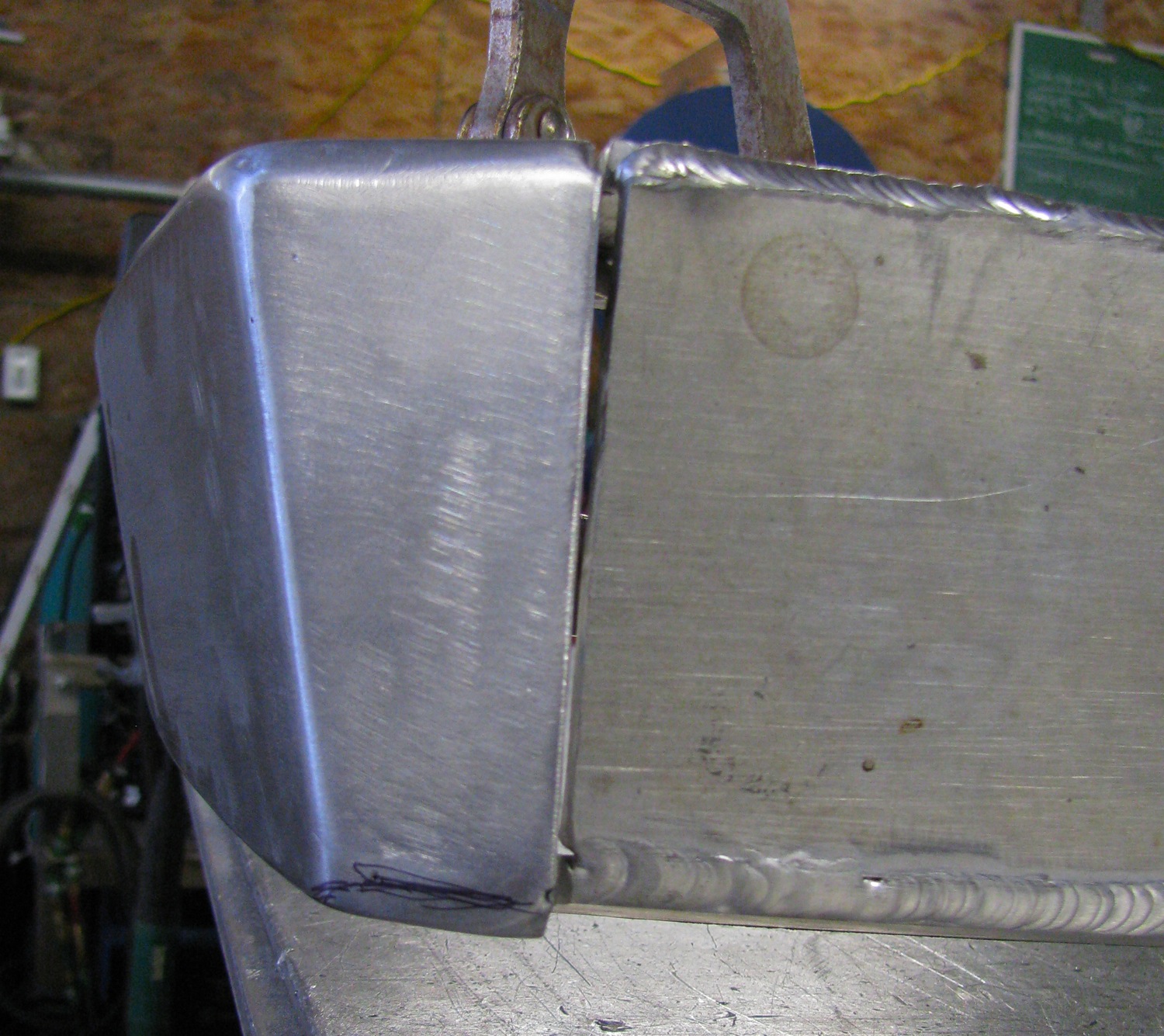
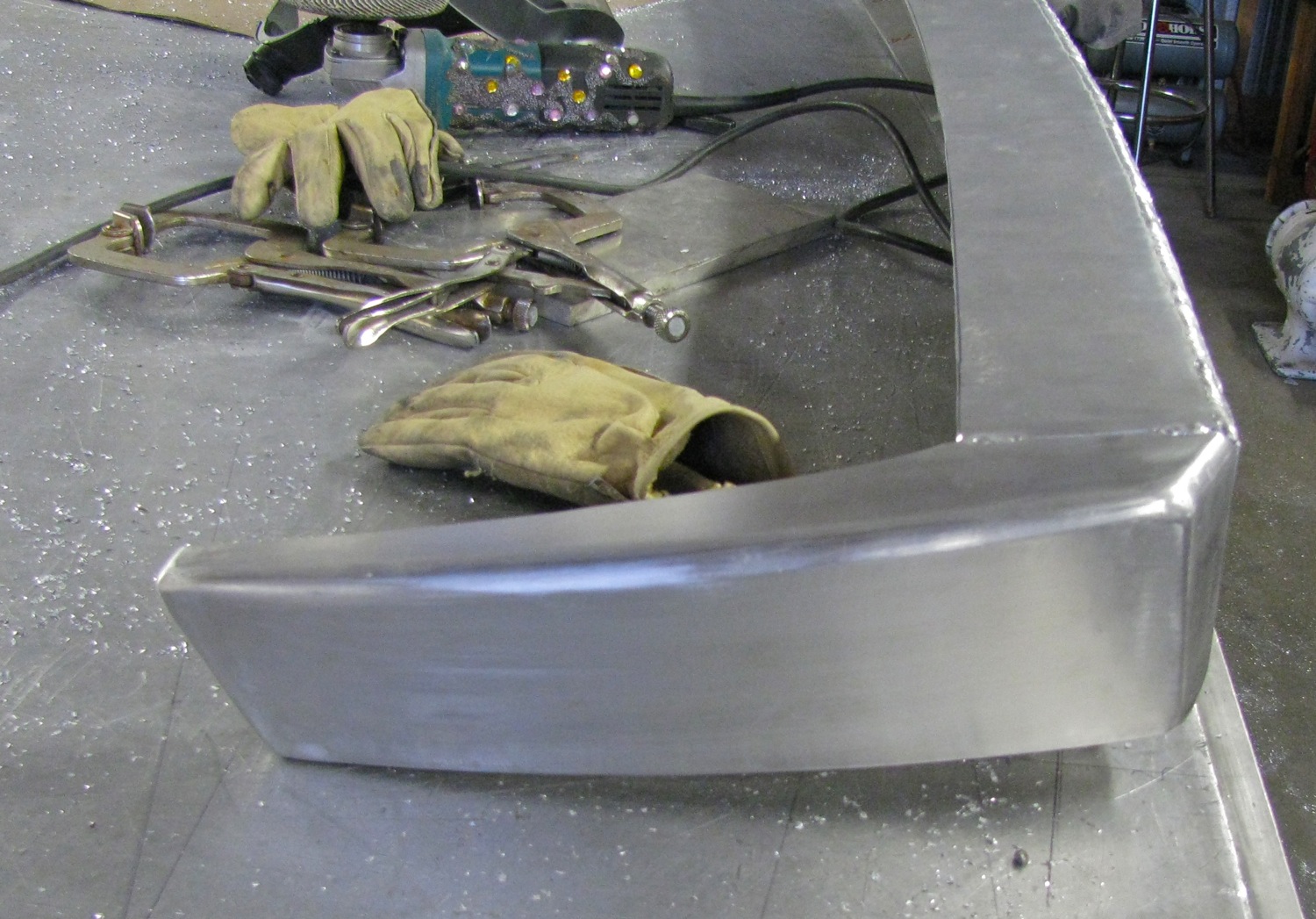
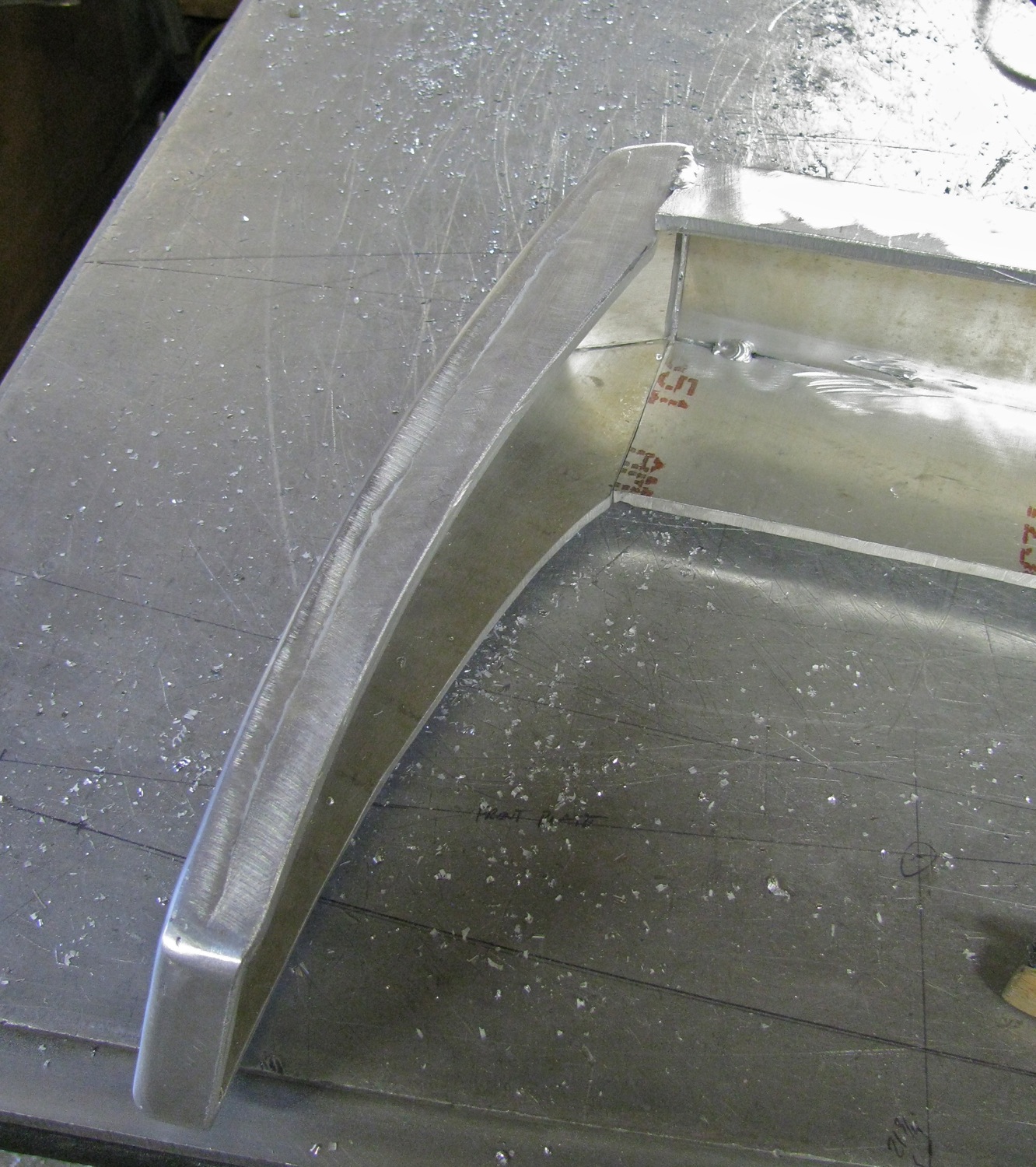
I have to be clear and say again that I’m winging it. I’m doing in aluminum what I should be doing in cardboard or thin plywood. So to fix the blunder, I cut the endcap up a bit, angled the bottom plate to match the bumper bottom plate, added another filler piece then welded it up and roughly smoothed things over. It is a lot better now, this might be the one to keep.

I didn’t take too much time grinding the welds, but enough to get the idea of how I want the corners to look.

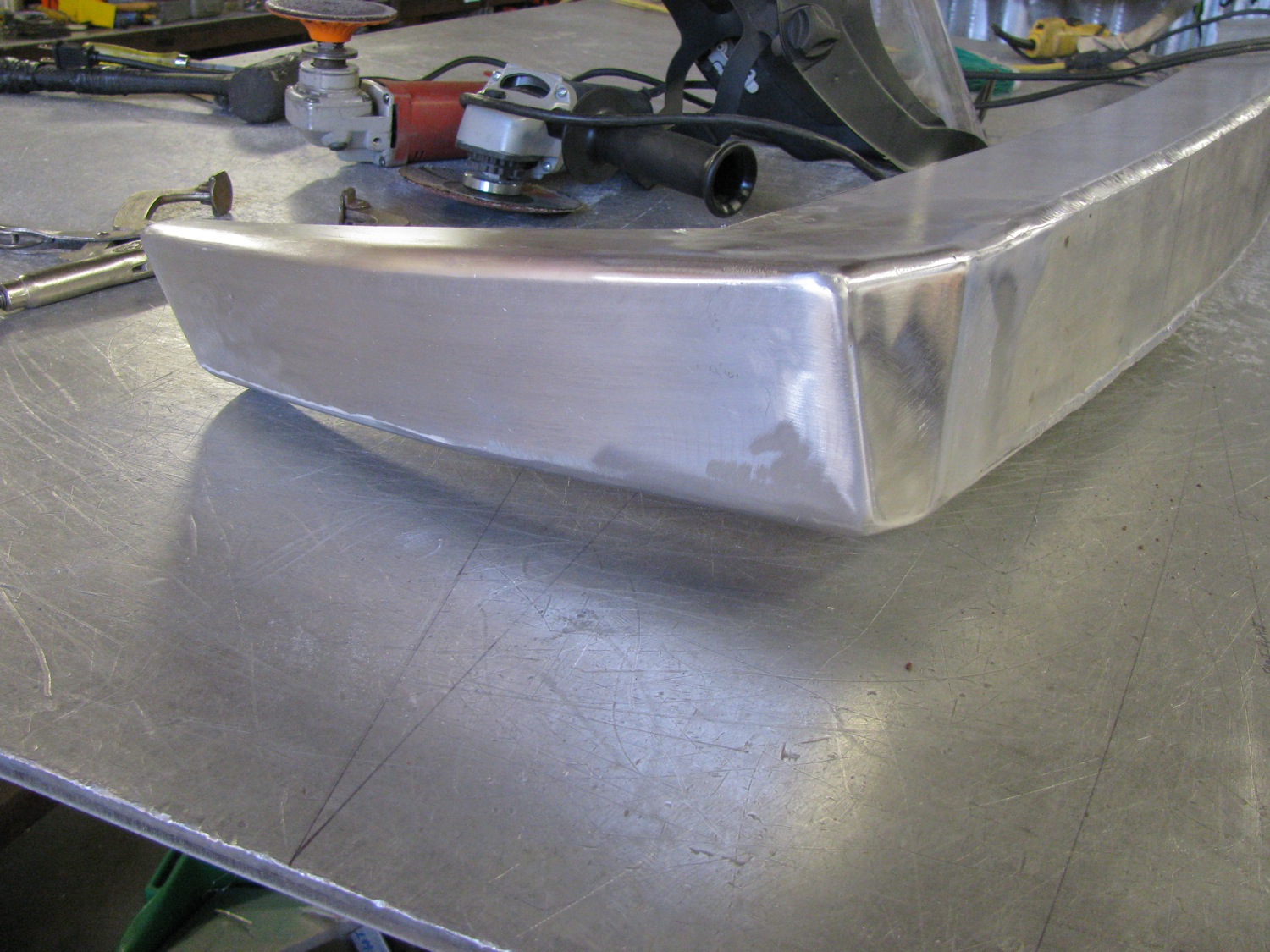

Both bottom plates, bumper and endcap, meet up a bit better. I’d like to radius or smooth out the inside corner also.


Next thing to do is to double check fit on van, smooth out some wavy edges and corners, then make a matching (ha!) endcap for the other side.
Trip – quick look at Loup Creek
Just back from a short overnight trip. Our goal was to see if we could find a camping spot on Loup Creek (a tributary of the Gordon River). I’ll leave it up to the reader to discover just exactly where we ended up.
July set records here for the lack of rain (it did shower for a couple of days at the end of the month) and we were worried that gates would be closed on some logging roads. Turned out many gates were closed and that stopped us from exploring some other spots before we got to Loup Creek. We drove up some fairly steep and rough roads, but at the end of them there was neither a good view or a creek or lake. For some reason I didn’t take any pics of the steep roads, I guess I was distracted by the search and the road conditions. I have to say that the little mods to add some more ground clearance on the van really paid off. No more scraping the spare tire carrier or the trailer hitch when going over the ditches cut across some of the minor logging roads. Those roads can be fairly steep (+20%) and the road surface is loose sharp rock.
The only pic I took of this part of the trip (not steep and not rough)
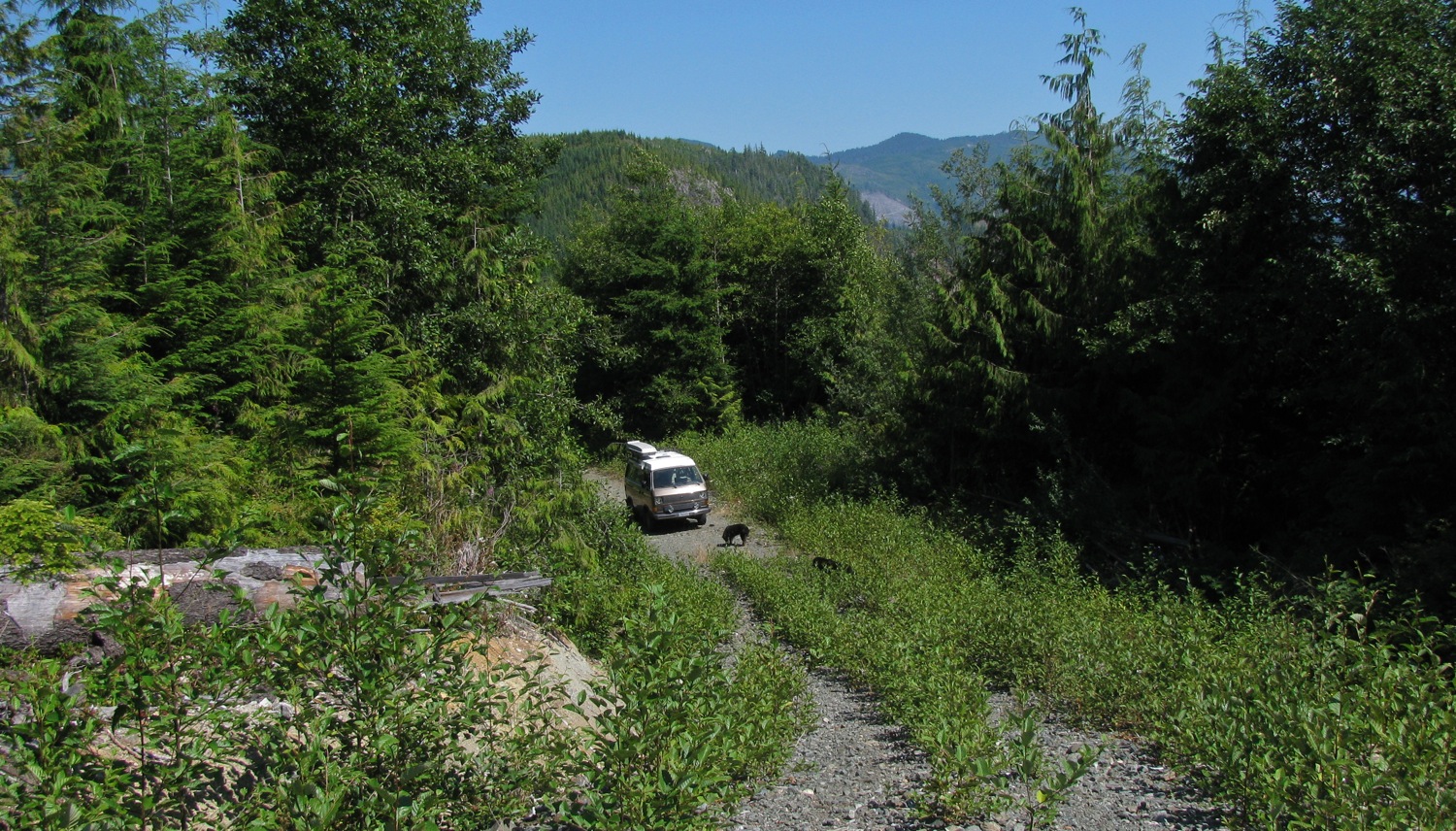
So off we went northwest alongside the Gordon until we found the old, abandoned Forest Service road. Moderately steep climb, loose rock, few over hanging alders. Toodled along until we came to the first bridge over the Loup. This was a bridge built to last – large concrete abutments, 2 giant I-beams spanning, and precast concrete sections as deck. Deck about 30 feet above creek. Other side of the bridge was pretty well alder choked, and the roads led to nowhere interesting so we decided to continue upstream to find the second bridge. There was this sign just up the road.

Then there was a steep section and the surface of the road was made up of larger than normal loose rock. At this point the van started to miss and buck, just the same thing it did at the end of our last trip. We barely made it up the steep section, van bouncing, tires slipping. Not that much fun with a ditch on one side and a very steep drop down to Loup Creek on the other side. We had to drive on a kilometre or so before we could find a level spot to stop. I won’t go into any thoughts about why the van was missing and bucking in this post, but we let the engine cool down (it was a hot day and we had been working it hard) to see if that made any difference. Well it didn’t and even thought I really wanted to go on to find the second bridge we decided to turn back and camp at the first bridge.
It really wasn’t a bad place to camp. Secluded, beside a creek, bugs not *that* bad.
So here I am sitting and thinking. Am I marvelling at how good the classic Thule Combibox 250 looks on the van? (that’s for you Phil Z.). Am I enjoying using the table mod? Am I enjoying a drink and some potato chips? Or am I wondering why the van engine is acting up?
All of the above 🙂

As the creek runs pretty well north – south at this section, and as the sun was in the west, I couldn’t get very good pics of the creek from the bridge. I did get a pic of the van lit up by all the led strips later that evening, for Jerome.

About 11 am next morning, sun made it down into the creek. Still hard to get a shot, the river rocks reflect a lot of light
Looking upstream (north).

And downstream.

We packed some food and drink and clambered down to the creek and walked up stream a short distance. My wife and Jake found the way down.

There are some small trout, and perhaps salmon fry?

You might be able to make out the bridge.

And about 6pm we packed up and drove home. Van bucking came and went, no rhyme or reason. Ah well, that’s something to figure out later. It didn’t spoil a nice little trip.
Vanagon – bumper build – end cap attempt
Posted by albell in metal working, vanagon, vanagon mods on August 2, 2013
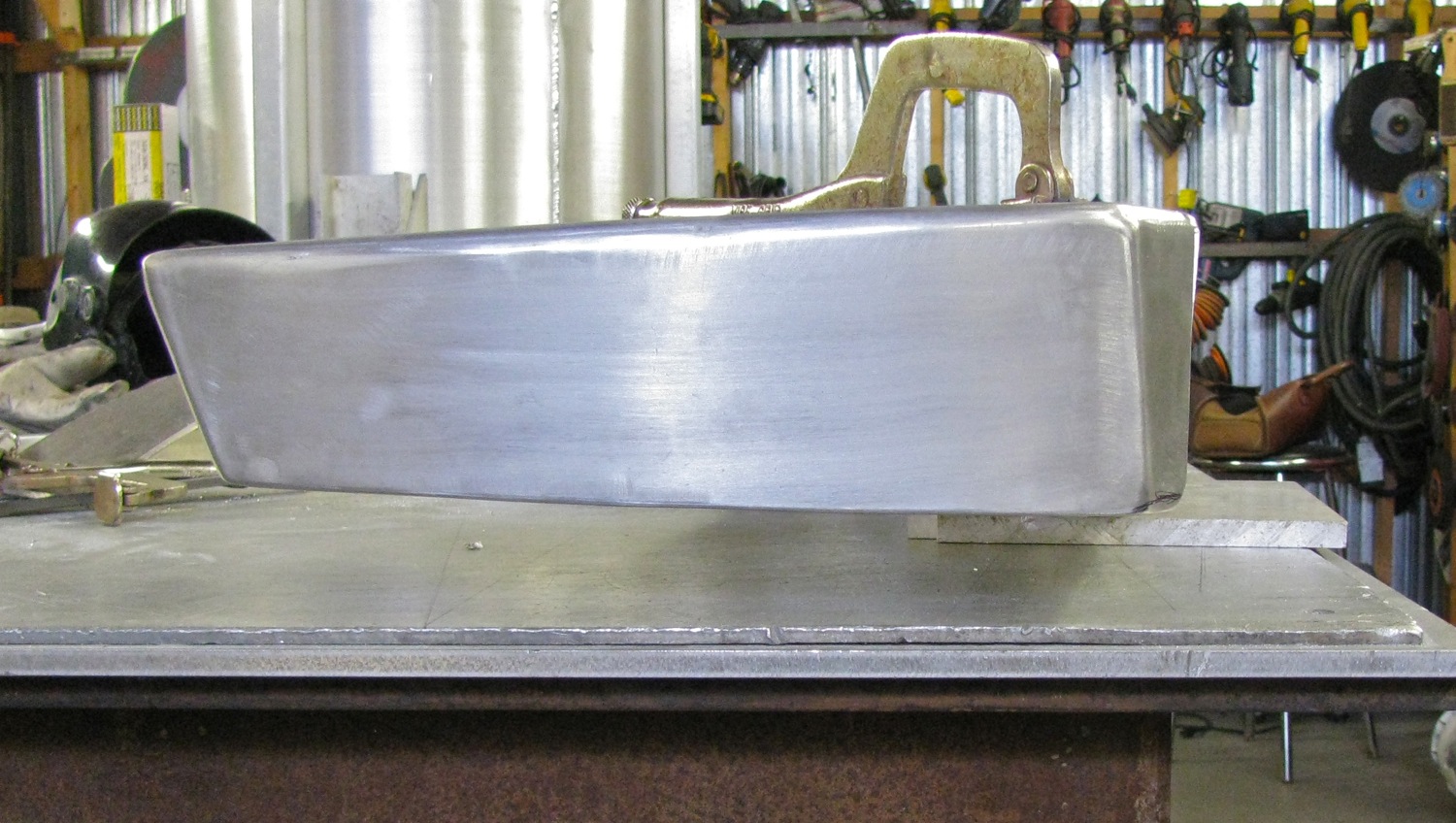
Didn’t get much done today, just worked on one end cap. I had thought about making a mock-up from door skin or cardboard but instead I went ahead mocking up with aluminum (1/4″ for top and bottom, 3/16″ for the face plate).
The 3/16″ face plate (vertical plate) was from a bit of scrap that was curved, large radius. I cut some 1/4″ plate for top and bottom and tacked them on. Then clamped the affair to the bumper.

It’s a trick transition, and you will see later that I still haven’t figured it out. I cut a bit of 1/4″ to fill the hole.
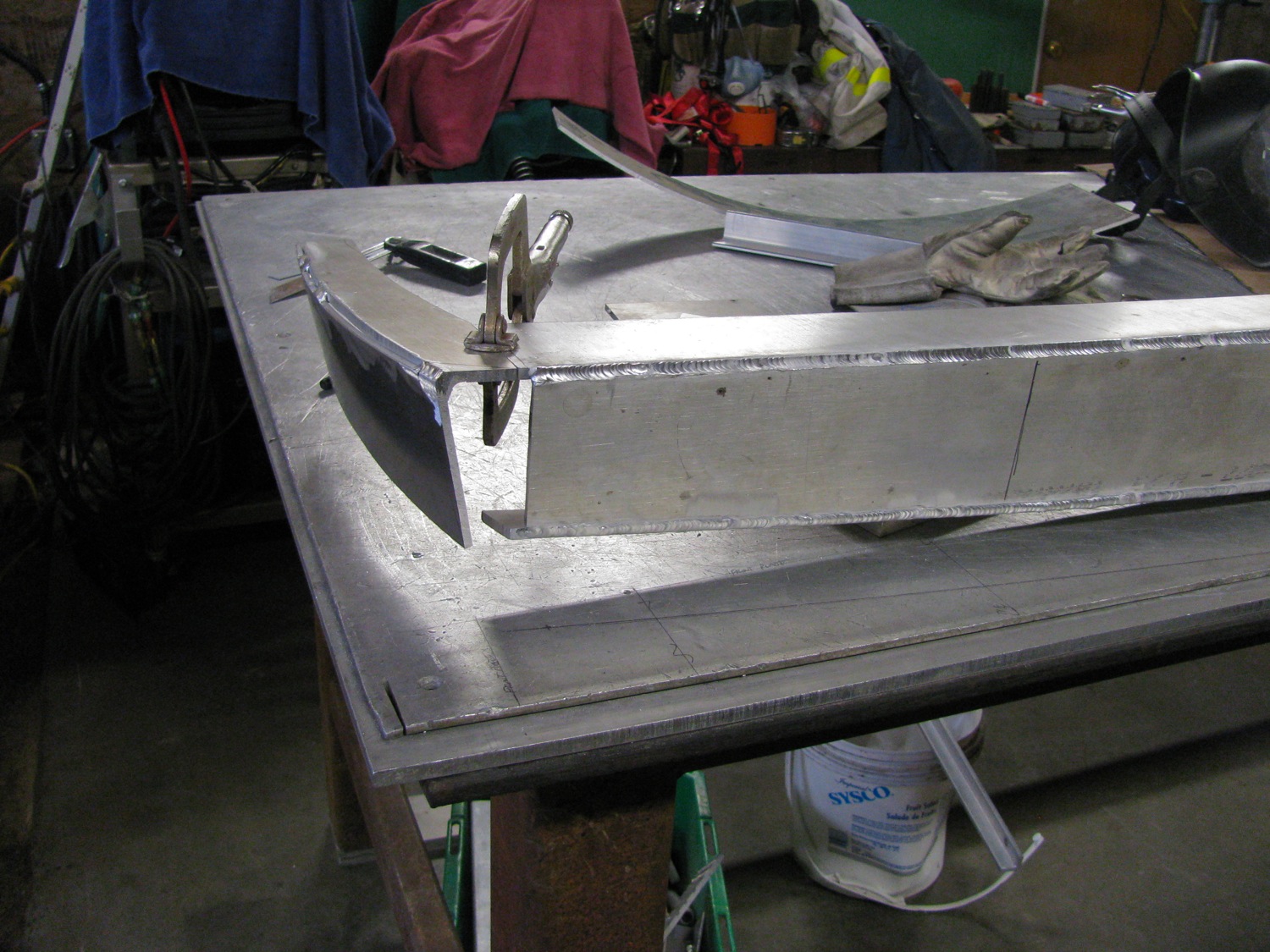
I couldn’t resist rough grinding a radius on the welds.

Another view.

Side view.
The corner filler bit is obvious in this pic.

I’m quite there yet, am I?

“if you can jump it, I can weld it”… ha!
I tacked the end cap to the bumper so that I could remove the clamp and took the bumper out to the van to see how it fit. Up until this point I was only guessing the dimensions of the end cap – I wanted it to end up about an inch behind my mudflaps and about 1/4″ from the body. Turned out I had to thin the endcap down a bit, was hitting the body.
So it was “MIller time!”! One tool that gets a lot of respect and care in use. Nasty bit of work but cuts the aluminum nicely. What’s with the rust on the blade? Must have got splashed with water, and we don’t put any oil or the like on tools that will be touching aluminum or stainless for fear of weld contamination.

Slimming things down.

I think it looks nicer than the first version.

And it fits to the van like I want it to.
I will have to zip cut the front of the endcap and re-form it to make the transition to the lower plate of the bumper. But I’m liking how things are going.
Vanagon – bumper build part 2
Posted by albell in metalworking, vanagon, vanagon mods on August 1, 2013
I managed to tack and weld out the 3 main parts of the bumper. It was a little bit of a struggle pulling the bottom plate into position (inside edge to inside edge with about a 1/16″ overlap). I ended up TIG welding all the joints. I didn’t like the MIG welds I made on a test piece (I don’t have many hours on the machine). I’m not saying that my TIG welds are very good, but at least I got some practice. In any case, I’m going to grind down the welds to make a rounded or at least a beveled corner. I haven’t finished fairing the free edges of the top and bottom plates yet.
Tacked up.

Outside tacks on the face to bottom plate joint.
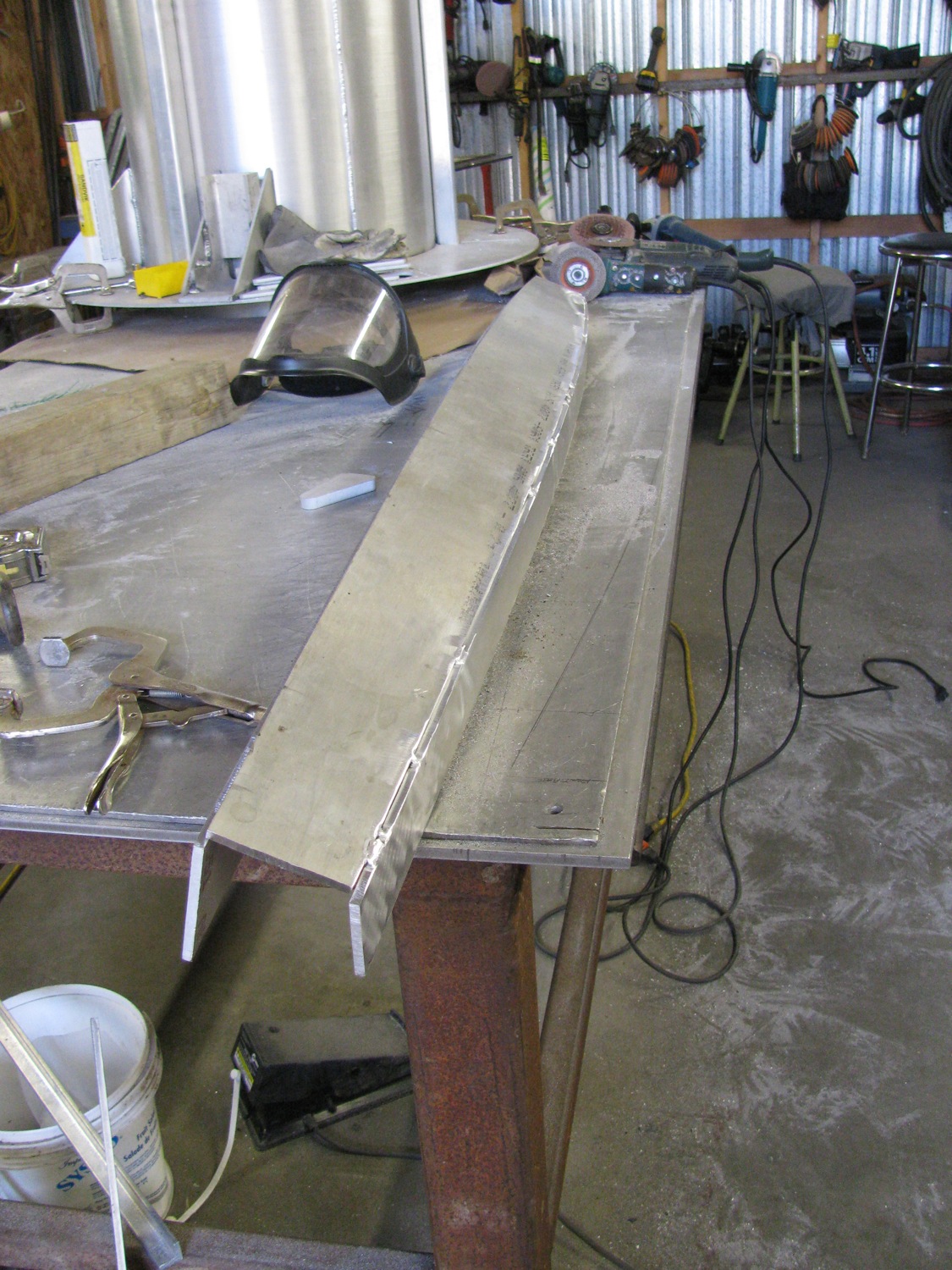
Inside tacks on top plate to face plate.
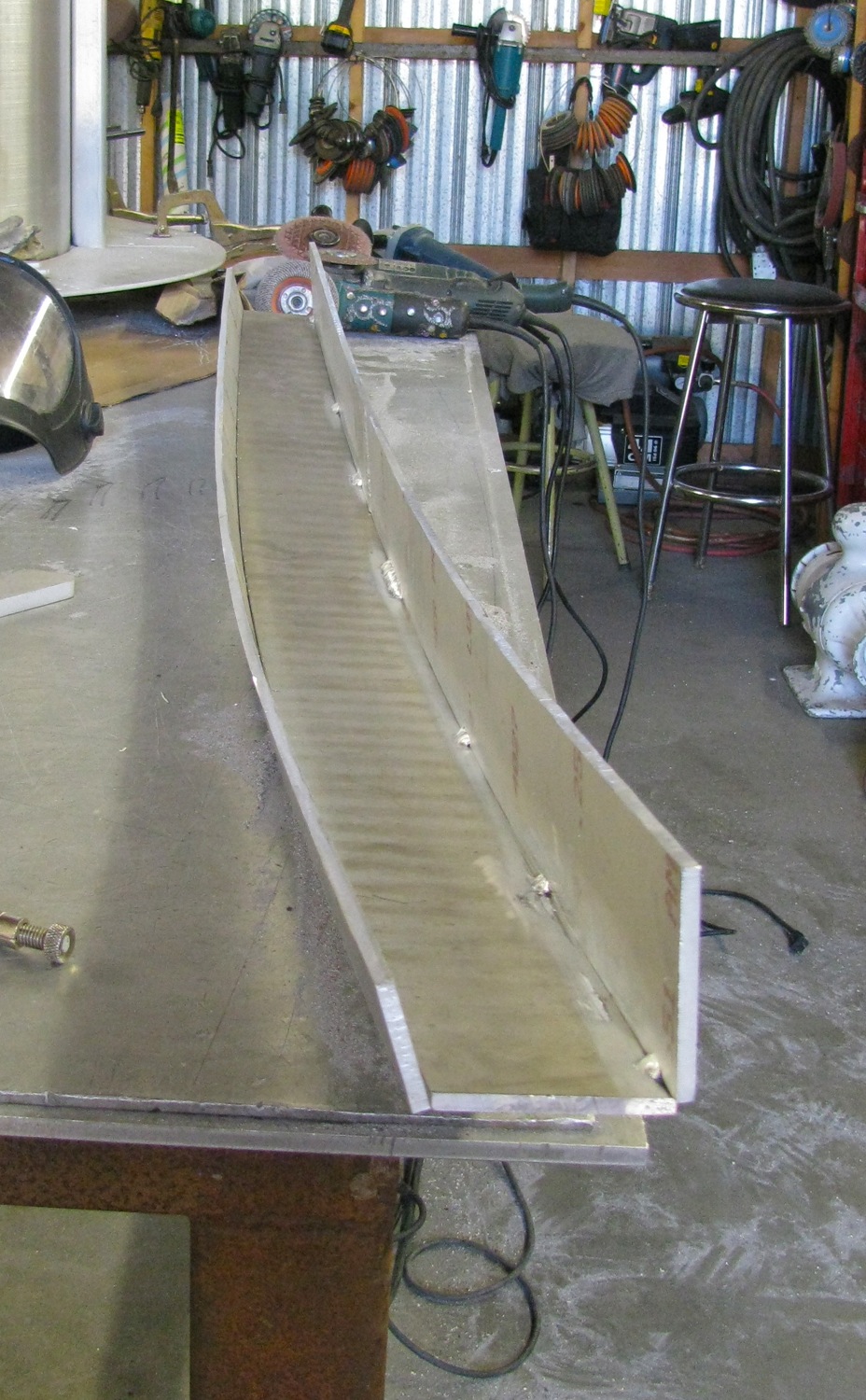
Then on to my inconsistent and amateurish weld out.
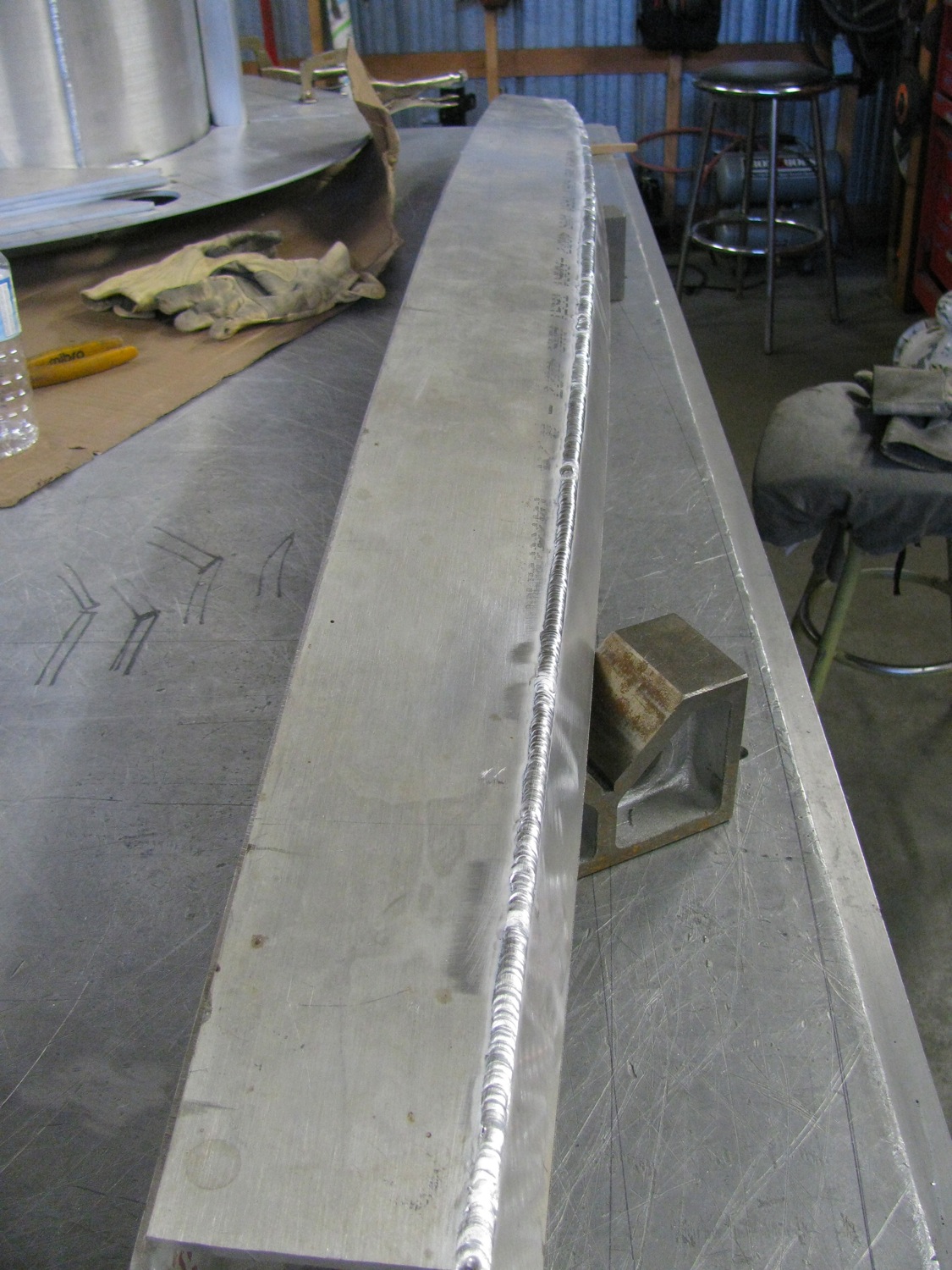
All done, top and bottom plate welded on.

I’m rubbish at estimating weights, but I’d guess around 10 kg as is.
Vanagon – rear bumper build
Posted by albell in metalworking, vanagon on August 1, 2013
I figured I need to post what I have done so that I have more reason to finish the job. I want to make new bumper, front and rear. Not because the stock bumpers are damaged or rusty, but because I want bumpers that are a bit stronger and will be able accept a spare tire carrier on the rear and better aux. light mounts up front. And just because I want to make some bumpers.
It’s a project that never seems to get really going nut here is the progress to date.
Last year I fooled around with making a mock up rear bumper out of door skin and hot glue. I came up with a shape that to be honest was the best I could given the brief of it being simple, slim (not bulky like some aftermarket bumpers – yes, I’m looking at you Go-Westy) and easy to make. The door skin and hot glue construction makes it easy to add or remove material and have a relatively solid model to play with. I have a hard time visualizing an object from drawings so I tend to make a mock up (or remake the real object).
I started with a slim bumper design, very simple with a flat top surface (to make standing on bumper easier), a gentle curve on the rear vertical face that closely mimics the stock bumper, and a curved lower edge rather than straight lines to where the bumper caps would be. I took the first design over to let Simon have a look. His tastes lean a bit more towards a heavier bumper so I stuck on more door skin and made it so.
BTW, in the mock up pics the bumper is shifted to the left due to interference between the stock bumper mounts and some wooden braces in the mockup.
I don’t like this at all.
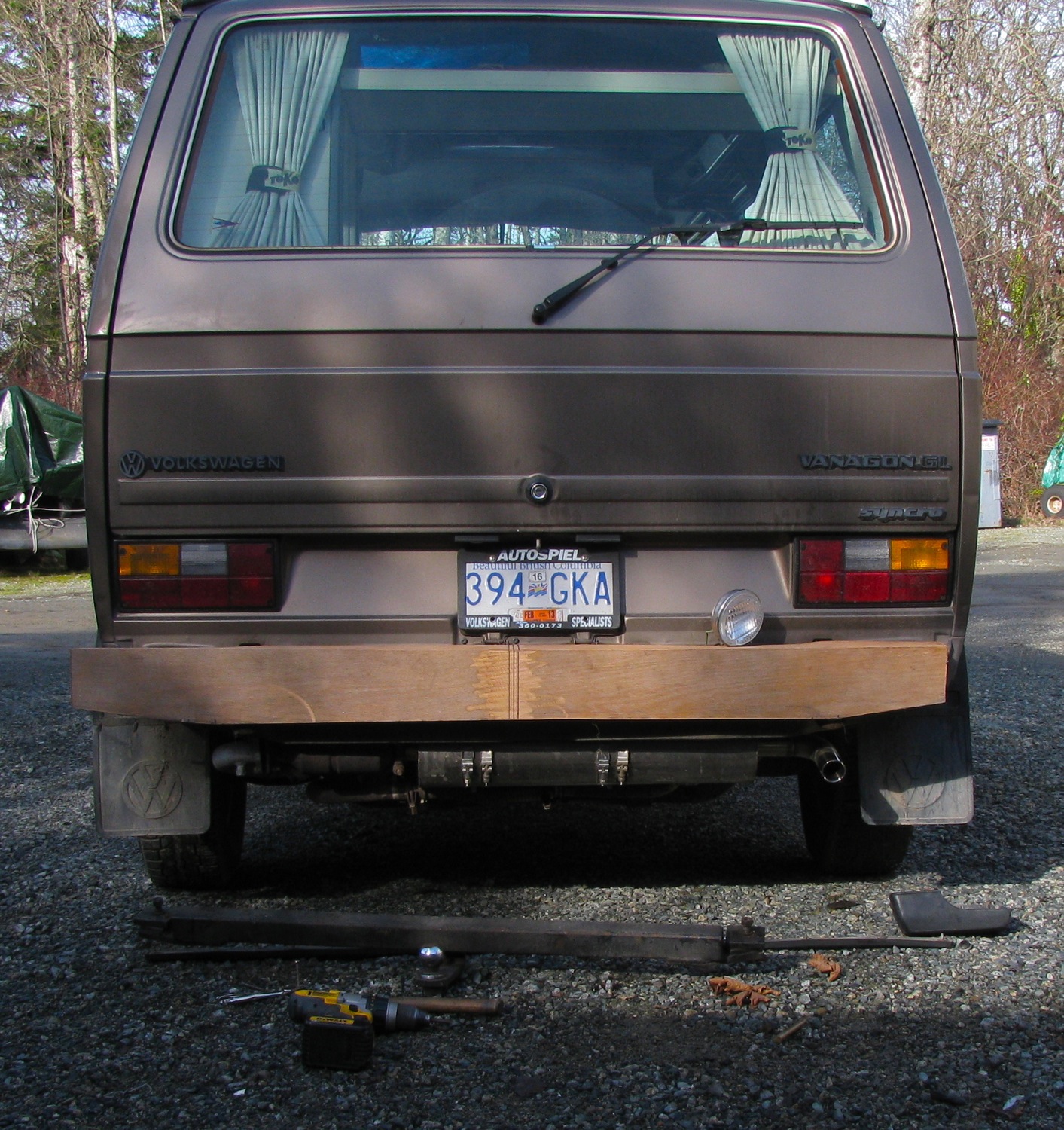
I removed some wood, looks better. Probably would please Simon.

But I like ’em slimmer still. Ended up back to the original shape.

Right then, I’ve settled on the rough shape now what material will the real bumper be made from? Silly question, aluminum naturally. I’m using some off-cuts of 1/4″ aluminum plate (6061). I think that thickness will be plenty strong, especially when it is bent and welded up into the final “C” channel of the design.
I should mention that I took dimensions from the mock up and “projected” the 3 faces onto the top of the workbench. I used a bit of wood to fair the curves and picked up the shapes for the 3 main parts (top, bottom, rear face)h onto some polyethylene sheet. I could then tape the pattern onto the aluminum stock and use a prick punch to mark the shape on the aluminum. But I’m getting ahead of myself, I have to weld some of the aluminum together before cutting out the shapes.
My lumpy and large TIG weld. In my defence, I hadn’t touched the welder for a couple of months so what little skill I did have seemed to have slipped away.

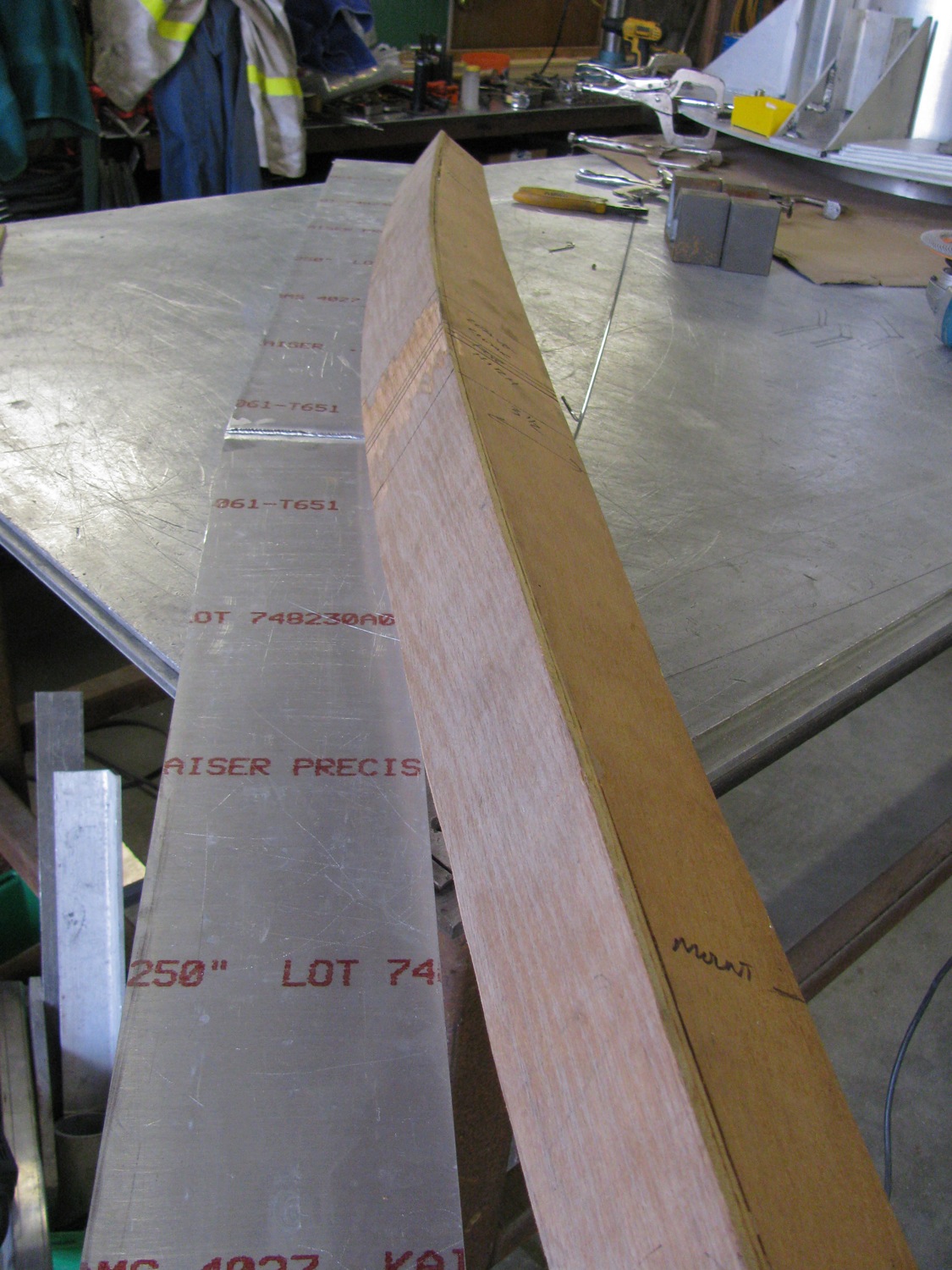

I’ve cut out the 3 main parts, rather roughly I’m afraid, and if I have time today I’ll try bending and tacking them up. I’ll need to make some internal braces just to make the weld up easier. I’ll TIG weld the tacks, then I think I’ll use the MIG welder for the final weld up. It would be sort of silly for me to TIG the long welds.
Vanagon – kludgy roof rack rail
Posted by albell in syncro, vanagon, vanagon mods on July 27, 2013
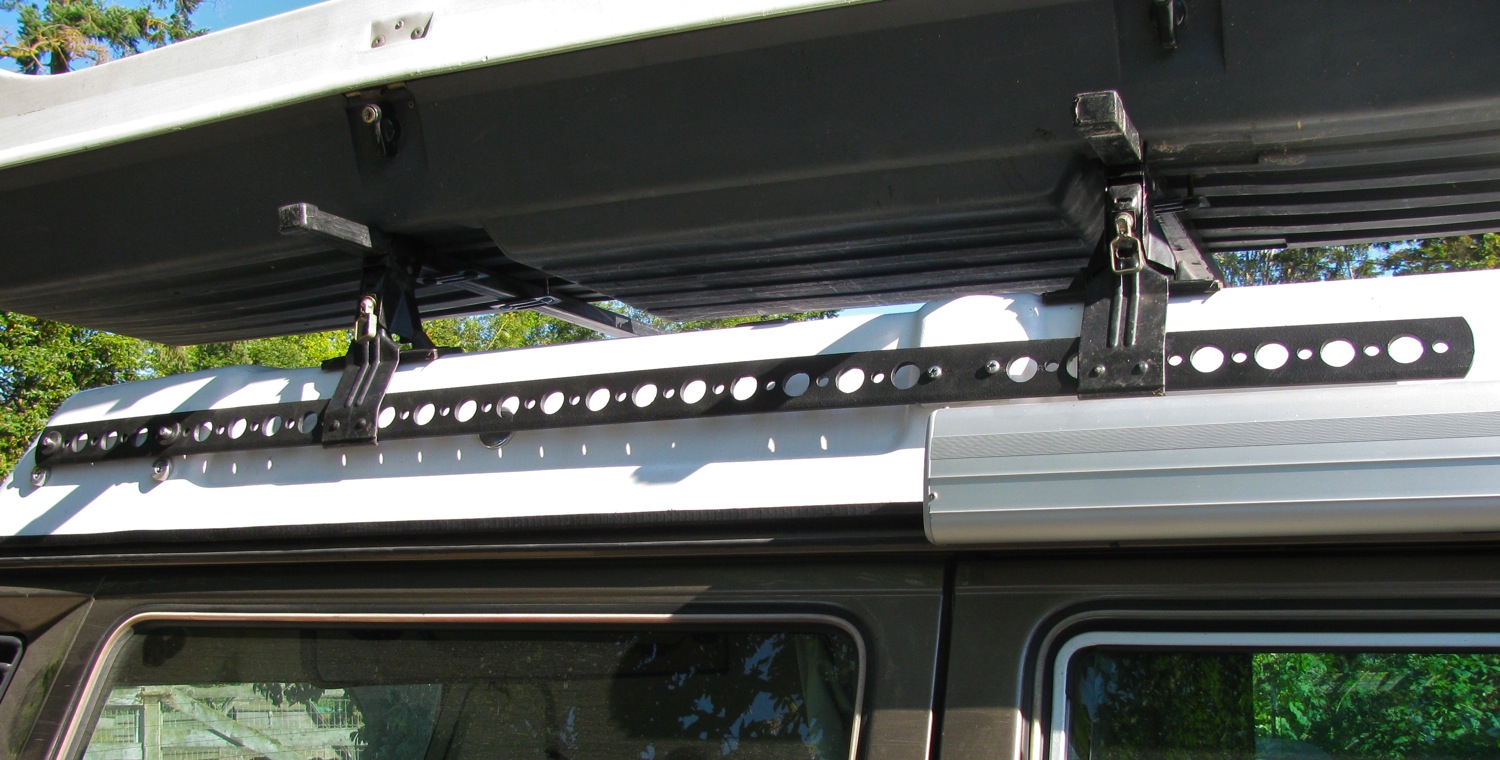
A while back I made some artificial rain gutter things to quickly get some roof racks on the van so I could carry my son’s kayaks. They worked even if they were ugly. But then this year I found a good deal on an old school Thule ski box. I think it is a Combibox 250, you know the kind, seemed to be on every Volvo station wagon around here during the ’80’s.
Anyhoo, the distance between the mounting points on is greater than the distance between the mounting points in my quick and dirty solution done for the kayaks. I didn’t want to drill more holes in the pop top to add another pair of mounting brackets so I came up with an another kludge.
I took some 1/4″ thick, 2″ deep 6061 aluminum flat and drilled some holes in it (for looks mostly). The rear end of the strip attaches to the top two bolts of the pop top hinge. Up front I screwed up and drilled holes in the centre line of the strip which did not line up with the holes in thhe pop top that I drilled for the old bracket.
So I drilled a bit of 1/2″ aluminum plate, and pressed in some nuts (M6). The plates then screw into the old holes and the pressed in nuts take bolts from the strip. I beveled the lower edge of the strip to fit the hooked arm of the roof rack. The strip got some rattle can bedliner as a finish.
I have some spacer blocks to go between the front end of the strip and the pop top. Just to prevent branches from snagging. But i ran out of double sided tape so they are not installed yet.
Well it works, no points for aesthetics, but it works.
Now I need to make a ladder to access the damn box!


Vanagon – LED powered rear side marker light
Posted by albell in vanagon, vanagon mods on July 26, 2013
Peter R. sent me this info on swapping in an LED bulb to replace the stock incandescent bulb on the rear marker light. He writes:
“Well here is an image of the new lense with LED bulb installed. As they say, the photo does not do it justice. Remember that this is with new reflector/lense and there is a significant improvement even without power as the old plastic was cracked, discoloured and scratched.
Biggest improvement will be the fact that the LED bulb generates no plastic deforming heat whereas the old bulb in that tiny enclosure was like an easy bake oven”
“hThe bulb part # is BA9S-4 LED”

Vanagon – Temp II sensor replacement
Posted by albell in syncro specific repairs, vanagon on July 25, 2013
A rather thin post but since I took pictures I might as well post them up. On our last camping trip the van had a strange missing/bucking/bogging problem. This has happened twice before, always in summer, and always cured by a fill up of gas. So I’m leaning towards the “bad gas” explanation but I’m not ruling out other causes. I have checked and re-adjusted the throttle position switch and perhaps I should take the throttle body off again, take some pics and do a post about that. The next on my list was the temp II sensor. This is the sensor that tells the computer what the coolant temperature is. Not to be confused with the dash water temp gauge sensor. The connector to my sensor was broken and I’ve always wondered if it was making a good connection all the time. I thought that if I was going to install a new connector why not put in a new sensor too. Dave, from Dave’s Automotive in nearby Sidney BC (great guy) found me a connector and wired in a pair of pigtails. So off we go then, with the install.

The sender takes a 19mm wrench, but I didn’t pull it until I spliced in the new connector.

I took a couple of resistance measurements from the new sender, one in the evening and one in the morning. Pathetic eh? 🙂
I used crimp style butt connectors and heat shrink to make the splice. Not shown in above pic are the two smaller bits of heat shrink to go over the individual butt connectors.
Here’s a shot of the damaged connector.

And replacement one spliced in. You don’t loose much coolant at all if you are quick with the sender swap.

New connector and sender in place. The extra wire (and it does help to have extra wire when you splice in situ) is taken up to some degree by one turn and a zip tie on the crossing.

And boy oh boy, the new sender really has transformed the van. No, I lie. No noticeable difference. But then again my strange bucking/bogging problem occurs every 18 months or so…h
Vanagon – front table stand
Posted by albell in metalworking, vanagon, vanagon mods on July 21, 2013
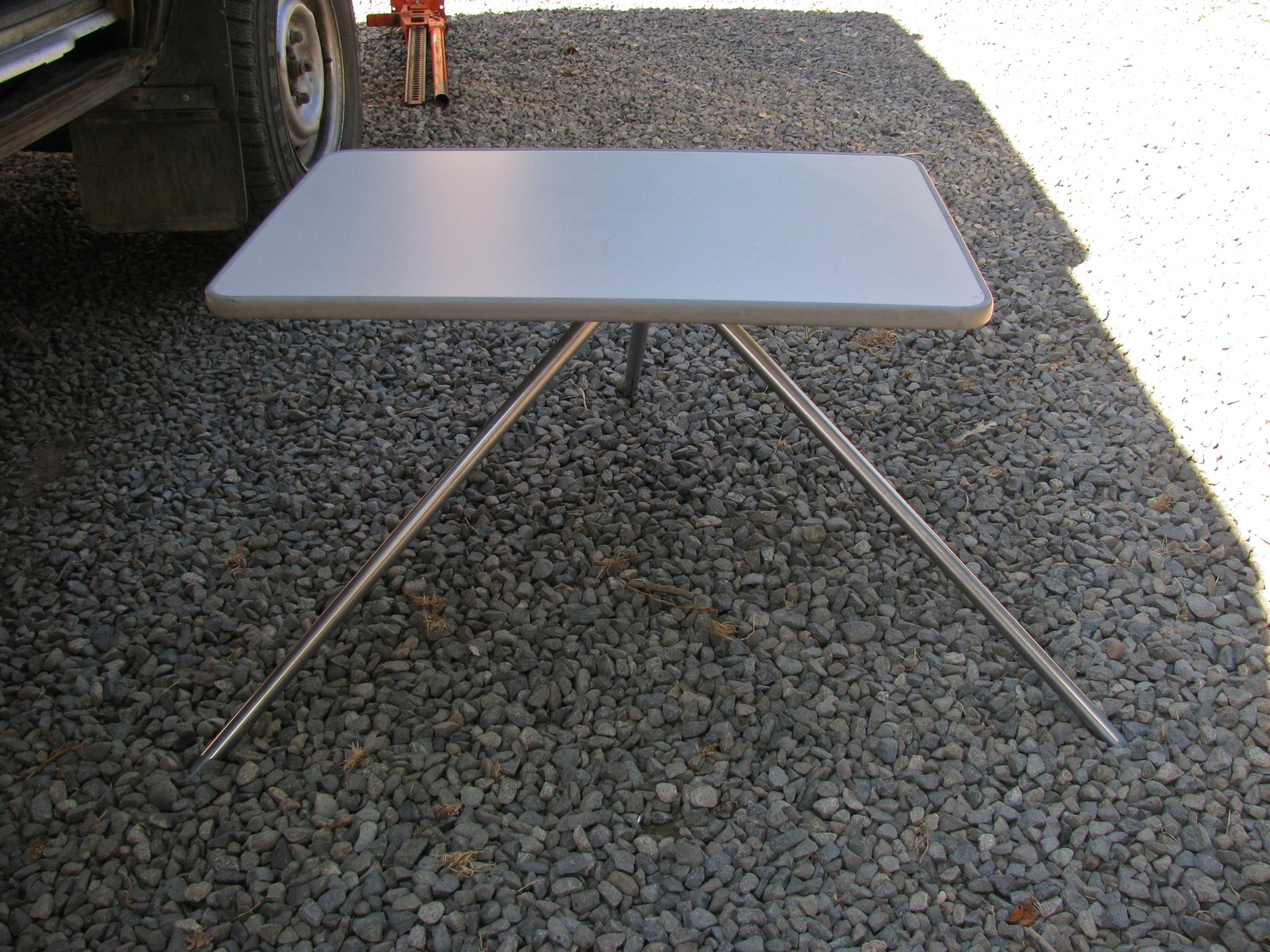
From the same twisted R&D department that brought you the “Excelsior” toaster, comes this slightly silly stand for the Westy front table. It is kinda nice to have a low table beside the camp chairs, something to put your drinks and snacks on. One could modify a cheap camera tripod to do the same thing, but when one of those tripods are set low they don’t have a heck of a lot of stability. A box works well as a support, but really, that’s far too practical and sensible.
Again, made from scraps – 6061 aluminium, stainless bolts, and some Delrin. The leg to hub connection does look a bit weak, but if it fails I’ll go from the M8 threaded stud to a M10. You would be right thinking the 3/4″ diameter legs, at that angle, put some strain on the connection to the hub. But the open ends of the legs dig into the ground and stiffens things up.
Table sits about 16.5″ high.
Yes, I could have, maybe should have, female threaded the base of the hub so it could be left attached to the table and the stock “leg” in the van could screw into it. That was too much work to do 🙂
Oh I should mention this is a front table from a later year Westy. The older version has a short section of pipe sticking down from the table.


Vanagon – nasty
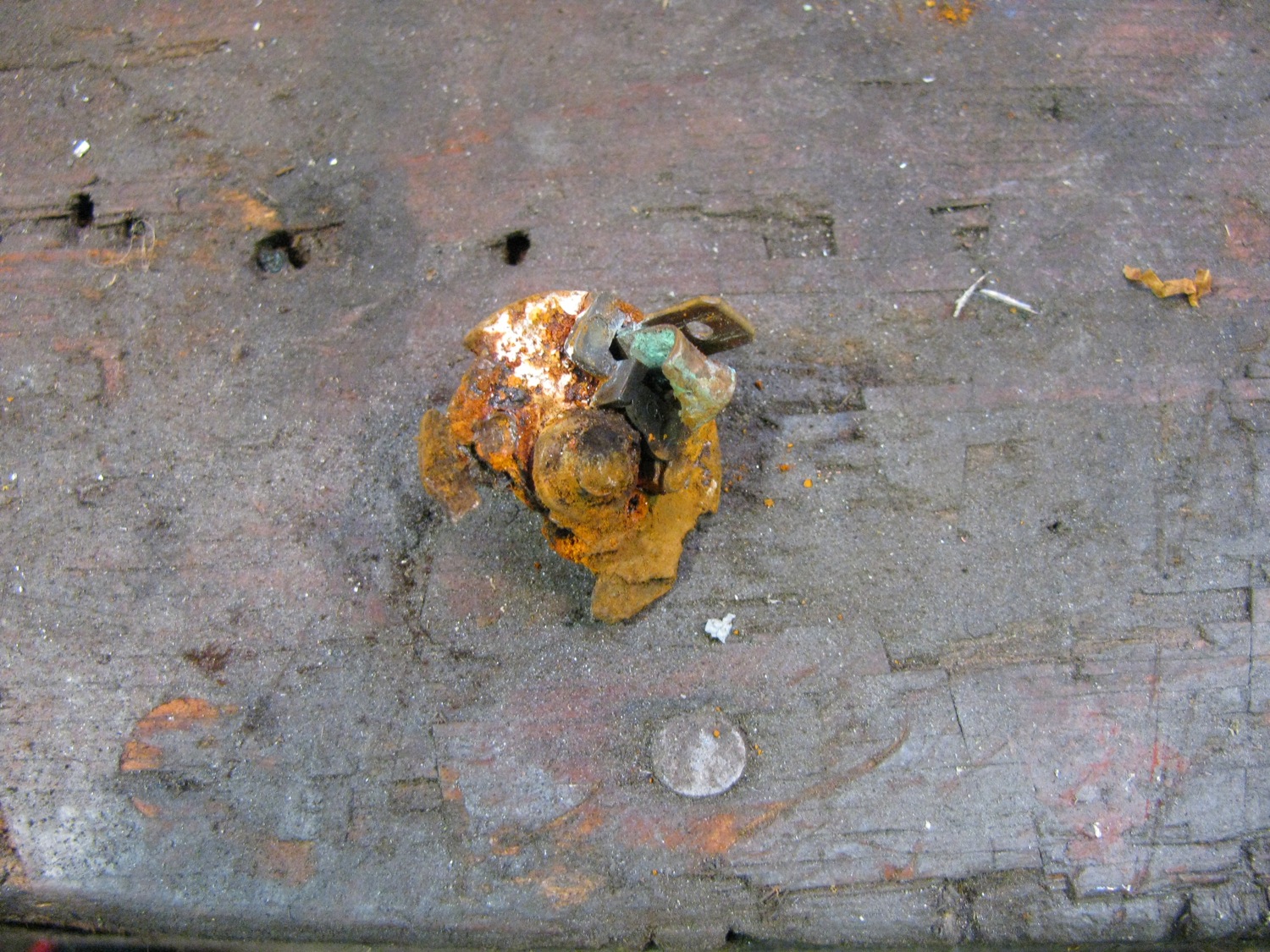
Replaced side marker light last week, took some pics of the nastiness. Eric, I hope you don’t find this under the boot.
One spade ok, one spade ugly.

Water in the lens assembly.

Tab on the right needs to be gently pried to the side to get the bulb holder out. Notice the plastic distorted? Some corrosion induced heat?

What the bulb holder should not look like.
WHat the bulb holder should look like.

Trip – again to Port Renfrew area
Can’t waste a sunny weekend staying at home, so off we went Saturday morning for an o/n trip to the area NW of Port Renfrew. Yeah, we go there a lot is seems, but it is secluded and pretty.
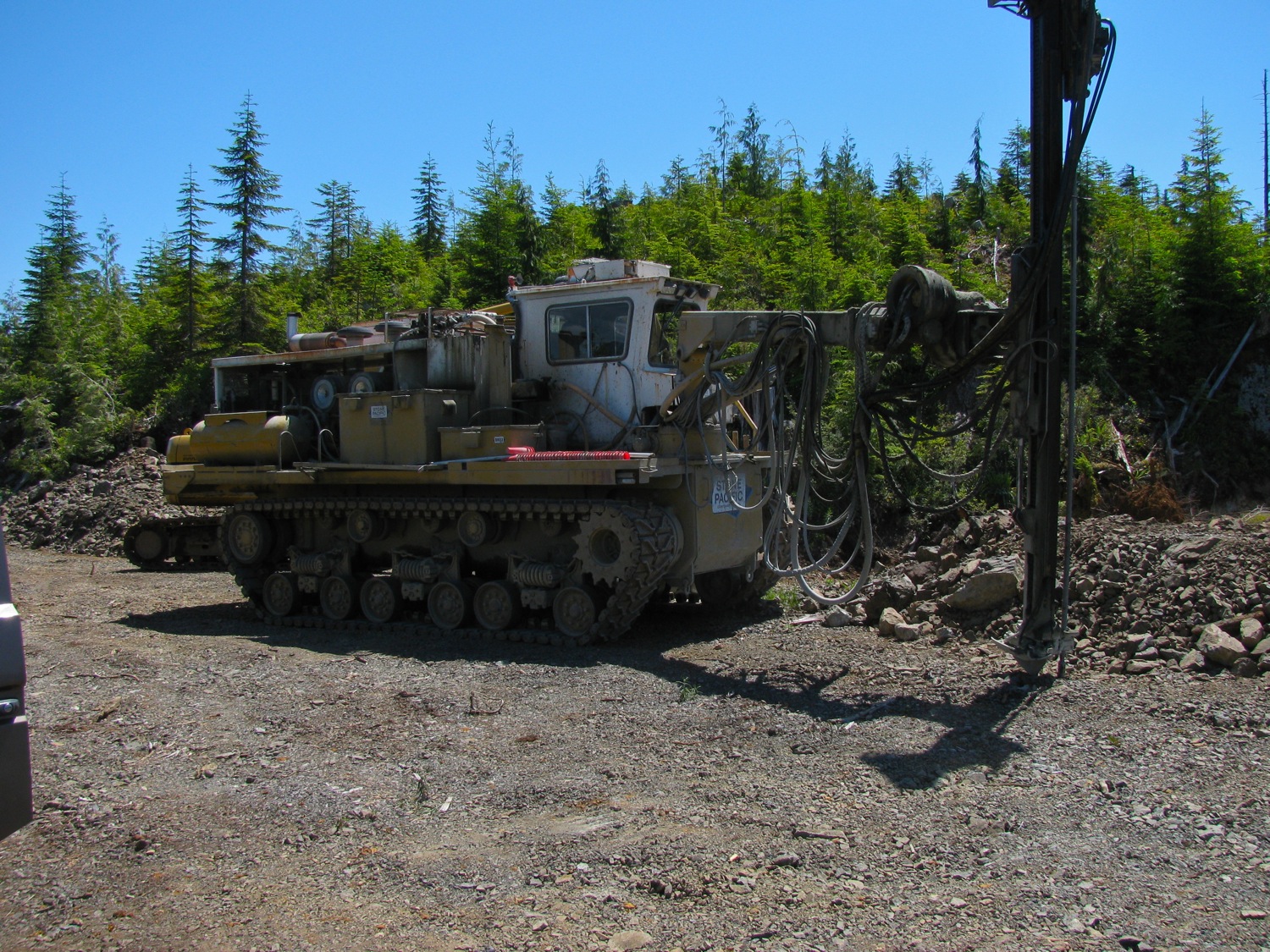
Before setting up camp we did some exploring on the Sad Lake main logging road. BTW, there is no Sad Lake in that area, no idea why the logging company gave the road that name. We got close (less than 1 km) to the southern boundary of the Carmanah-Walbran provincial park, and ran out of road at about 615 meters elevation. Most of the hills in this immediate area have been logged below this elevation and now we found construction of a new road to log some of the smaller trees (about 1 meter diameter and less). A fair amount of Yellow Cedar, lovely wood. I wonder what the market is for this species now that wooden boats aren’t very popular?

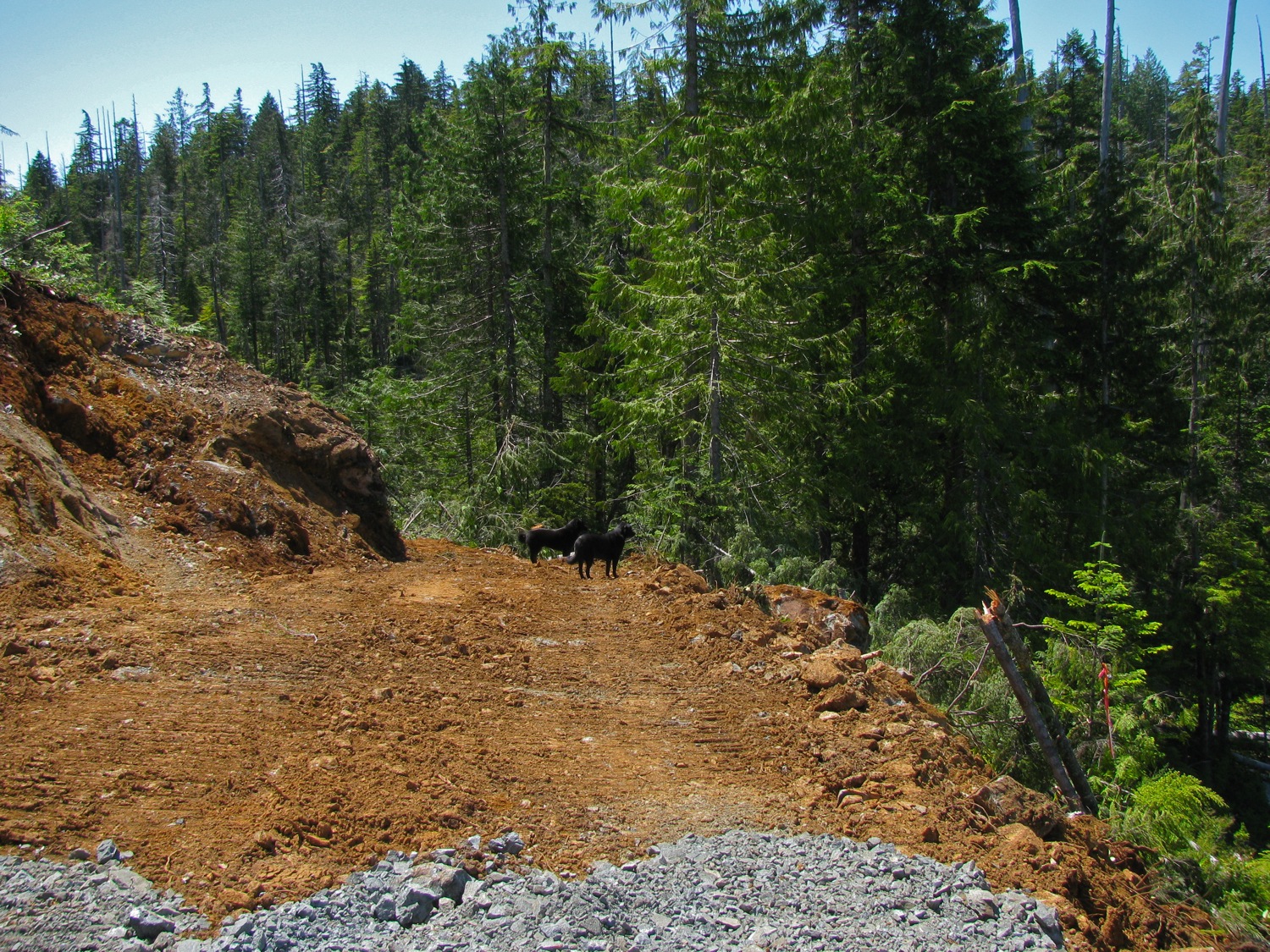

Nice view of the ocean fog from up there.

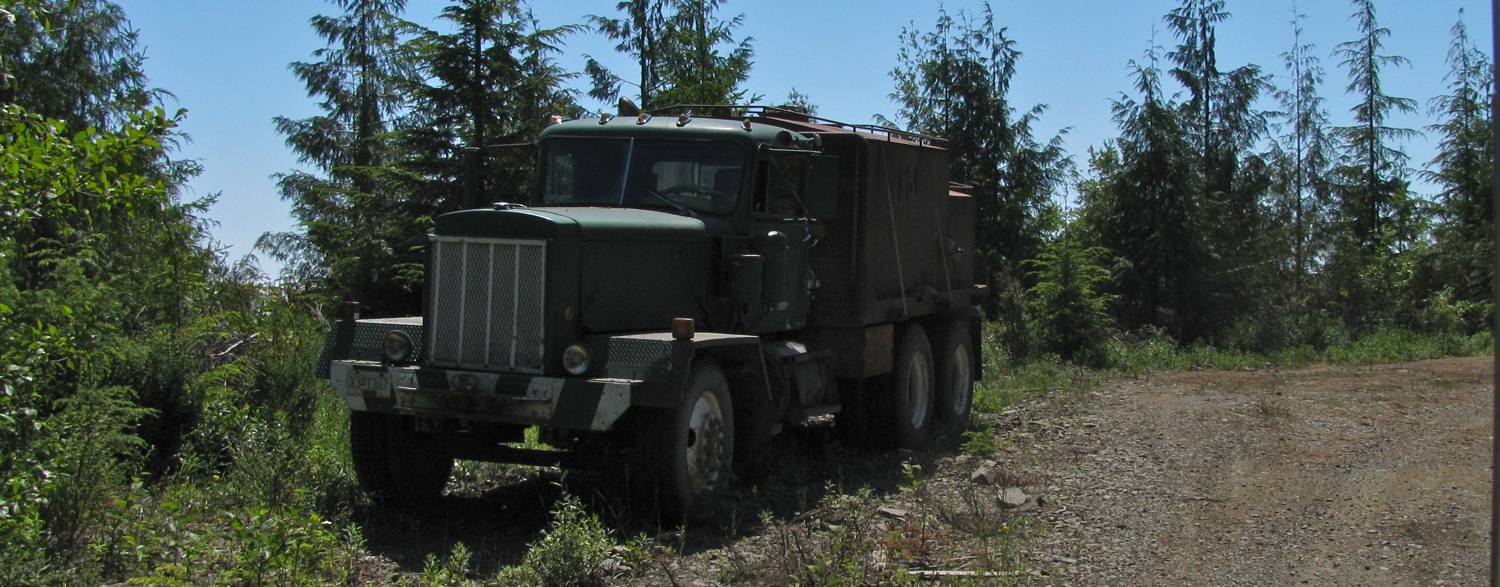
Oldish truck being used as a fuel tanker
A little further west. This is about as thick the trees get in this area. Combo of elevation and rocky ground. No shortage of rain here.

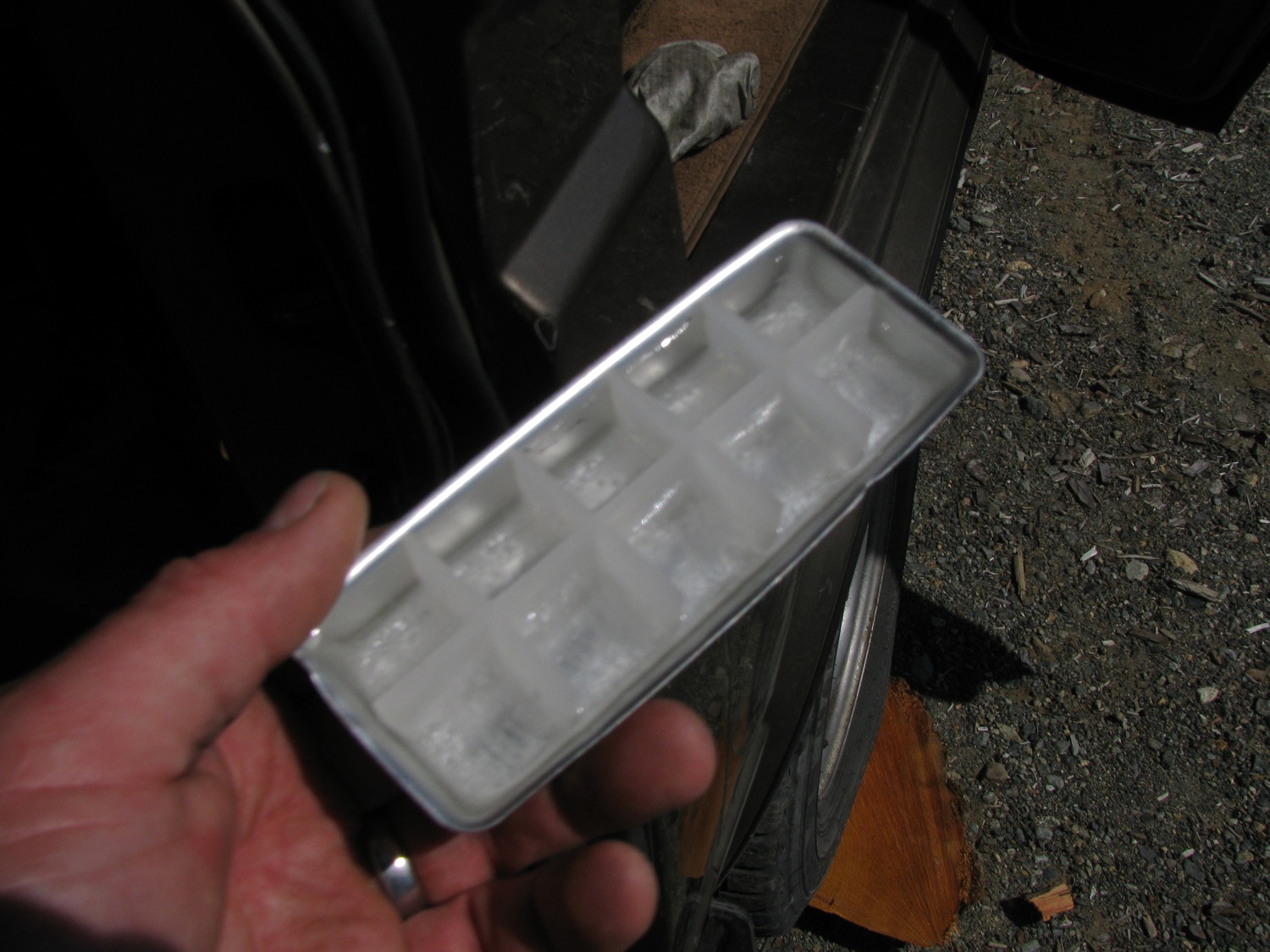
And then we headed to our old campsite. I’m telling you, the Dometic engineers just nailed the design specs for the Westy propane fridge, well at least for us up in the temperate rainforest 🙂 Yes, solid ice in the Barbie sized ice cube trays. A rather poor surface area to volume ratio with these cubes, they don’t last long in the G&T.
Yup, same spot, same picture. Poptop canvas different though.

Just about then the dogs started casting about, some scent got them alert. Looking down from our campsite, 3 bears. Look to be 2 yearlings and what I presume to be the mother.



Mum?

Ok, all the LED lights on.

Next day we explored further. Nothing much to report except coming across a bear carcass. Been shot, hind legs were a few feet away, the paws cut off. Bear hunting pisses me off. The fuckers who buy bear paws and gall bladders should be… well, I won’t say.

So on the way back we took a few side tracks, exploring. On one track the van started to lurch and miss. This got worse so I stopped in Port Renfrew to fiddle with the engine. Nothing looked amiss, no vacuum leak or bad connection.O2 sensor was disconnected, no differance. At the worst point (and it was not consistent) when I moved the throttle valve just off fully closed, I mean *just* off, the van would miss, stumble, almost die. This was me moving throttle by hand. I replaced relays, checked evap/emissions tubes. Nothing seemed amiss. Then it would run well enough to get going again. For minutes it would be normal, then it would buck and die. For most of the trip I either had to have the pedal full down, or else coasting. I suspect the throttle position switch. Will check it out.
Vanagon – what part is this?
I was rummaging through the boxes of Vanagon stuff in what I charitably call the workshop. I was making an attempt at a clean up and I came across this thing. I don’t know where or when I picked it up, but I don’t think it was on any of my vans.
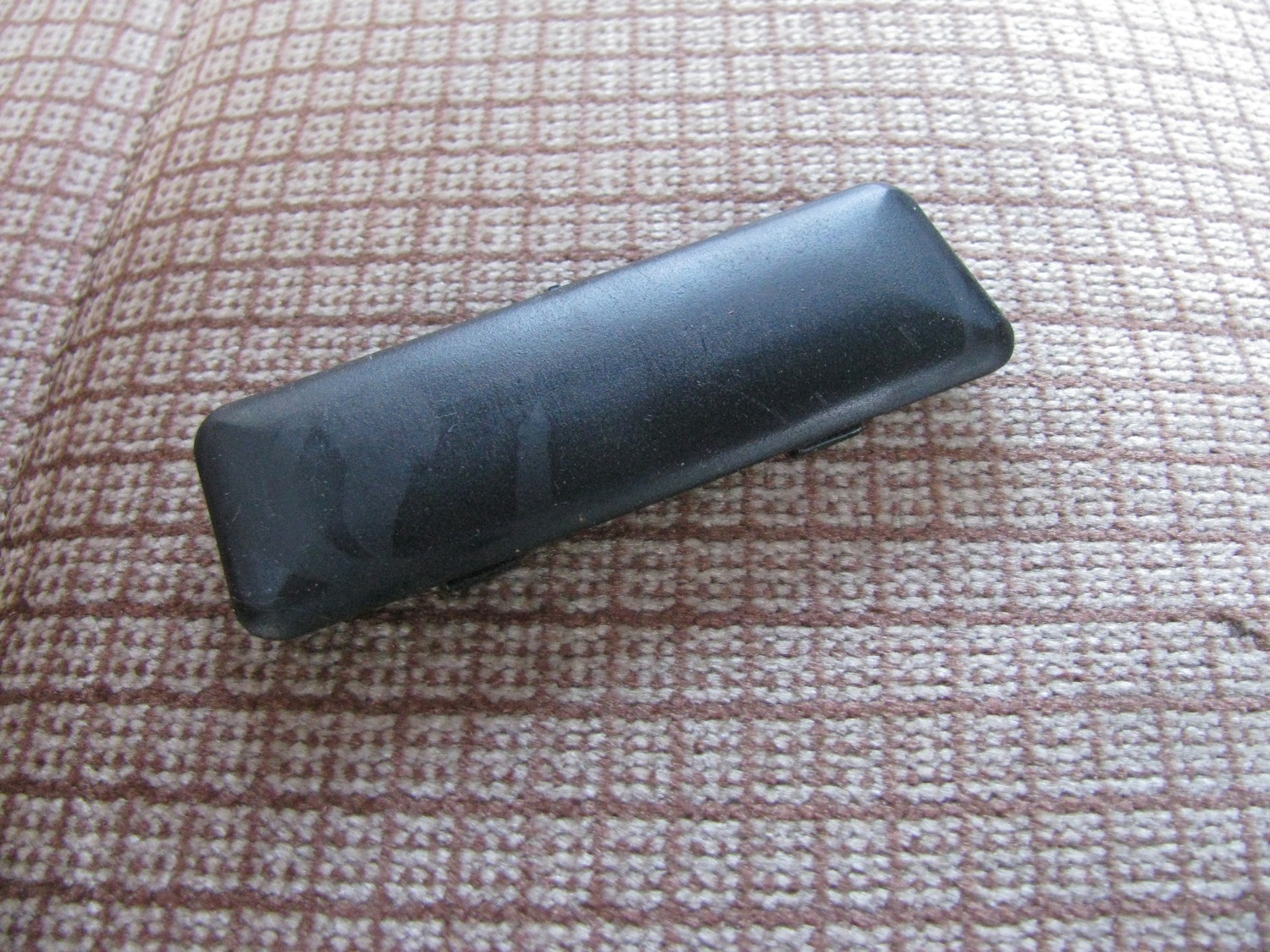
Answer is in the comments section.
Vanagon – how much power do all those LED lights draw?
Posted by albell in vanagon, vanagon mods on July 4, 2013
So I’ve bedazzled the interior of the van with a mile o’ LED strips, how much power do they draw?
Full brightness:
strip over kitchen area = 0.37 A, 4.7 W
strip over sliding door = 0.39 A, 4.8 W
strip over lower bunk = 0.30 A, 3.1 W
pop top perimeter strip = 1.43 A, 17.6 W
total = 2.47 A, 30.2 W
(funny, power values differ slightly than what I posted back in Feb when I installed the strips over the kitchen and the sliding door. Due to the different controllers?)
With the PWM brightness controllers, the power consumption does go down when lights are dimmed.
For comparison, the stock fluorescent light above the sink found in some westies draws 0.9 A and 8 W. I don’t know what the power draw is with the stock light and incandescent bulbs.
Update: David and I were discussing (in the comments) white LED spectrum. He sent me the pdf file about that subject that is buried somewhere in the Cree website.
Vanagon – pop top canvas swap
Posted by albell in vanagon, vanagon mods on July 1, 2013
Long weekend here in Canada, and it was a warm one. Others might laugh, but out here on the wet coast hitting 30 C is warm. What better time to put in a different pop top canvas. The one I had on was from my old ’82 westy and it had seen better days. My wife had patched it up and replaced zippers but the time had come to give it some rest. Last summer I helped my friend do 2 canvas install and one of the old canvases was in pretty good shape. All it needed was a new bug screen in the window. My wife sewed in a no-see-um proof screen last year so it has been ready to go for a while. Why not put in a brand new canvas you ask? After all it is a pain in the ass to install the buggers. I am storing a brand new (Just Kampers brand) 3 window canvas for the aforemetioned friend, why not whip that in? First of all I think he would notice, secondly I like the way the stock VW canvas fits, the cotton material looks better than the Sunbrella versions inmy eyes (Sunbrella tops often drape like elephant legs). I guess the third reason is that the top was free.
As I was trashing the old canvas I went at it with a knife. Easier than dealing with the lower screws with canvas in place.

After hinges and lifting mechanisms disconnected, I rolled the top back on a long dowel laid across the van. Neighbour was called in to help lift the top onto a worktable beside van.

A couple of years ago when I painted the top, I installed what I thought at the time was a great idea, a fabric covered foam pad on the ceiling of the top. Well, this innovation was a dud, didn’t stay up, dropped, sagged, looked like ass. The idea of having a foam pad up there still appeals to me but I have to figure out a better way of attaching the foam (removable way). This time I went the expedient rote and bought some cheap indoor-outdoor carpet from Canadian Tire. It is very thin carpet, but it’s a not unpleasing texture and colour. The length is just enough to fit the top.

Just a matter of cutting to rough size and spray gluing it down, in stages, to the top. Went pretty well except towards the end (and I foolishly started at the rear) and the limited stretch of the material and my lack of skill created some wrinkles.

But if you squint, and have another drink, the wrinkles disappear.

In the little space between the canvas and the ceiling I ran a strip, on all four sides, of LED lights.

I swear I tested them before I installed them, honestly. Little things like this really pisses one off. The photograph of the lit strips doesn’t really do them justice. It does make a good light up there, and the LEDs are on a dimmer so it doesn’t need to look like the Blackpool Illuminations all the time. I’d show you the wiring and controller but I’m not really happy with the wire routing (down the lifting mechanism) and I want to tidy it up.

Not a bad job, perhaps a little loose at the back, but sides and front are tawt.
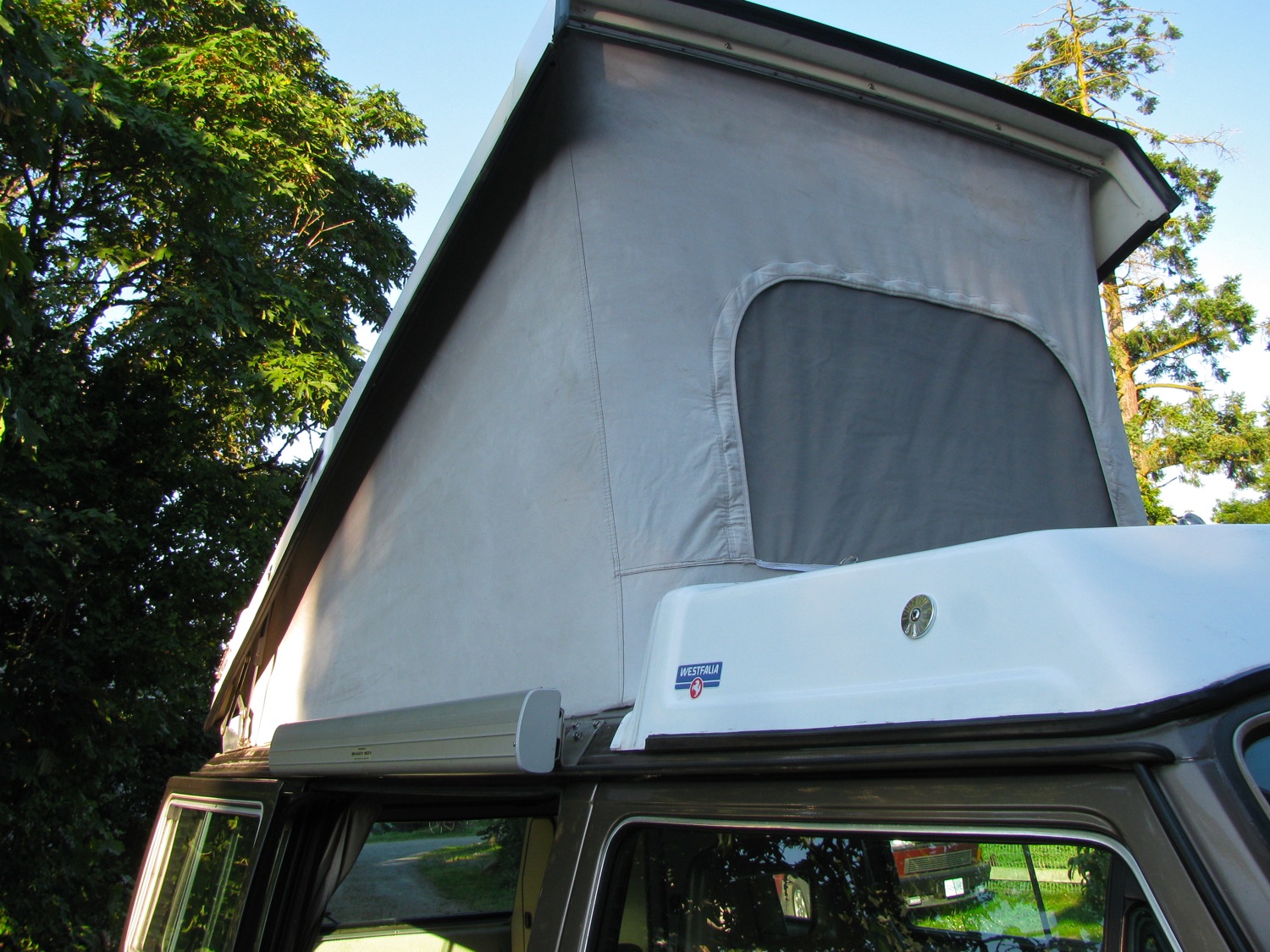
One more thing… a little thing to hold a flashlight.

Vanagon – darned Dansk
Posted by albell in vanagon, vanagon mods on June 26, 2013
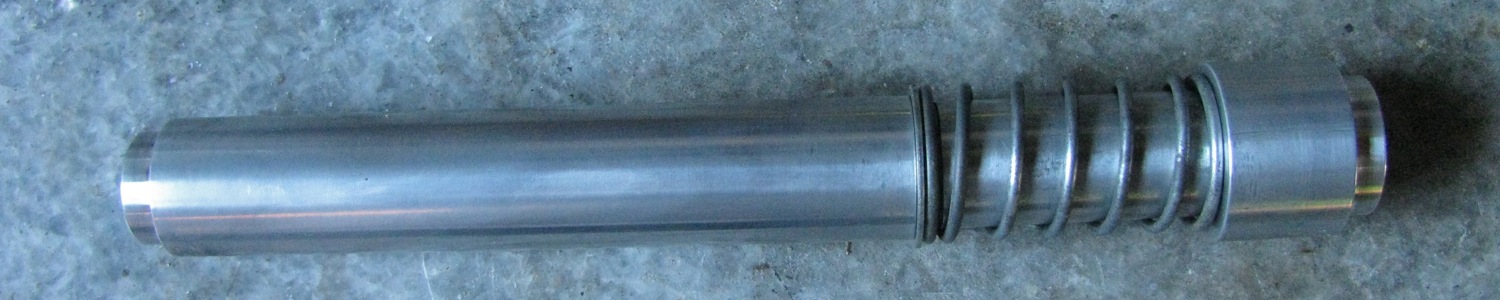
I had 2 niggling problems after the head R&R. One was a pushrod tube oil leak. Seemed to be on the case end of #1 cylinder exhaust valve pushrod tube. I don’t know why it leaked, perhaps I did not expand that tube far enough when I installed the heads? Or maybe there was some dirt on the sealing surface. I did install the seals “dry”, no sealant. So to fix this leak I pulled off the rocker arm assembly on that head, pulled the pushrod from that tube, and removed the tube (large tinsnips – collapsed the rube enough for it to fall out.). I cleaned up one of the spring loaded pushrod tubes that were originally on this engine and installed it, this time with a smear of Hylomar Universal Blue non-setting sealant.

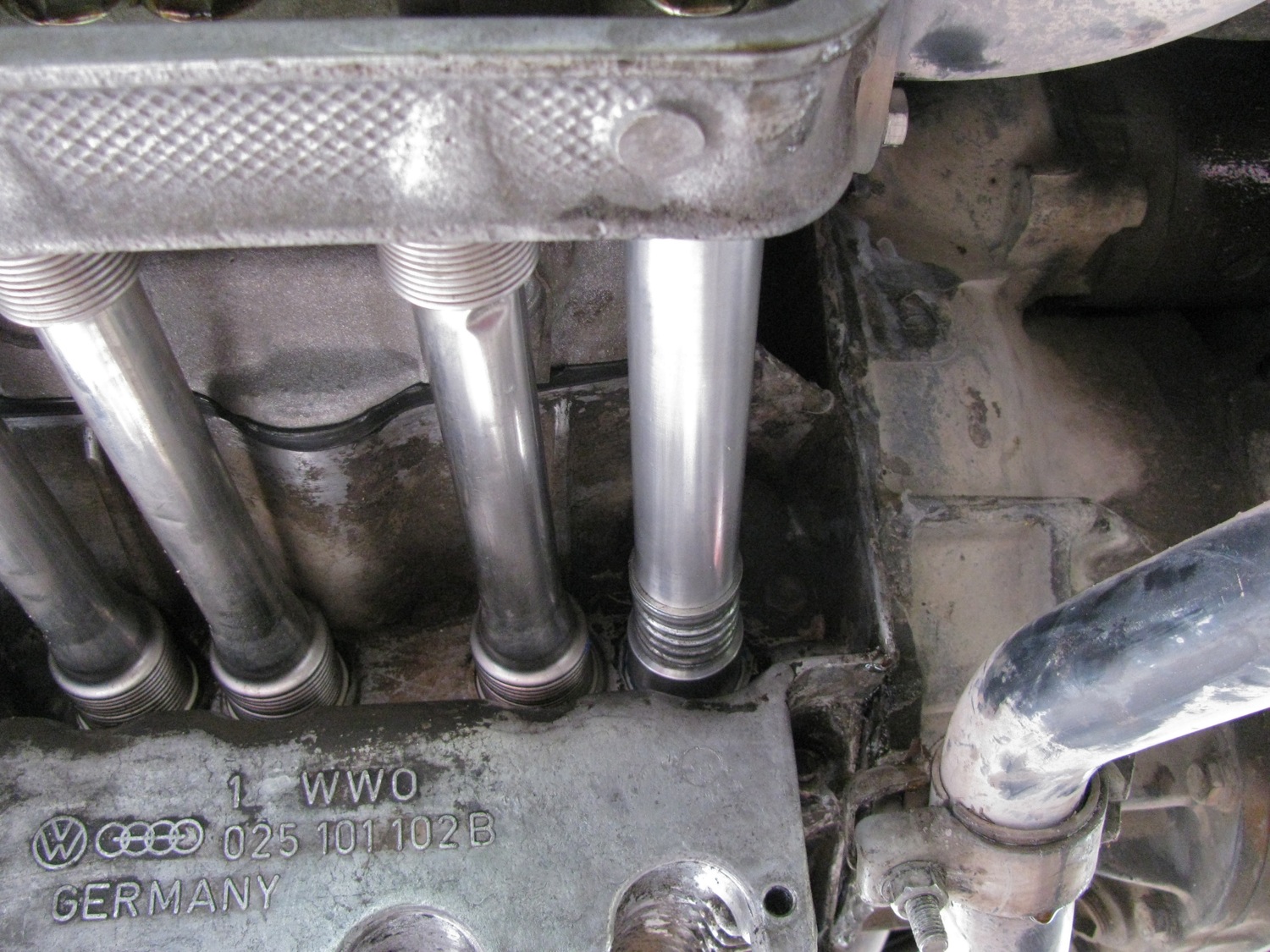
The other problem, and this one had me worried, was a scraping, rattling noise coming from the engine or transmission. You couldn’t hear it if you were standing back at the engine and revving it, it only started when the engine was warm and the van moving. Clutch in or out, or in neutral, when I was driving and revved the engine this noise was there.
I could get it to happen when parked, if I had the parking brake on hard and slowly let the clutch out in 1st gear.
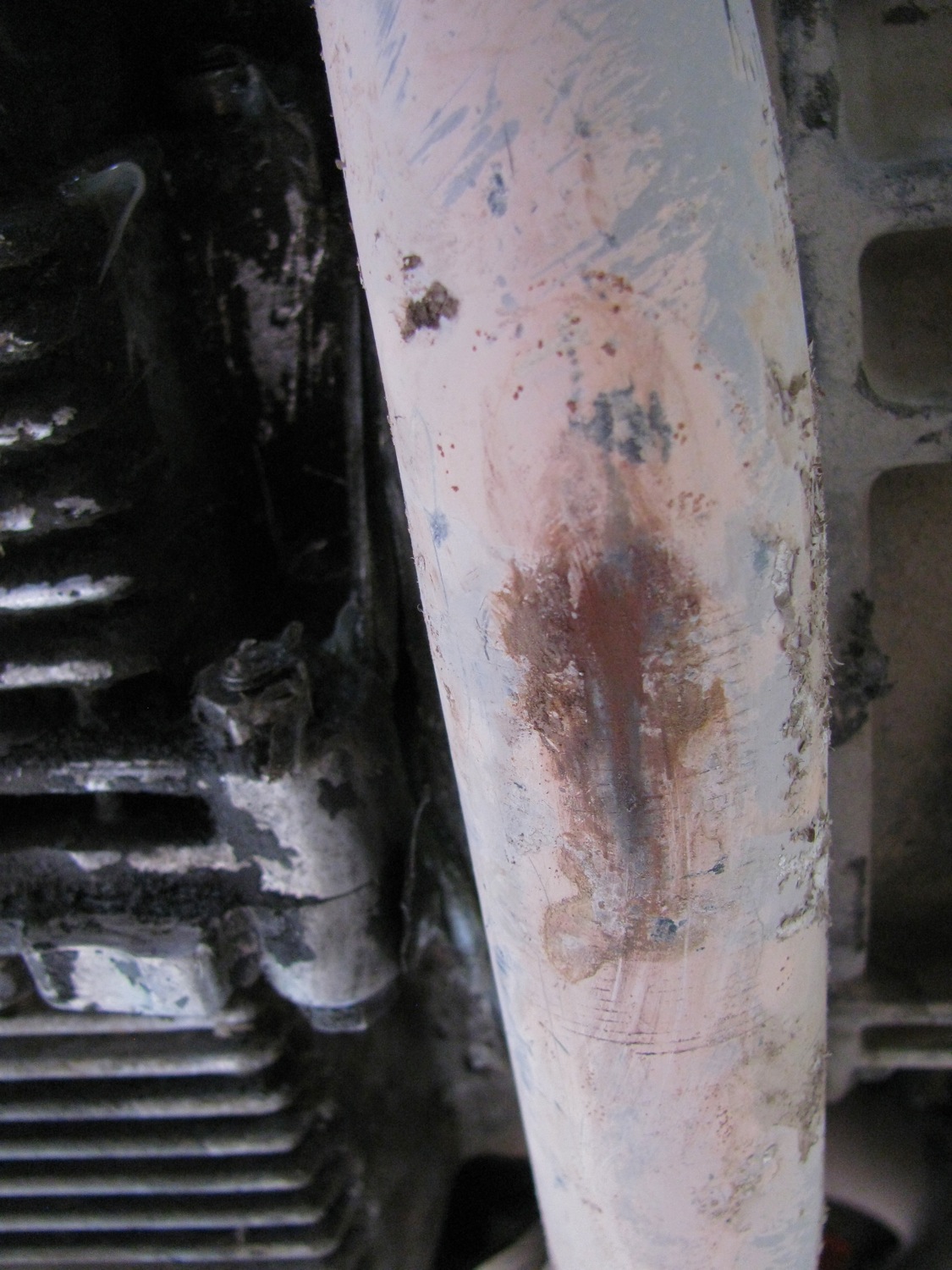
It really sounded like something was rubbing against something else. My rational side was leaning towards an exhaust pipe problem, my irrational side was making up all kinds of horrible scenarios. Well, it turned out to be the forward exhaust pipe hitting the skid plate where the pipe crosses under the engine. I’m going to blame the exhaust maker, Dansk, for this. My skid plate was not bent or damaged in that area. I think the pipe was just not bent correctly. I took a heavy hammer to the skid plate and bashed out some clearance.
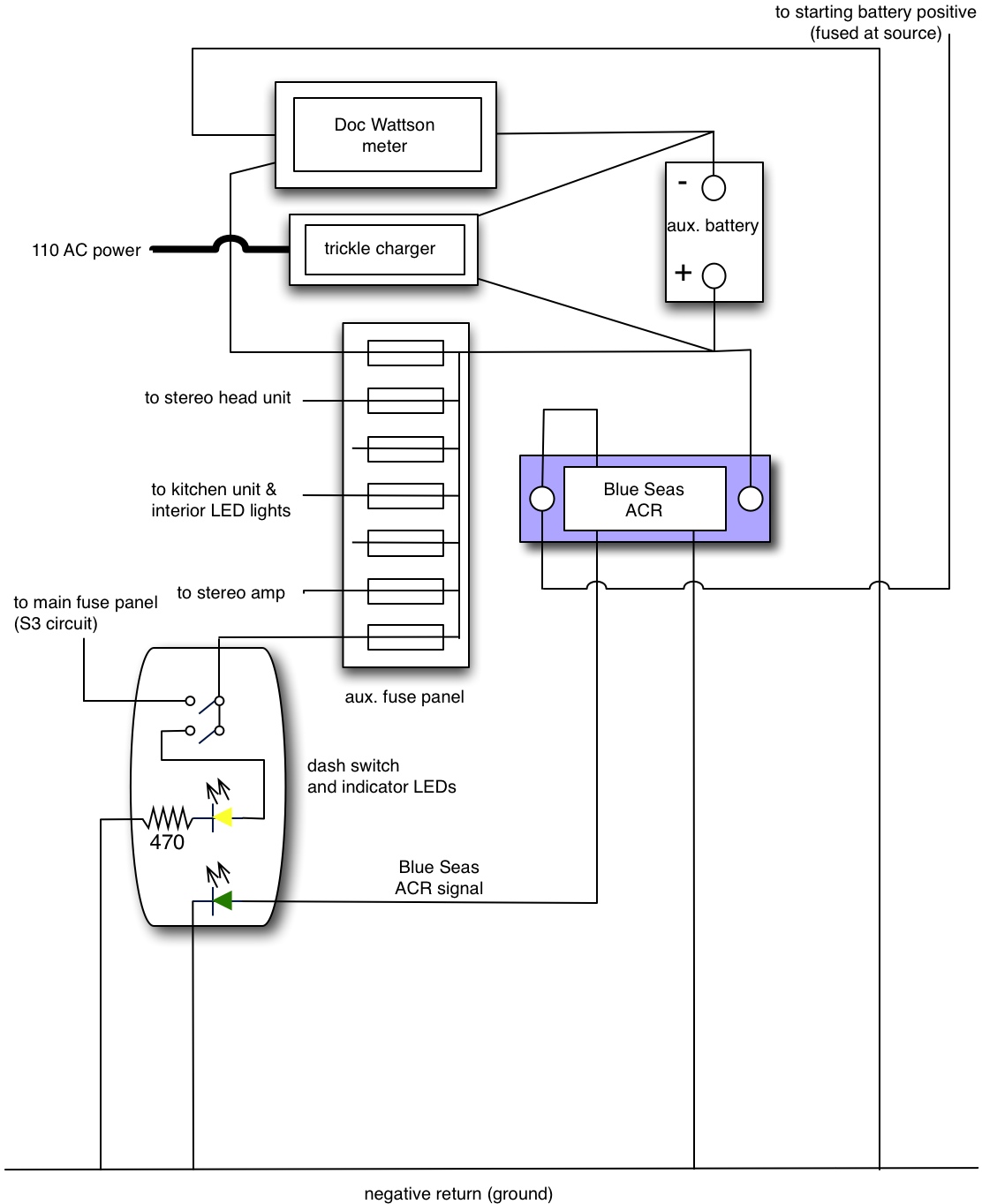
Vanagon – auxiliary fuse panel schematic update
Posted by albell in vanagon, vanagon mods on June 24, 2013
I have a confession to make. When I wired up that switch to shut off the door activated cabin lights it did not affect the additional lights (LED strips) I installed in the footwells and the step protector. Had me puzzled for a while, I thought I had connected those lights to the map light feed which I thought was the same feed that the other lights were on . The Bentley wiring diagrams didn’t help until I looked at the “after 1990” pages. Turns out that the map light gets its power from a different feed (but still protected by #3 fuse). So in order to be able to switch off those lights independently of the door switches I would either have to intercept the power feed or simply intercept the power going to #3 fuse.
This post describes how I feed the circuits on #3 fuse from my auxiliary battery. And in this post you can see how I subsequently powered the radio with its own feed. So all that was being powered on #3 fused circuit was the map light, my footlights, glove compartment light, and the cig. lighter. Easy to see that putting a switch on that circuit would do the trick. But wait you say, won’t you want to have the cig. lighter powered all the time so that you can plug in a USB charger or something? Well, yes, I suppose. I’ll see how it works out. I’m wanting to add more power points in the van, the cig. lighter may become redundant.
I went ahead and rewired the switch. Here is the updated schematic.
Addendum: cutting power to #3 fuse circuit also cuts power to the dash clock. I can live with that, I have plans to hard wire the dash cluster due to a very deteriorated instrument foil.
Vanagon – sliding window felt and interior light switch
Posted by albell in vanagon, vanagon mods on June 21, 2013
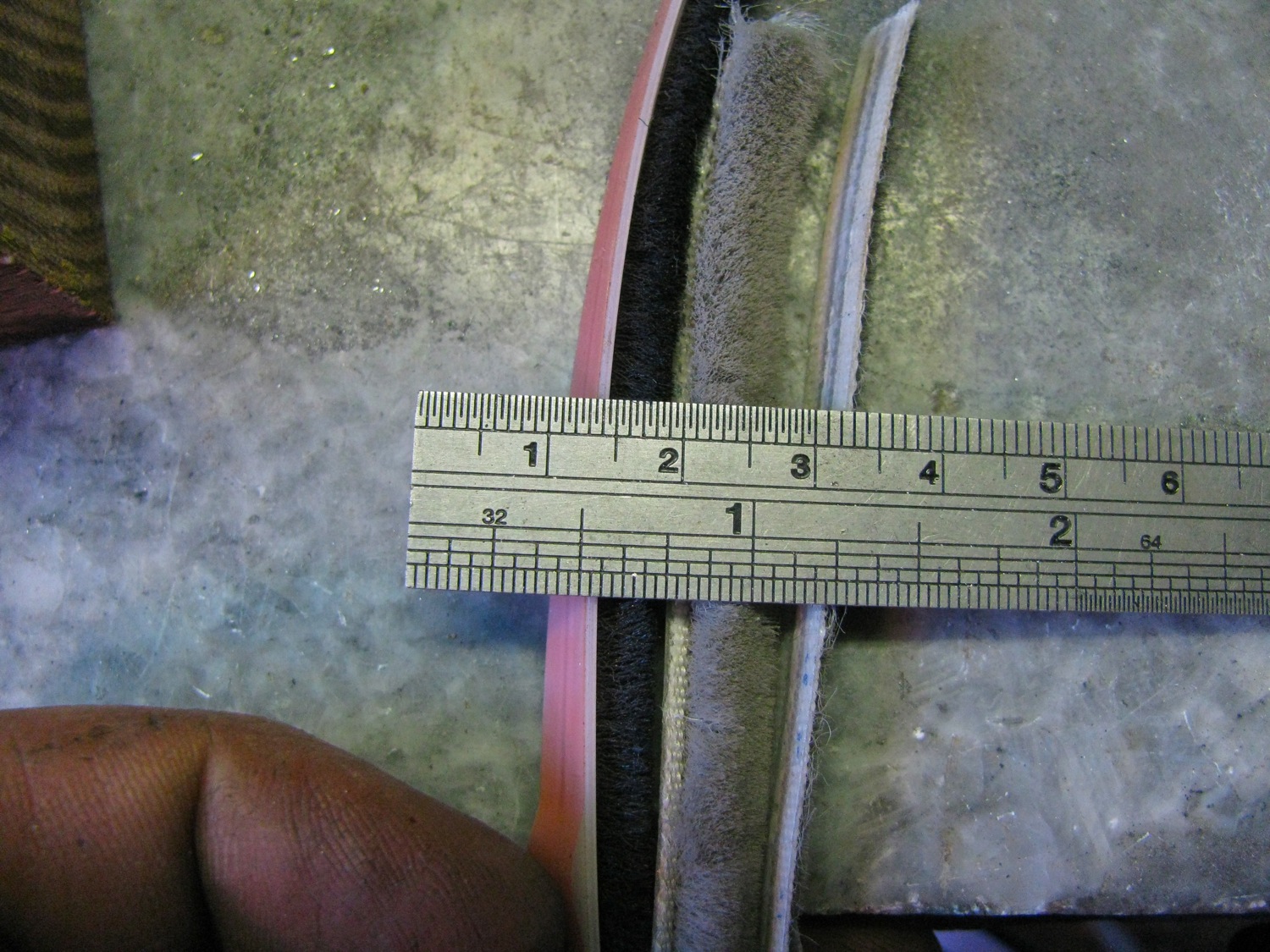
A couple of small things. First off is replacing the window felt in the sliding windows. You can only get at the horizontal felt with the window in the van. But if the entire window is out, then the frame can be spread and the sliding portion removed and you can get at the vertical felt seal. I found some felt seal at a local RV supply store, and I think that auto glass outfits can supply it too. I looked in the hardware store at some patio door felt seal but it wasn’t quite the right size. You might have better luck.
So open your window and at the forward end pull out the rubber seal a little, just so that you can get better access to the seal. Grab the seal and slip it out, little by little as it has to make a sharp turn out to get past the window frame. My old seal was very worn and brittle, kept breaking as I pulled it out. The new seal goes in the way the old seal came out. It is easier than it looks.
The new seal is so much fluffier than the old one and the window initially did not slide very easily. But after a day the felt compresses a bit and sliding is easier.
Picture time. Three felt seals: on the left is the new seal (yeah, not the same colour), middle is a bit of what looks like unused original seal (lord knows where I got it), and on the right is the old seal.

Back side. And yes, the new dark seal has an peel off backing, adhesive under. I din’t have any problem installing it with backing on.
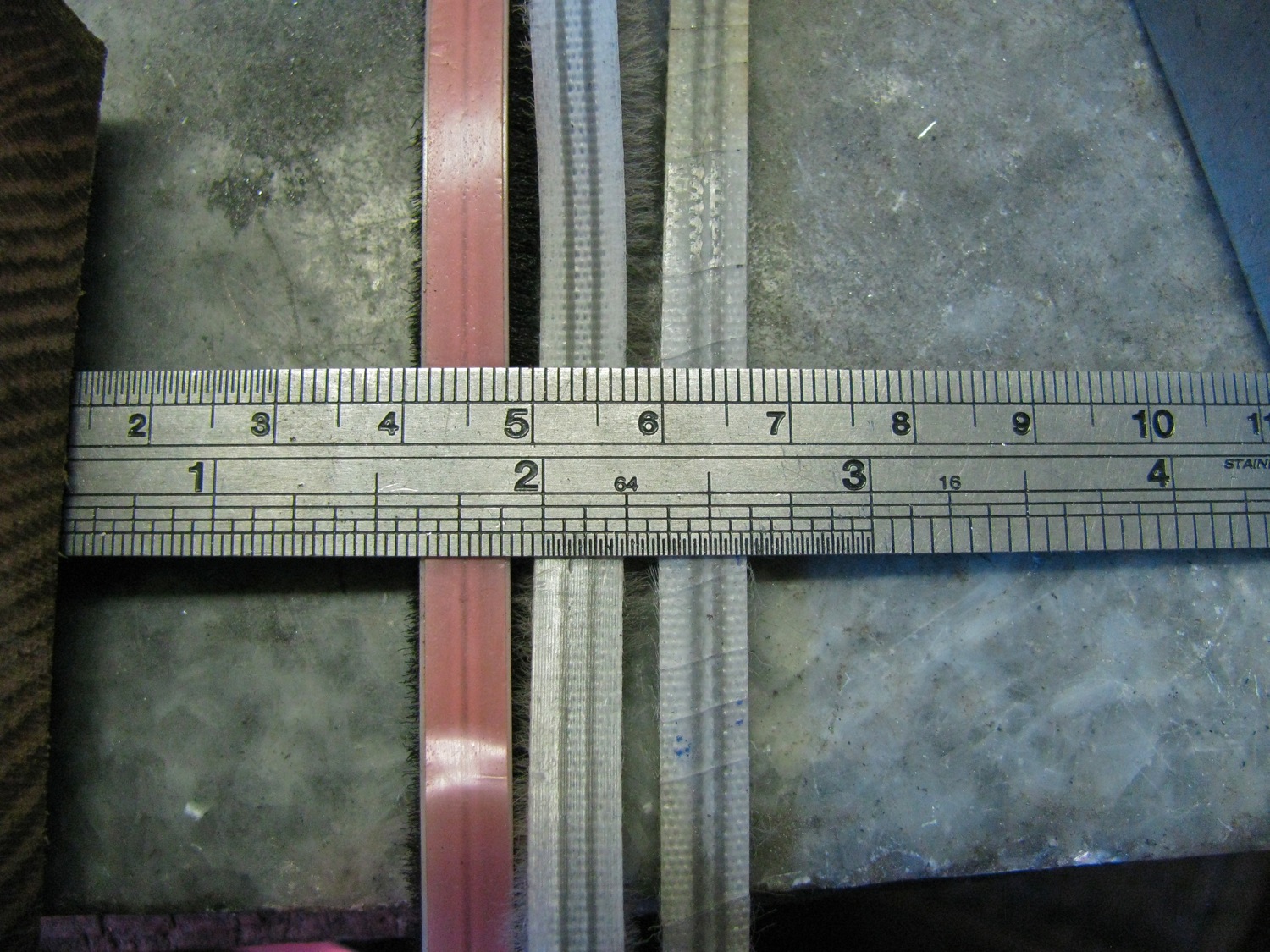
An attempt at a side shot. The old seal is very worn out.
Installed. The dark colour is not that bad.

Next up is a silly little mod. My van was originally a 7 passenger tin top and so it has interior/cabin light switches on all doors, including the hatch. Factory Westies do not have door switches on the sliding door and the rear hatch. So what you say? Well, when you are camping, and you have the sliding door open then the interior/cabin lights are on whether you want them on or not. Kinda silly during the day, and not really needed at night if you have added lighting on a different circuit. Of course you can turn off each individual light, or you can find some of those door switches that have the little notch in the plunger so you can have the plunger stay depressed, but jings, where’s the fun in that?
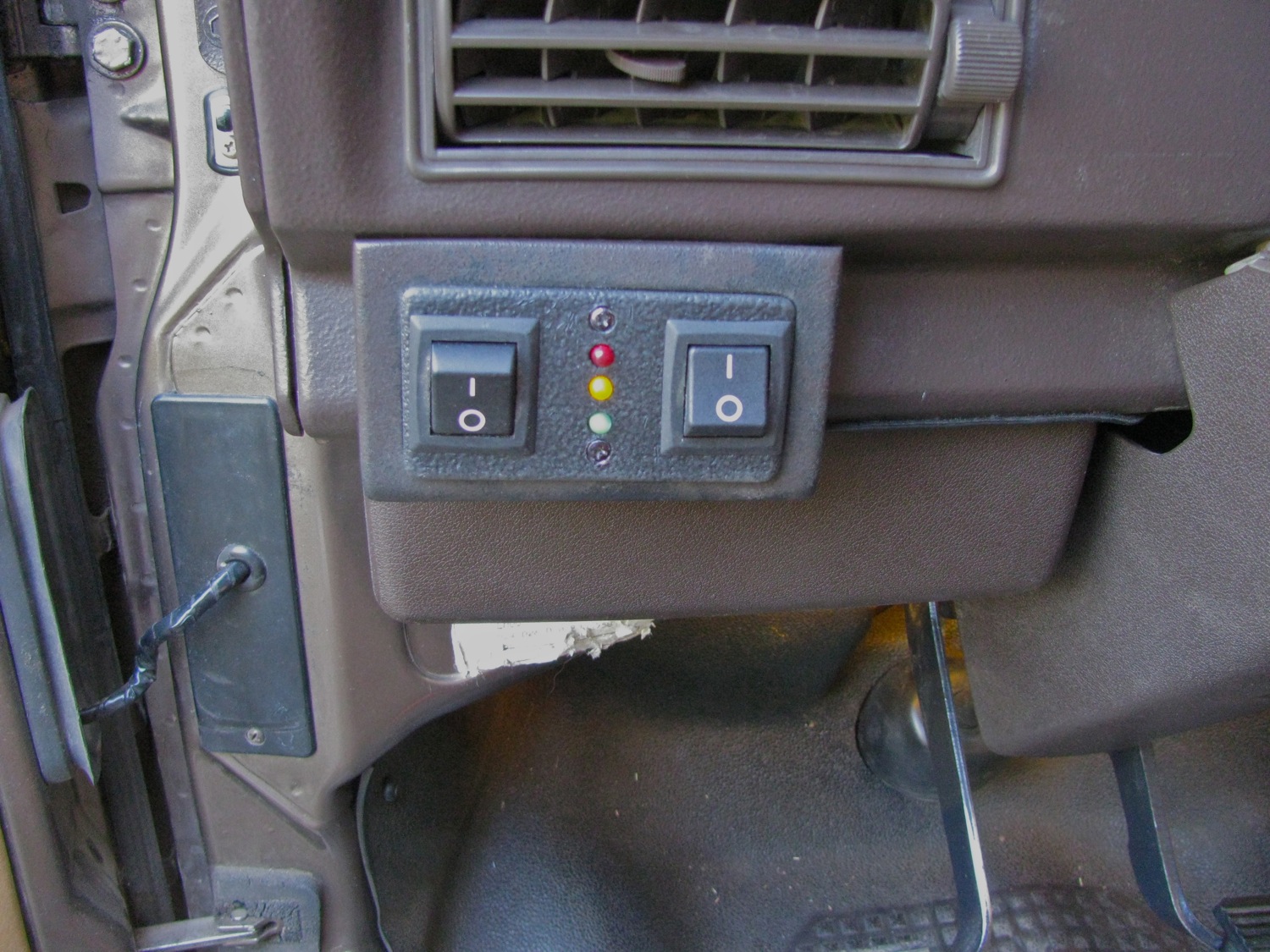
So one evening I made a little switch plate to fit where my old Webasto BBW46 control panel was (I gave up on the heater, removed all the plumbing during the head replacement job). I didn’t use the sexiest of switches, but they are what I had. I used two just because one switch looked silly. And the two switches left an awkward space between them, so I added some LEDs.
So what I did with the wiring was to intercept the power wire to the interior lights (on my van it comes out out panel from B12 connection, then splits at connector T2c. That power feed also supplies radio and make-up mirror light. I did not have to worry about power to radio, I’m supplying it another way. Ok, I cut that power feed and connected it across on of the new switches. Just for fun I wired in the amber LED to light up when switch is closed. So to turn off all the door switched lights I just have to flip one switch.
The green LED is connected to my Blue Seas ACR and lights up when the main and auxiliary batteries are combined. The red LED is still waiting for a use, as is the other switch.
Vanagon – Q and D head replacement – catch up and conclusion?
So the deed is done, but the doer not quite undone. It turned out to be more of a chore than I bargained for. Let me see if I can relate what happened from the time took the engine off the stand to how things are today.
The engine had to be removed from the stand to get the clutch and flywheel on. I decided to replace the main oil seal there. This pic shows two used seals on top row, lower left is a seal I bought before I bought the Victor Reinz gasket kit, and the lower right is the seal that came with the kit.
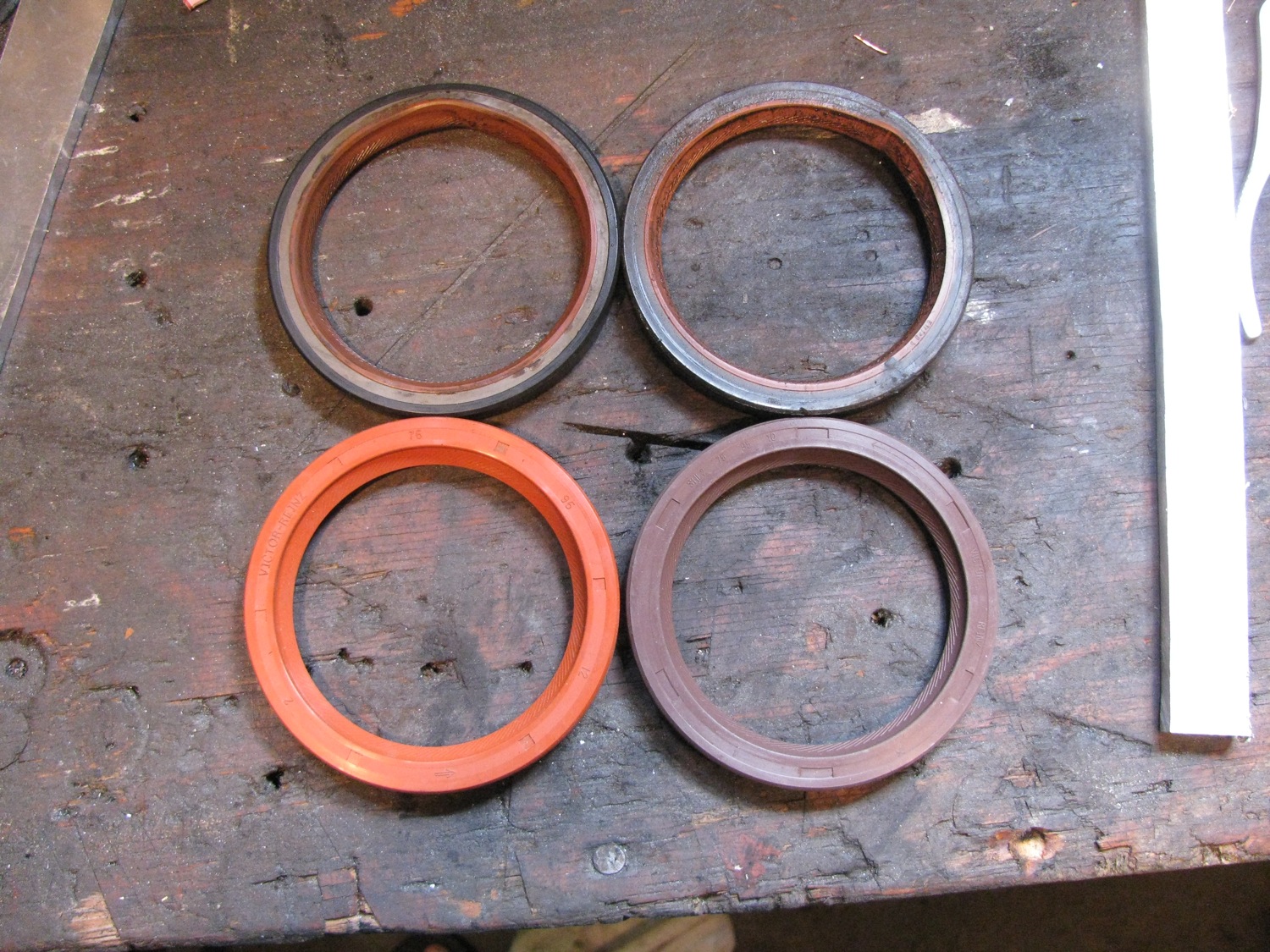
Side view, from left to right, the 2 used seals, the kit seal, and the bought on its own seal.

I decided to use the larger seal. Before installing I de-burred the case.

Not quite all the way in, should be recessed a little more. One of the old seals was used between hammer and new seal. Pilot bearing got some moly grease.
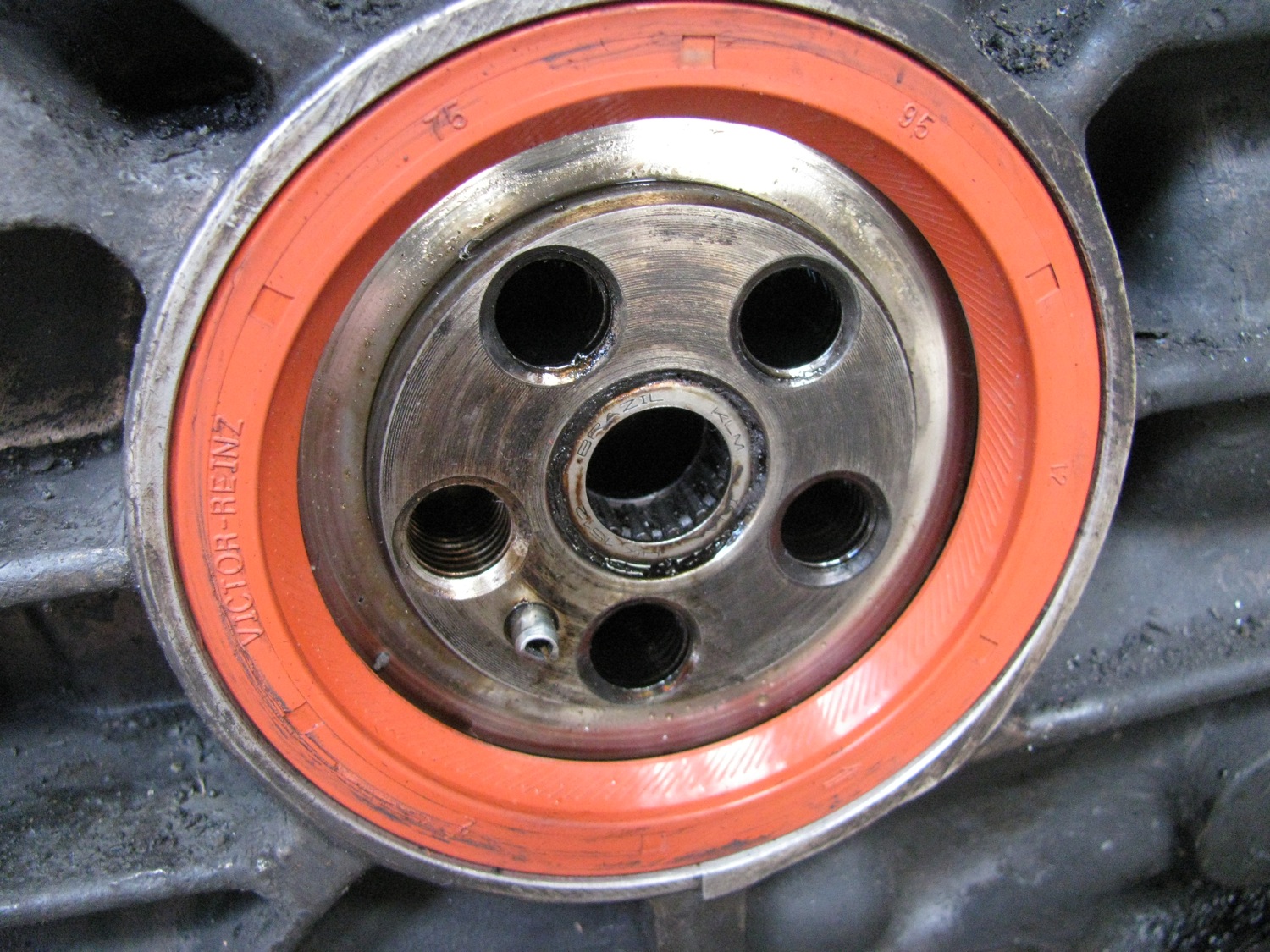
I didn’t forget to install new felt ring and new O-ring in flywheel (I used the clutch install tool to form and settle the felt seal in place a little nicer than what you see in the pic.
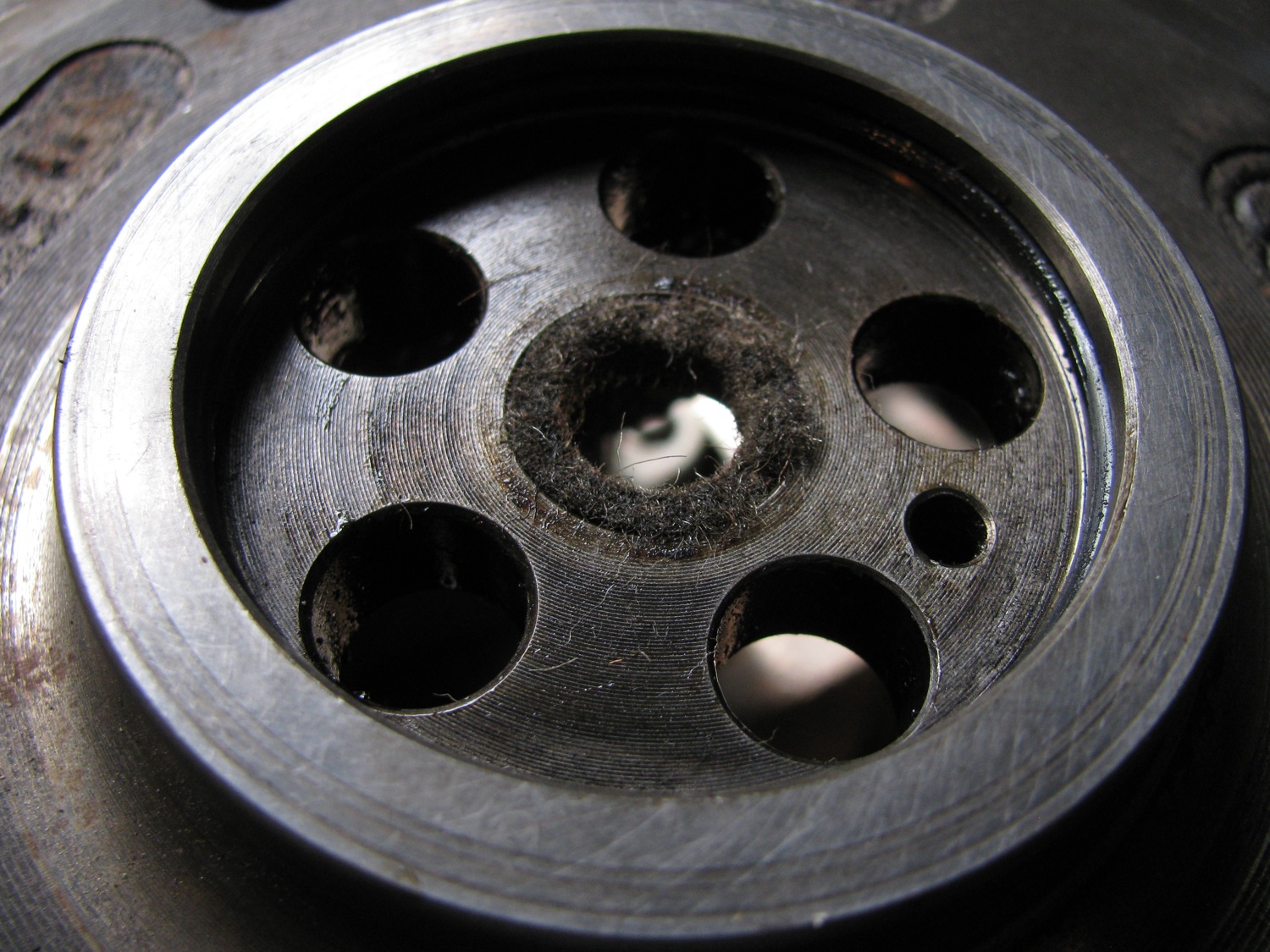
i installed the flywheel and tightened the bolts. There is no nice way to say this, I fucked up. What happened was the thrust bearing (which sits behind the thin shims behind the seal) had fallen out of its recess and jammed as I tightened up the flywheel bolts. It smooshed over the the edge of its recess. When I figured out what had happened I was scunnered. I used a series of bearing scrapers to carefully cut away the smooshed part of the case, trying to not damage the flat section where the thrust washer sits. I checked the crankshaft endplay a few times and used a combo of shims to get at an endplay of 0.005″. Was the best I could do. So it was the thinner of the 2 new oil seals I finally ended up using (the thicker one destroyed during removal to fix thrust bearing).
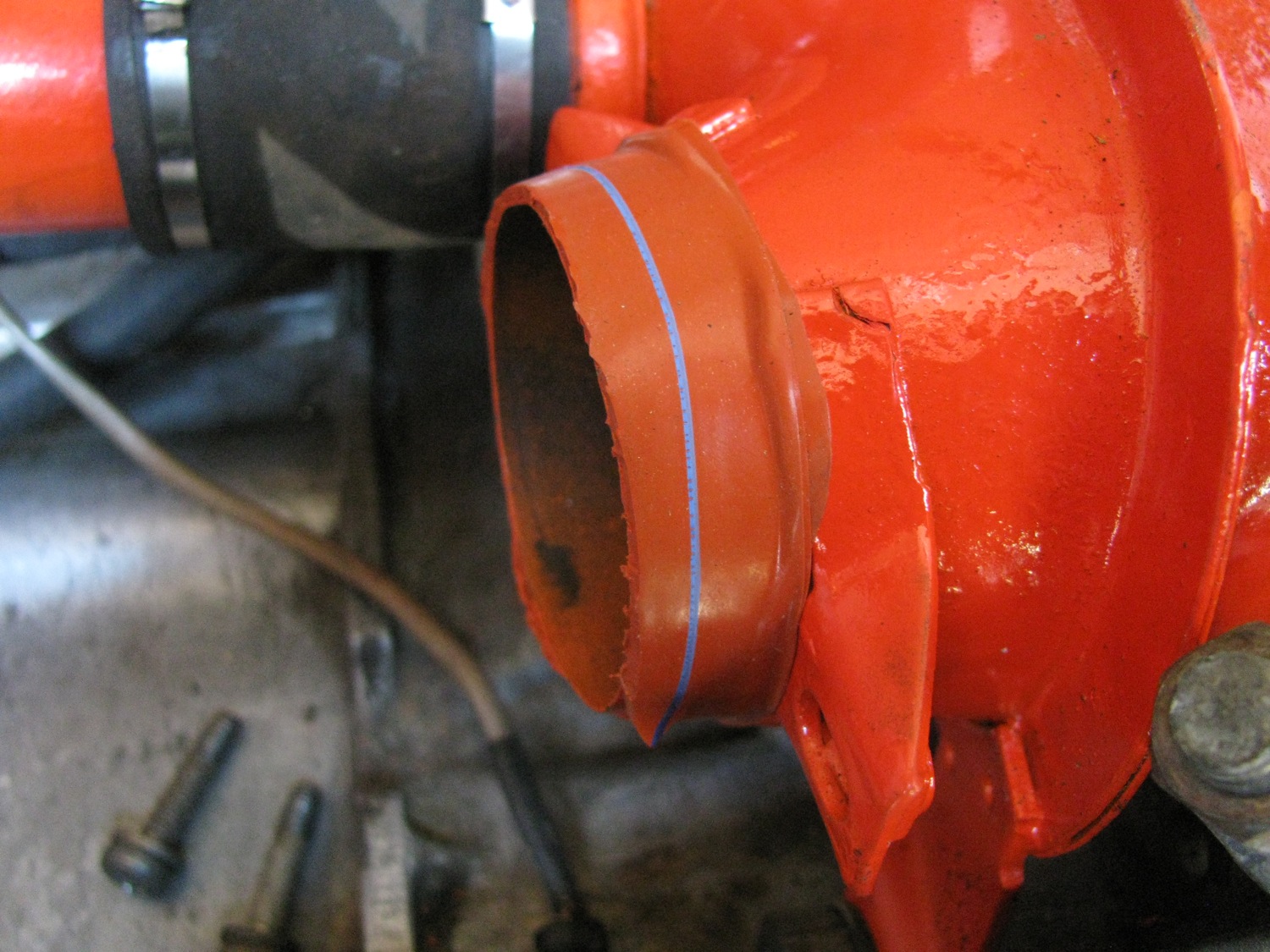
Okay, after a little self flagellation I got back at it. The connection between the throttle body and the intake plenum needs a special gasket. A truncated cone affair and my old one was really torn up. Seems to be NLA, but I think a replacement is on the way to me (right Bill?) and in the meantime I wrapped some silicone repair tape around the plenum “spigot”. Turned out to be, well at least it appears to be, a fairly good fix.

Getting the engine mated to the transmission took me an entire morning. I had the transmission on a bottle jack so I could move it up and down, and the engine was on a hoist. Still it was difficult for me to get things connected. I finally got it on, and the joint sealed with silicone (one of those syncro things).
All the electrical, fuel, and coolant connections made. Engine filled with oil and coolant. Coil power feed removed and engine turned over. No oil pressure. None. Cranking and cranking, even a 10 second run with coil connected. No pressure. This job was killing me. Of course it turned out to be a rookie mistake by me. I should have packed a little grease in the oil pump to help it pull some prime. I got the pump primed by removing the oil filter and cranking until oil came out. Filter back on and then cranking.. pressure!
But not much pressure really. Cold idle was 25 psi, cold max pressure was 60 psi. When hot, oil pressure was close to zero, max was 25 psi. With oil temp >80C, and at 2000 rpm, oil pressure was 25 psi. What the heck could be going on? I’m going to make a long story short. I removed skid plate and then got at the pressure relief valve. Took it out and measured the spring. From the Samba I found out that a new spring is 62 point something mm long. My spring was 59 mm long. So I made a spacer.

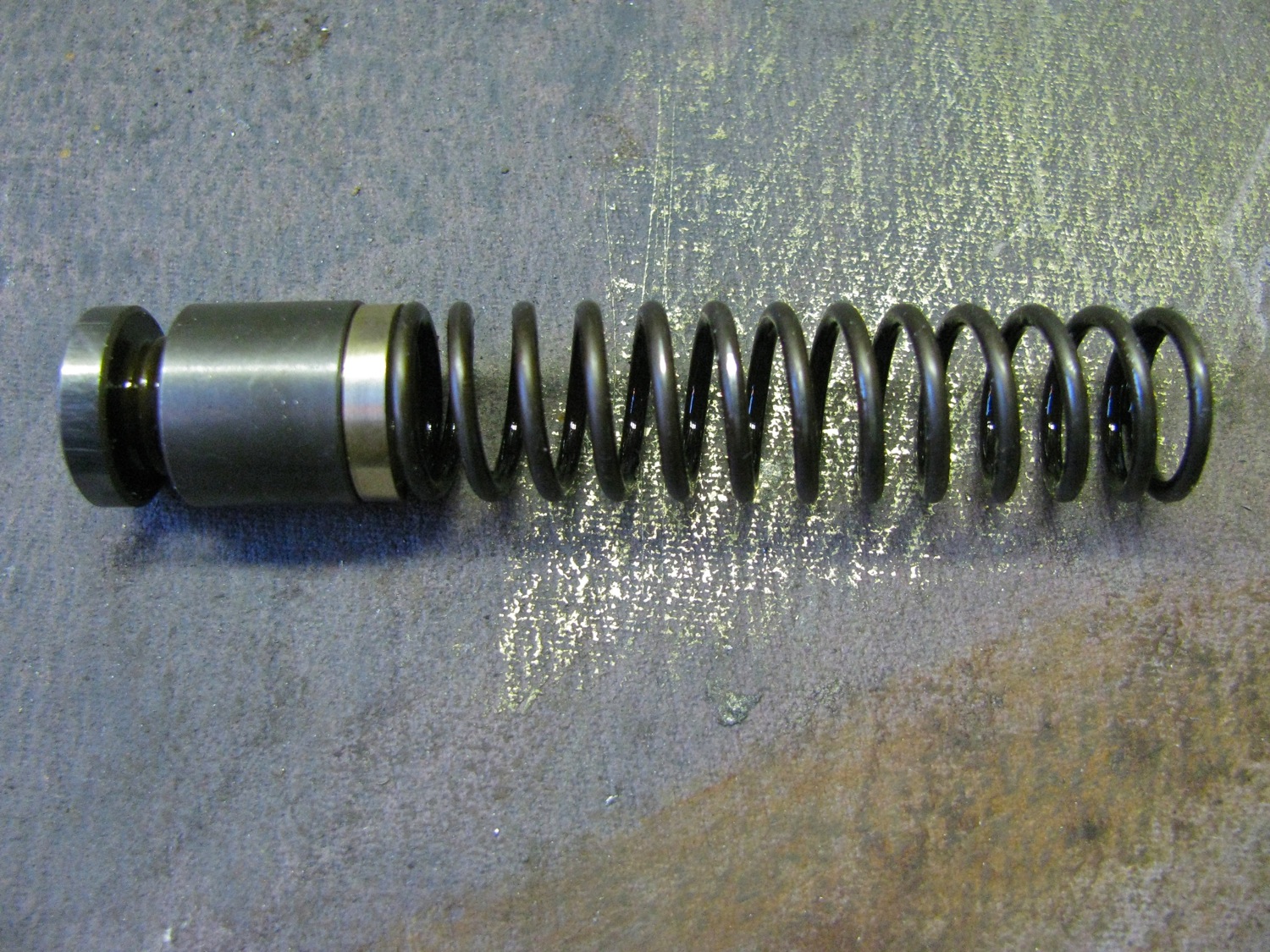
Back in it goes, start up engine… I got 30 psi cold at idle, max 75 psi. Hot pressures were 7-10 psi idle, 45 psi max, and just shy of 20 psi at 2000 rpm.
During all this the oil drain plug hole stripped. Damn and blast, what else can go wrong? I took a 14 mm bolt, one that was longer than the drain plug, drilled and rapped for a 13 mmm head bolt, turned down the head of the 14mm bolts, made a Delrin washer and ended up with a new plug that was longer and caught some of the remaining un stripped threads in the case. This will do until I put an insert in the hole.

Back to the oil pressure. Next step was to pull the oil pump cover and check the gasket. Then I pulled the cover from the oil pump. I was *this* close to putting it back on sans gasket, but I decided to use a 0.004″ gasket I got from local mechanic. I did not have this gasket before. Ok, added a little grease to pump gears (to help in priming), all the other things all put back on, coolant replaced, oil replaced.
Engine start… cold pressures: idle 70 psi, max 90 psi. Hot pressures, idle 20 psi, max 60 psi, a solid 30 psi at 2000 rpm. Much better. Turns out the gasket in the kit, the one for under the oil pump cover, was 0.012″ thick. Far too thick. BTW, the endplay for the pump gears measured between 0.002 and 0.003″. After driving around for a week I am still not happy with the oil pressure, I think I can do better. Hot idle (after hwy run) is only about 7 psi. I am going to pull the pump cover again and re-install with no gasket, just sealant.
There were other annoyances after install – poor fitting (new) exhaust pipes was the big one, but I won’t bore you with my griping. So here we are, engine in.
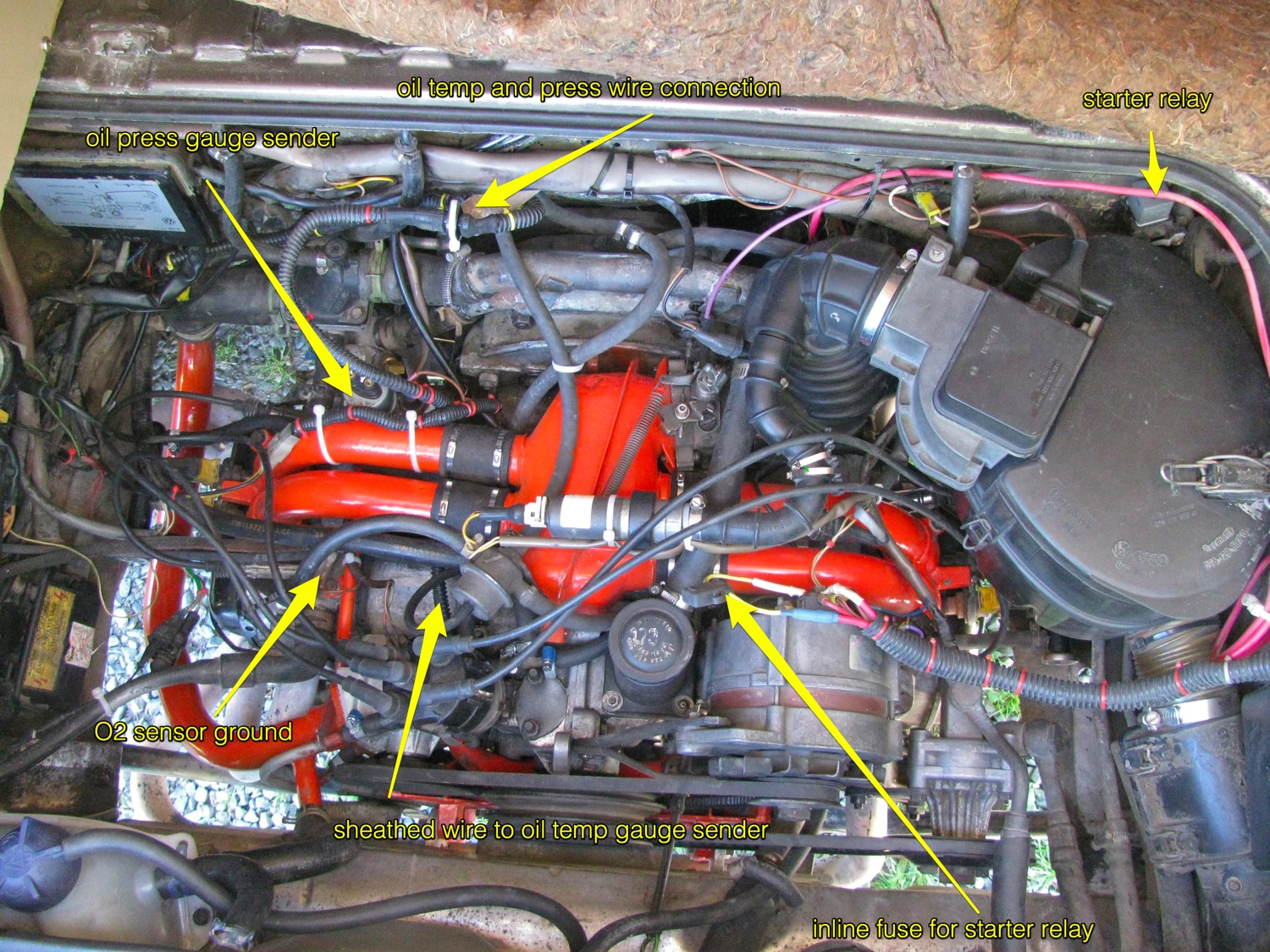
A closer shot of how the oil pressure sender relocation manifold fits in. God I hate non-black cable ties.
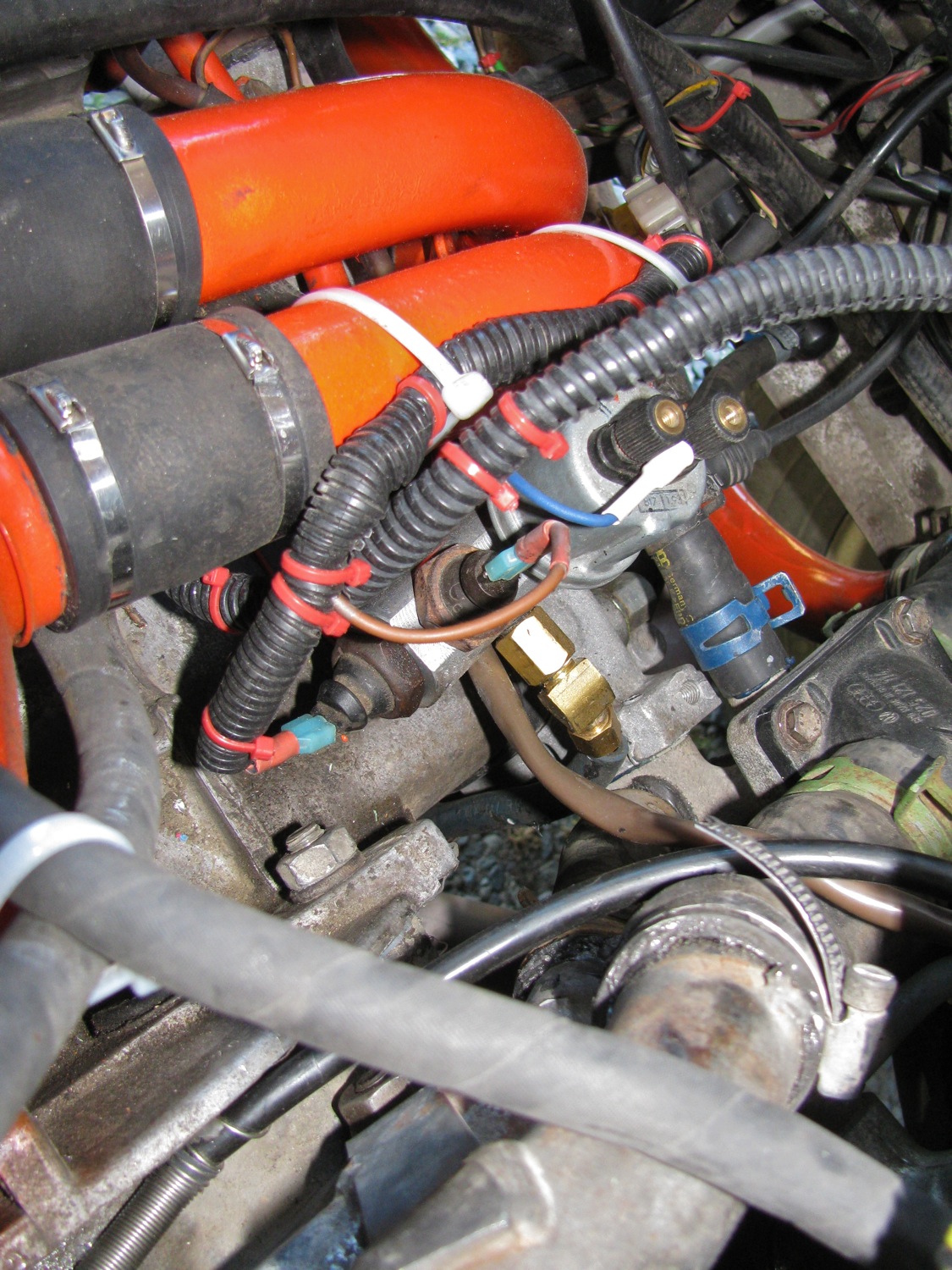
So after a week or so of driving? Well apart from my lingering concern about oil pressure I have 2 other niggling issues. One is a little oil leak from the engine end of #1 cylinder exhaust push rod tube. Probably no chance of it sealing itself, so I’ll be putting in one of the spring loaded push rod tubes that I found on this engine. I cleaned one up and replaced O-rings.
The second thing is a funny, intermittent scraping, rattling noise. I think the forward exhaust pipe is sometimes rubbing on the skid plate. Only happens with some torque on the engine, and not when revving when van parked.
To finish up this post I’ll mention a couple of tools that made this job a whole lot easier. First one is a bit of a surprise, “The Larry” miniature trouble light. Was given to me by good friend Stephen and it really does do the job. The clip is magnetic so the pen sized thing will stick. Gets into tight places, puts the light where you need it and not in your face.


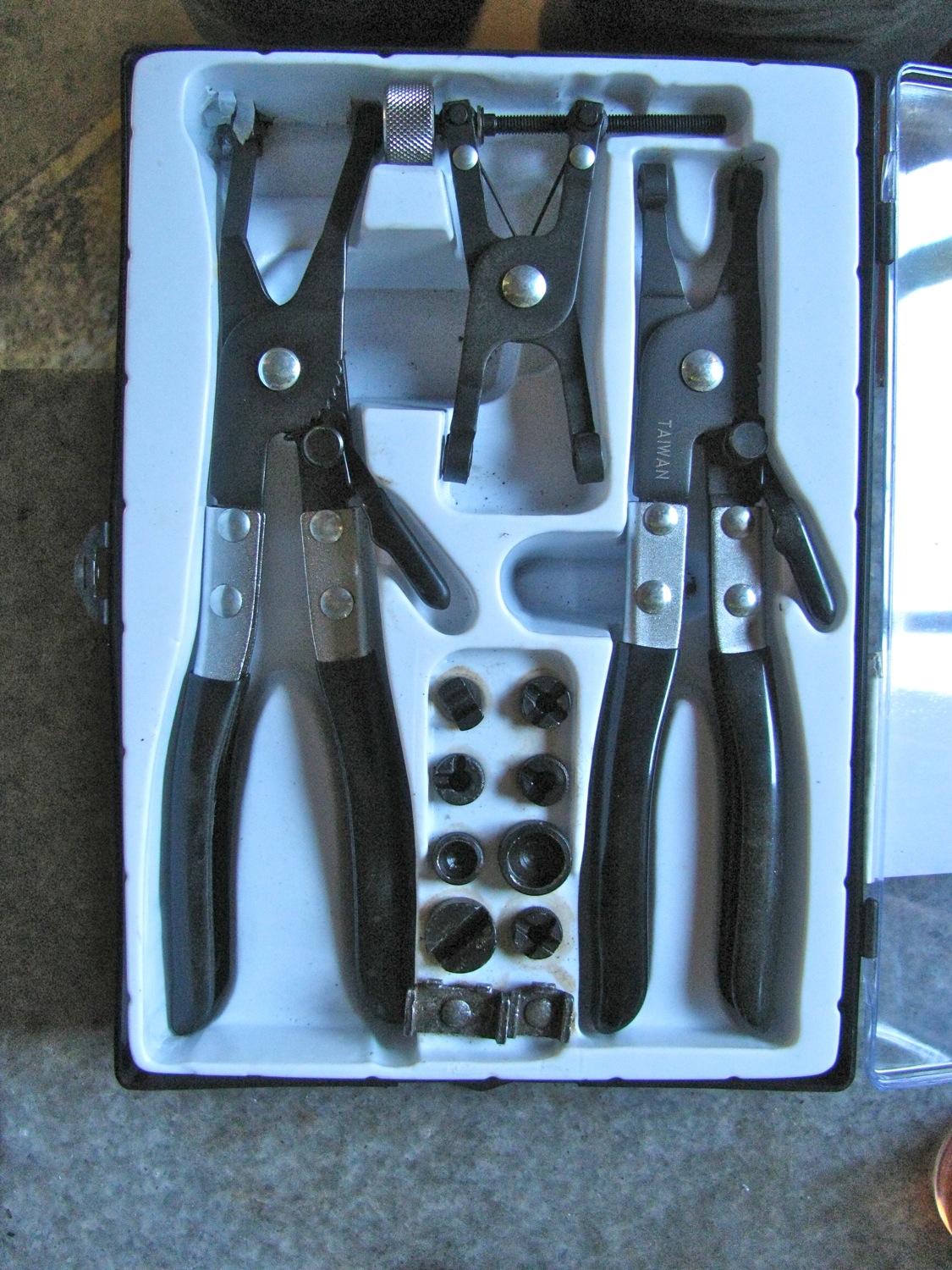
A set of hose clamp pliers. This is a pretty cheap set but works quite well. Well enough to make you love spring clamps.
This tapered punch came in handy to line up recalcitrant bolt holes on the exhaust and my skid plate/

The job is not completely over, but I’ll say it was a success. Tragedy + time = comedy, I’m laughing now.
Vanagon – front door speaker mounts – painted
Posted by albell in vanagon, vanagon mods on June 18, 2013
A year ago I made some speaker mounts to help hide the torn up lower half of the front door panels, and to mount the speakers more securely. It was a previous owner that installed (and cut some door metal) these speaker and it really wasn’t a very good job. My solution worked out ok, but I tired of the unfinished aluminum look and the speaker grills had been kicked repeatedly and were dented. I can’t really blame anyone for the kicking, the speakers are in a vulnerable spot.
So I pulled them off, took them apart, and reformed the stainless mesh grills back into a shallow dome. Then I painted everything with rattle can bed liner. I think the paint stiffens up the stainless mesh, gluing the wire crossings. I painted some plastic screw cap covers to match.
Original look:

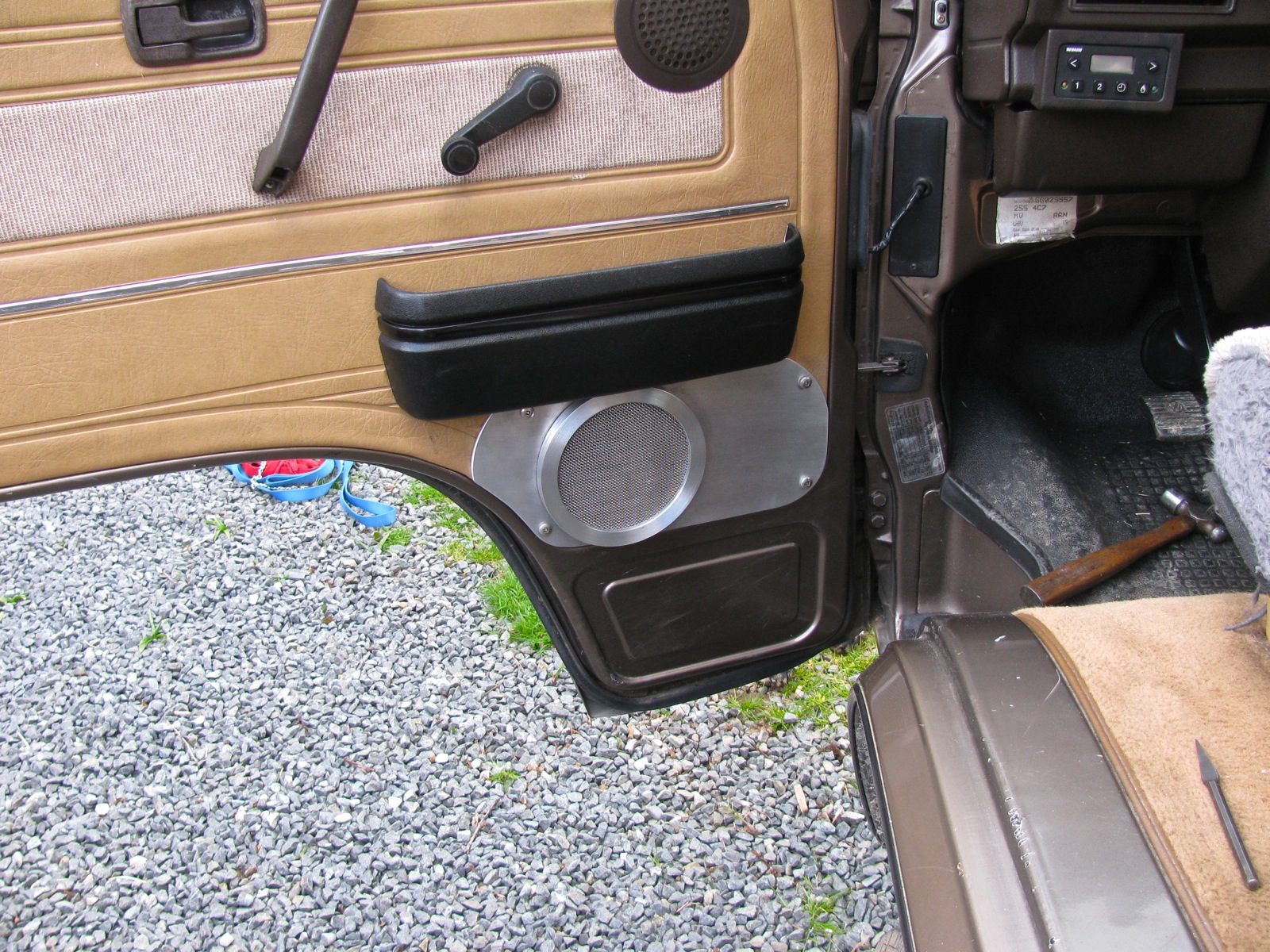
New look:
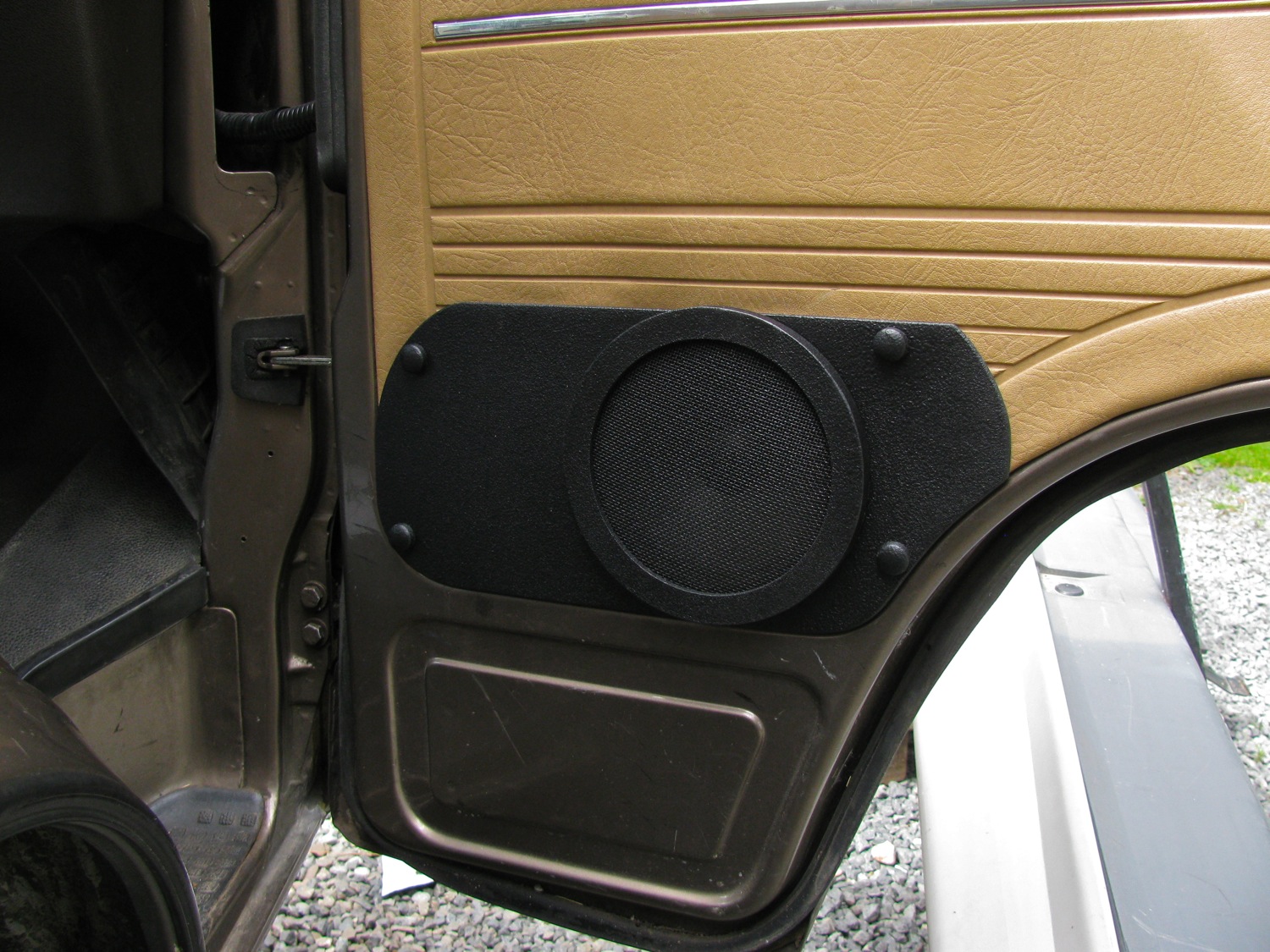
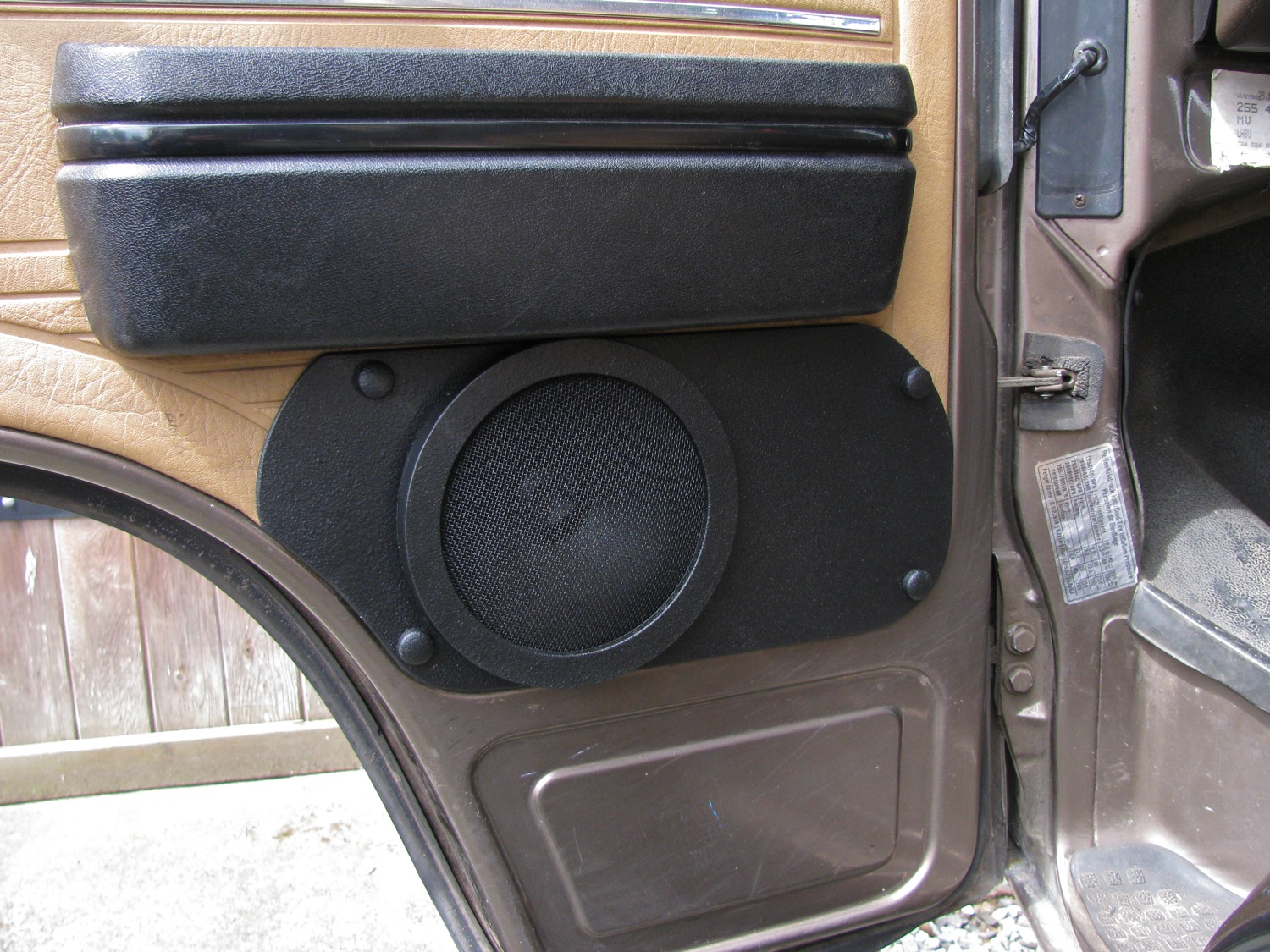
Vanagon – auxiliary gauges
Posted by albell in vanagon, vanagon mods on June 18, 2013
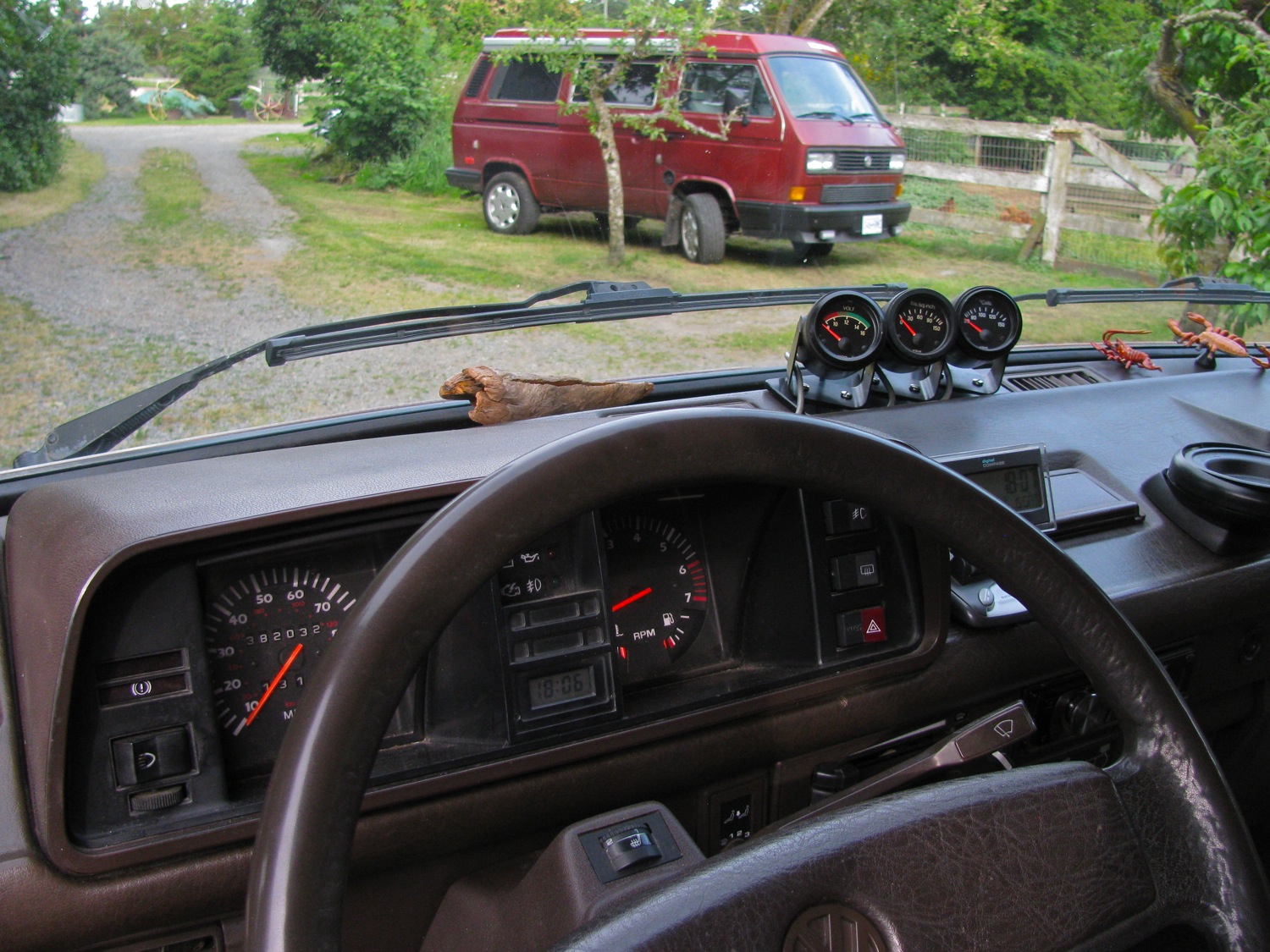
I installed 3 old gauges, VDO Cockpit series, that I had in my old I4 powered ’82 Westy. It was sure easier to install the senders in that engine, no relocation manifold needed. But on the WBX I had to relocate the stock oil pressure senders so I could add an oil temp. sender and an oil press. sender.
I detailed the sender install in this post. That short temp sender (Beck Arnley part# 201-1098) seems to be the right one, the oil temp gauge is indicating pretty well expected readings. Yeah, yeah, I should have set up some boiling water and tested before installation. But I didn’t, so there.
Hey, if anyone has a mind to copy the aluminum manifold for the senders, give more room between each sender. I put them too close together, wrench access not so great.
The gauges have seen some wear and tear, and I replaced the bezels on two of them with bezels from salvaged gauges from an old Volvo 245 turbo. The bezels are crimped on so removing them means prying with a fine edged screwdriver and you can’t really get that back to factory condition. But from a distance it is not really noticable. During the bezel replacement I dropped 2, yes 2, of the glass faces. What a clumsy fool. I had one spare glass, and for the other I cut a circle of Lexan. I repainted the needles with fluorescent orange paint while I had the chance.
For wiring I used some old computer cable, 6 insulated wires in a grey sheath. Each wire was multi-strandded and the sheath was pretty flexible but I bundled the 3 cables in some black heat shrink tubing and the bundle is pretty stiff. I used a heat gun to warm up the bundle so I could manipulate it into the right route. And that route runs right in front of the padded dash to the corner of the instrument panel cover, where I made a rounded notch and the cable makes a 90 degree bend and a little down to end up close to the right hand side dash support strut. The bundle lays down with no glue or clips after the heat gun treatment.
At the sender end, I used a couple of spare wires from the now removed Webasto BBW46 heater wiring to send oil press. and temp signals up front. For the voltmeter signal I connected to “G5” terminal on the fuse panel (“15” power, ie hot when ign on). For illumination, I tapped into “G8″ (dimmer controlled power) on the fuse panel. To make things a little neater, I used an old terminal strip that has screw connections and used that to connect the gauge wires to the sender wires. This terminal strip was mounted to one of the dash support channels beneath the instrument panel.
The gauge pods were screwed onto a bit of 1/4” aluminum plate, painted black. One day I’ll get some black covers for the screw heads. The plate is glued to the dash with that foam cored double sided tape. That stuff seems to take dash heat better than other tape . The gauges seem to work fine, I didn’t confirm the oil temp or pressure with another method, but the values I see look reasonable.

Vanagaon – Q and D head replacement – quick update
I’ve had the engine installed for a little over a week now. I’ve had some niggling problems and I will write about them, but for now here is a crude little video of the engine running. Proof that I actually completed the job 🙂
(dirty lens, sorry. Oh the dipsy-doodle to the exhaust pipe was to try to record a bit of the exhaust note. Since the new exhaust pipes have been installed, my home made muffler does not sound as good as it did with my leaky exhaust. Wait, what? I dunno)
Vanagon – Q and D head replacement – closing in
A few more odds and ends before the engine goes back into the van. In no particular order…
My diff lock light has not been coming on for a while now. I narrowed the cause down to either a broken wire, a faulty switch on transmission, or a bad connection at switch. I had planned on pulling the switch, but as I didn’t pull the tranny with the engine, and as is (ie the vacuum actuator still attached to tranny) I could not get a wrench or a socket on the switch to remove it. See how tight (ie little clearance) it is?
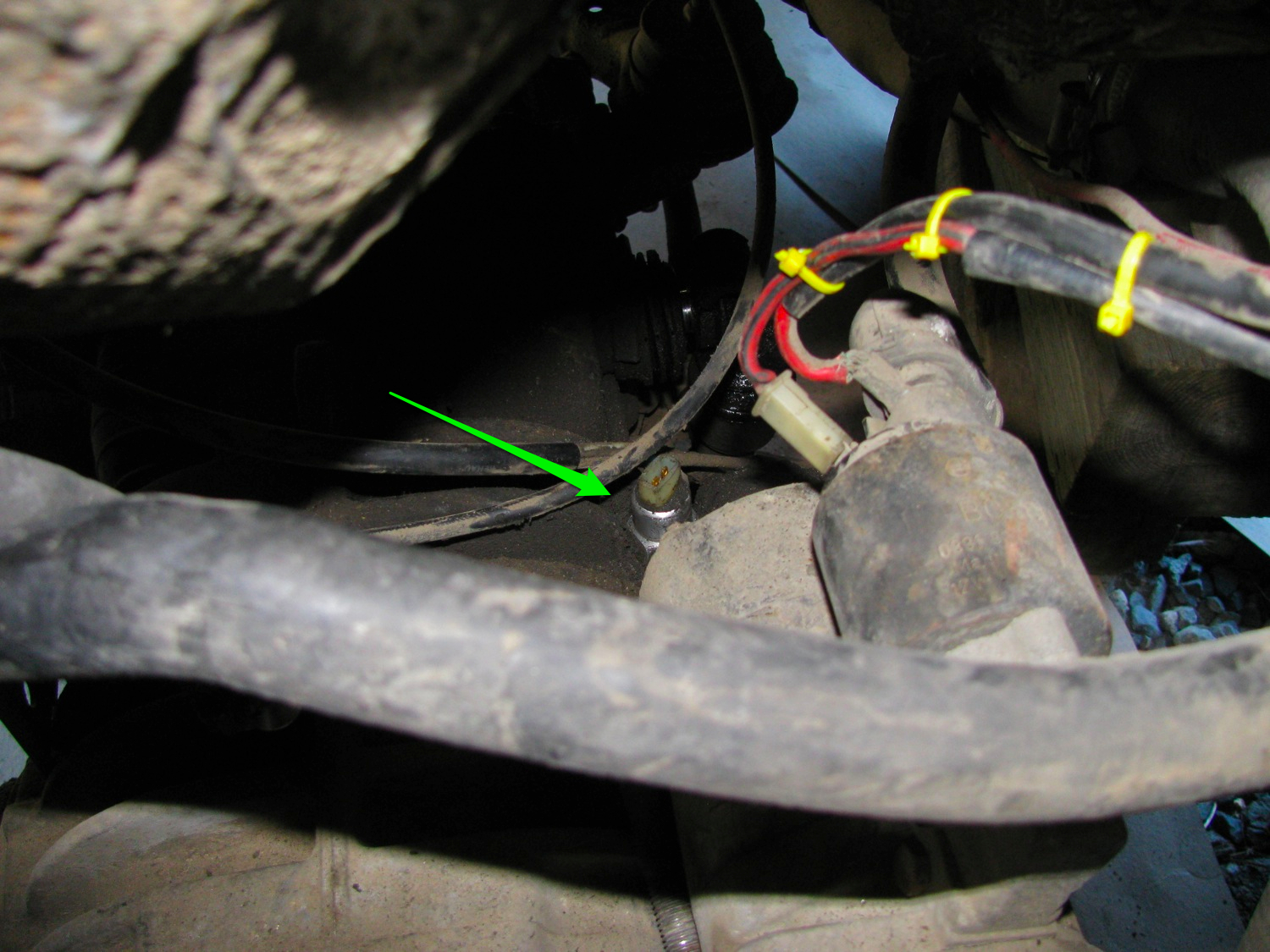
So as I stand there, kicking myself for not pulling tranny, I decide to cut open the bundled wire sheath to see if there is a broken wire where they make some tight bends. No luck, all is good, so I pull back the rubber boot on the connector and one wire comes with it. Did I just pull it off or was it broken already? Of course I am pumping for the latter. I fixed the connection and put it all back in place. Fingers crossed.
I forgot to mention before this that I found a bent pushrod when I took the heads off. If I remember correctly, it was on the side with the (leaking) spring loaded pushrod tubes. How does a bent pushrod affect the engine if the valve adjustment is done correctly?

I’m re-using the clutch drive disk and pressure plate and I measured things to check if that was a good idea. There is still some good life in the disk and the pressure plate has all its finger and is flat. The flywheel is ok too, I de-glazed with fine emery and I replaced the O-ring. The old one was quite stiff.
I did some head scratching when it came to the support bracket on the rear exhaust manifold. Seems that the syncro muffler carrier has extra holes in it to attach the bracket. As I have home made aluminum muffler carriers I had to drill some new holes. Pretty tight, not much wrench clearance. I’ll curse myself if and when I have to get the bracket or carriers off.

Boy am I happy to see the engine finally in this state.

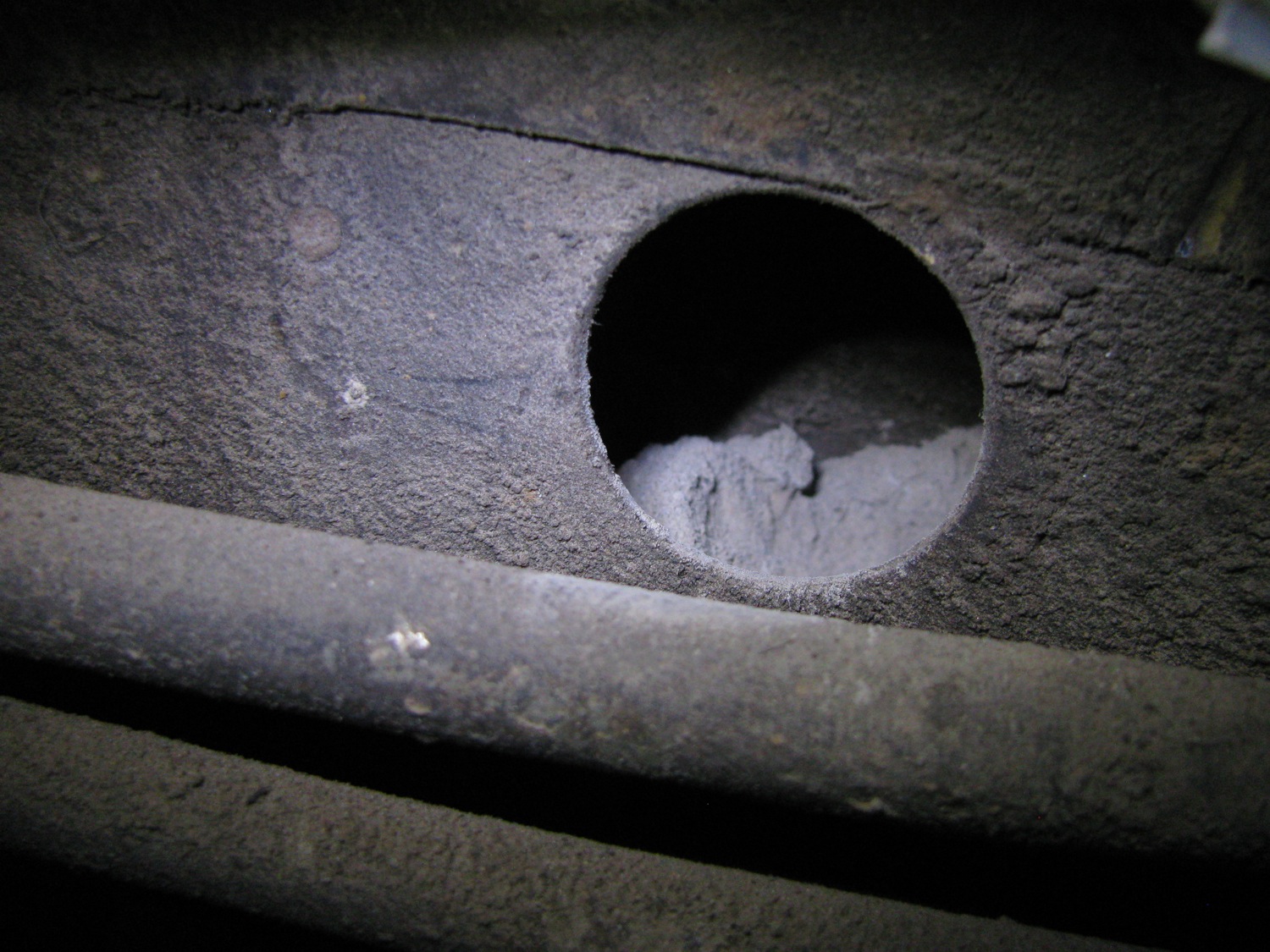
Oh, and when I was in the engine bay I looked into the holes in the frame members on either side of the bay. The frame members that further back house the bumper mounts. A lot of dirt in there.
Next job is to move the engine from the stand to the hoist so that I can get the flywheel and clutch back on.
Vanagon – Q and D head replacement – A little update
Life, god bless it, intruded on the project a bit. So really not much progress to report, but what I have I give to you. (sheesh!)
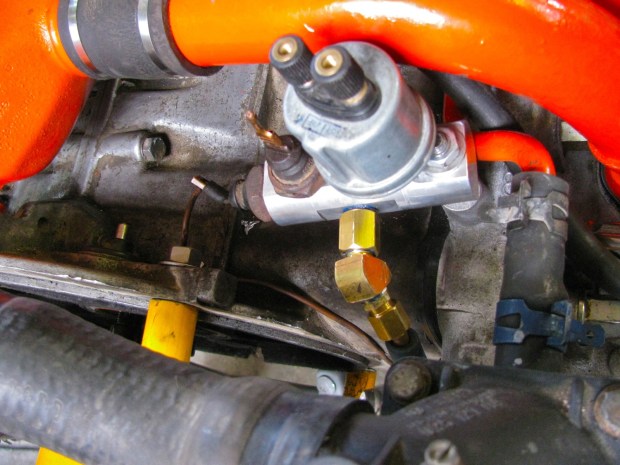
Way back when, I played around with an oil pressure switch relocation set up. I blogged about it here. I saw no reason not to whack it onto this engine. Some notes about the install:
– threaded hole between the pushrod tubes, where one of the 2 oil press. senders originally fitted, is M10X1.0 thread. I used a brass adapter, male M10X1.0 taper thread by female 1/8″ NPT. Note that I have got a male taper thread going into a female straight thread. I was assured that this will seal up fine.
– Then from the female 1/8″ NPT we go to 1/8″ soft copper pipe via a compression fitting. A better way would to be to go to brake line rather than copper, more vibration resistant.
– copper line sheathed in fuel line
– stainless steel cable tie securing line to pushrod tube. Not really needed, the line is pretty solid in it’s run (the covering stiffens things up a bit). I worry about the tubing vibrating and putting stress on the compression fittings, but as it is, the tubing is routed pretty nicely, tight and secure.

– the line runs up tight to engine case and out to the top surface between case and thermostat housing.
– I had to use a 45 degree 1/8″ NPT female to male to make the turn. A 90 degree fitting was too tight. Then we have another female 1/8 NPT to male M10X10 adapter which goes into the manifold.
-due to that little pipe that goes from water pump to Tstat, I had to make a little spacer to raise the manifold about 2 cm.
– that side pushrod tube protection plate had to be reworked a little. I’ll get a pic of that sometime.
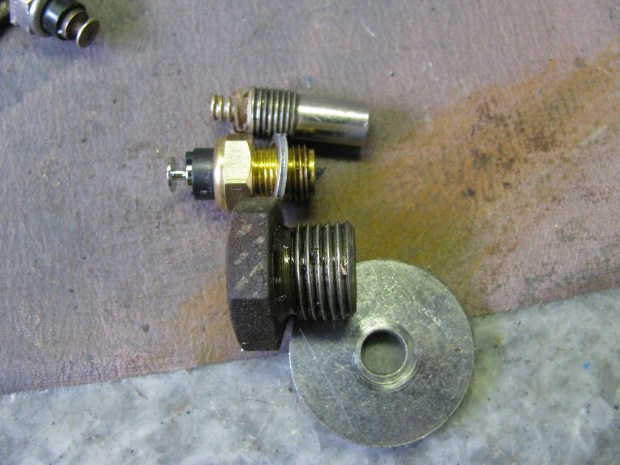
At the rear of the engine, just to the right of the water pump, the now vacant M10X1.0 hole (which is actually a reduction bushing) can have a temp sender probe fitted. I had this nice VDO sender (used it for years on my I4 engine in my ’82 westy) and popped it in there. Later I broke the bugger when I Was going round checking that “I had tightened things up”. Bloody hell. Local autopart stores could not get me a new VDO sender anytime soon, so I took a chance went for this sender (MKII/MKIII Golf). I don’t care that it is shorter and not reaching as deep as the other one. Well I do care but will it *really* make that much difference? Pic showing senders and reduction bushing.

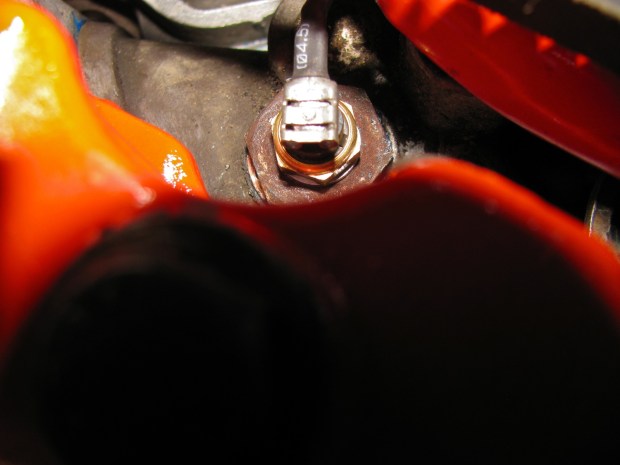
Installed in engine. Signal wire running up then back over top of engine and I’ll bundle that up with the oil pressure sender wires.

Remember my rotted coolant pipe? Well I found another. less rotted one and decided to patch that one up. It had one hole in the main pipe and another one in one of the side pipes. I brazed the holes closed and then slopped on more braze to fill in some minor pitting. That pipe, especially just at the bend where it comes up to connect to the Tstat housing is very exposed to the elements and heat from the exhaust pipe. The combo of heat and weather causes the paint to be eroded and the pipe to corrode. I had the idea to weld on some tabs to allow a little shield to be installed, but I had blobbed on the braze before I remembered and the TIG welder was being used on some serious stainless welding so I left the tabs off. I might try and clamp on a shield. Not the best way, the clamps might be a locus for corrosion starting. I painted the repaired pipe with POR 15, and then with some orange engine paint.
I encourage those of you with old 2.1 WBX engines to check this pipe. Poke at it with a screwdriver or an awl. Make sure it is not on the edge of failure.

I have to say that this project has been much more work than I thought it would be. I not regretting doing it, my god the rotted coolant pipe alone has made it worthwhile. But I have been distracted and unable to concentrate during the job and that is annoying me.
More to come, this job will end 🙂
Vanagon – Q and D head replacement – surprise
Catching up on my progress. I spent yesterday (Sunday) adding the bits and bobs that go on the motor. Intake runners and plenum, coolant lines, oil cooler, PS bracket, alternator bracket, dipstick, etc. A bit of a disappointment when I fitted up the spare rear manifold and found that the end did not line up with the end of the new front manifold. Not even close. I thought that the rear manifold was the same for all 2.1 engines (apart from, perhaps, the small support clamp and bracket) but this one was nowhere near close to working. The angle at the end of the pipe where it meets up to pair with the front manifold was all wrong. I bought a new one today and it works, but needs some slight adjustment.
But the real surprise yesterday was the coolant pipe that runs from the water pump forward along the left hand side of the engine to connect with the thermostat. I had forgotten all about it when painting other bits and yesterday, when I was going at it with the angle grinder powered wire brush I uncovered this.
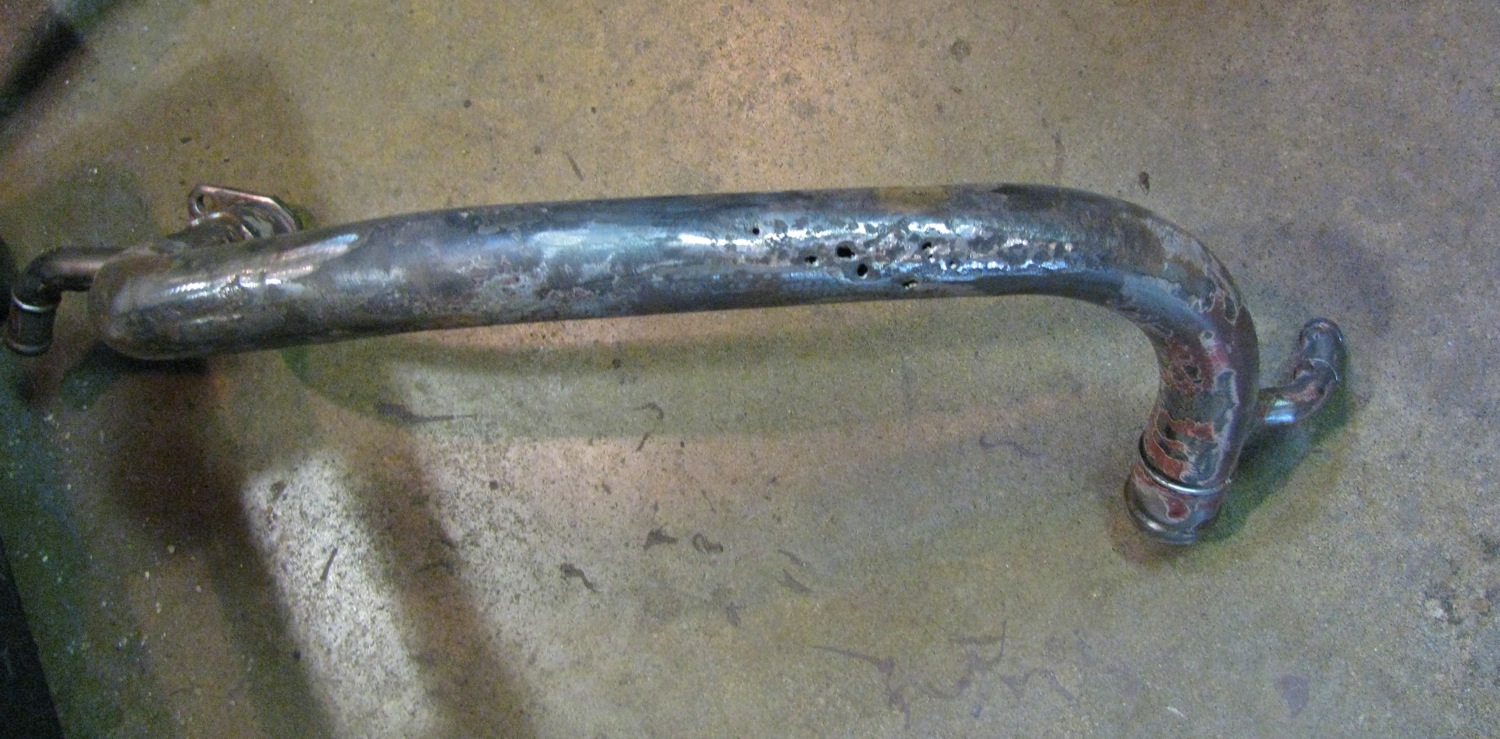
Wow eh? I think the paint was all that was protecting me from a massive coolant leak. Talk about lucky. This one discovery almost makes this entire ordeal worthwhile. I’ll talk about what I did about this in a later post. One more pic, before I put the rear manifold on.
A personal issue has complicated things, but I hope to get this thing done in the next few days.
Vanagon – Q and D head replacement – am I winning?
It has been a bit of a chore.
I can’t recall if it was last Friday when I updated last, here goes with a catch up of what I did on Saturday. I think it was Saturday, my weekends and evenings are so filled with gallery openings, theatre premiers, cocktail parties, and the occasional orgy that I often lose track of time.
First off, a pic of how I keep the cylinders in place whilst rotating the engine on the stand.
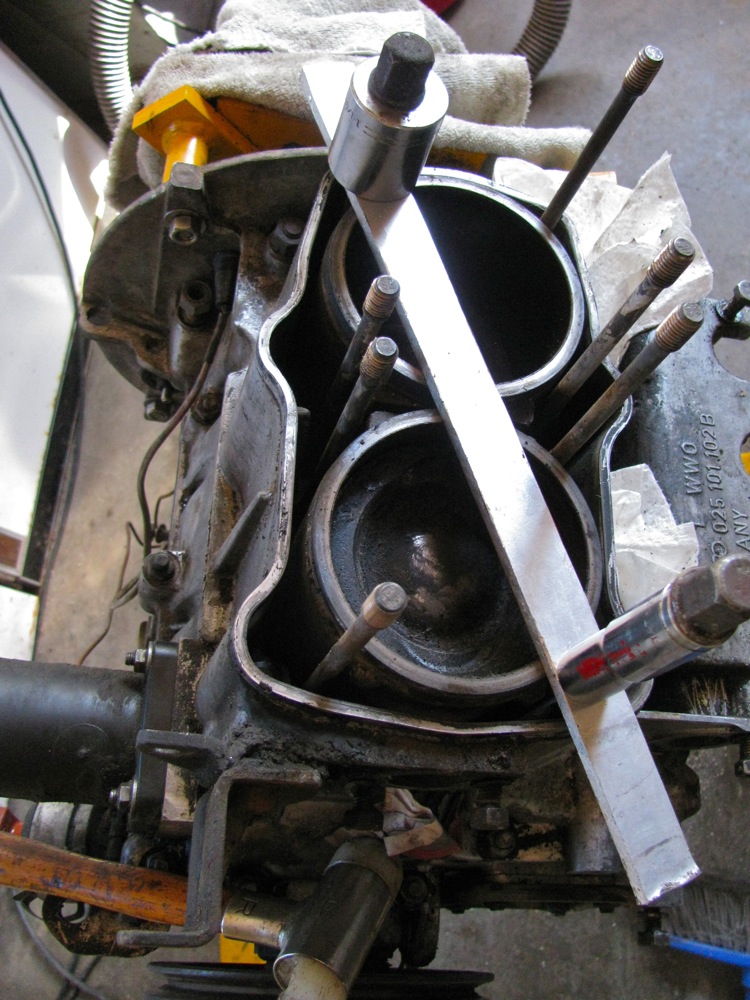
Removing the head from cyls 3 and 4 was difficult. The heads were stuck fast. Lots of tapping with brass drift got #3 loosened, but #4 was a real bugger. I finally got smart and ground the end of my pry bar so it had a sharp edge to catch on the tabs on the cylinder top, final pry and it was free.

Oh that thin green O-ring at the top of the cylinders, not doing much now eh?

Digging it out (dental pick).
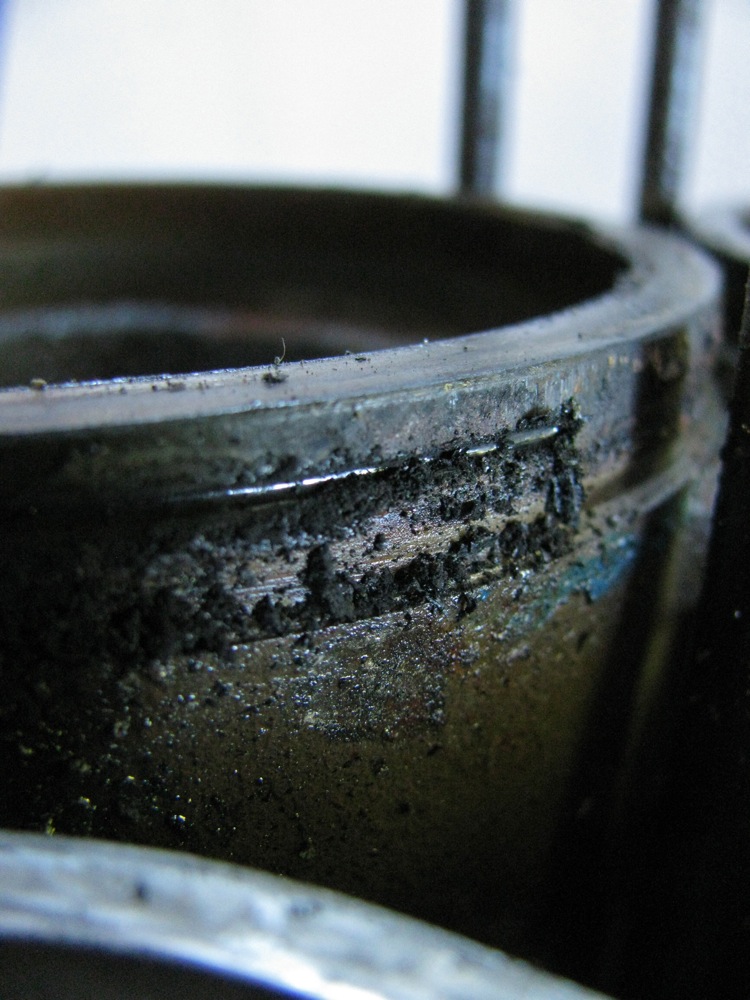
I was getting on fine with the clean up, then disaster struck. I inadvertently, or stupidly (take your pick), pulled #4 cylinder up too far and the bottom (oil) ring came out from the cylinder. “Oh darn it” I said.
Over the next few hours, during which I had no inclination to take any pictures, I pulled the cylinder right off, removed the wrist pin on #4 and took piston out, decided (rashly) to pull #3 cyl too but left that piston on con rod. With them on the bench it was easy to really clean the cylinders. And I was able to clean up #4 piston.
Ok, back to assembling rather than taking more things apart. I used a regular sized ring compressor to get #4 piston and cylinder together. Oh and I cleaned and polished #4 wrist pin, even so it was still a tight fit.
I cut down another of my ring compressors so that the compressing band was about 5 mm wider than the distance from top to bottom piston rings. This particular spring compressor could be taken apart. The head bolts and water jacket restricts access to #3 piston even with #4 piston and cylinder removed, bit the compressor worked like a champ and I got the cylinder over the piston first try.
But… when I was removing ring compressor a part of it fell into the open spigot of #4. “Oh gosh darn it”. The piece was aluminum and my Al magnet was at work. Rotating the engine didn’t work. I finally pulled #3 cylinder again and the lost part was tucked under the piston skirt.
Ok, again, cylinder back on, compressor removed very carefully, then the assembled (on bench) #4 piston and cyl brought over to do the gynecological insertion of wrist pin through water pump and into (flopping around) con rod. VW has a special tool to hole the cond rod in place, but I did it by getting the engine rotated on stand “just right” so con rod hung in position.
Phew!
Pic taken just before all that.

And after things back together. Also replaced black O-rings at bottom of both cylinders.
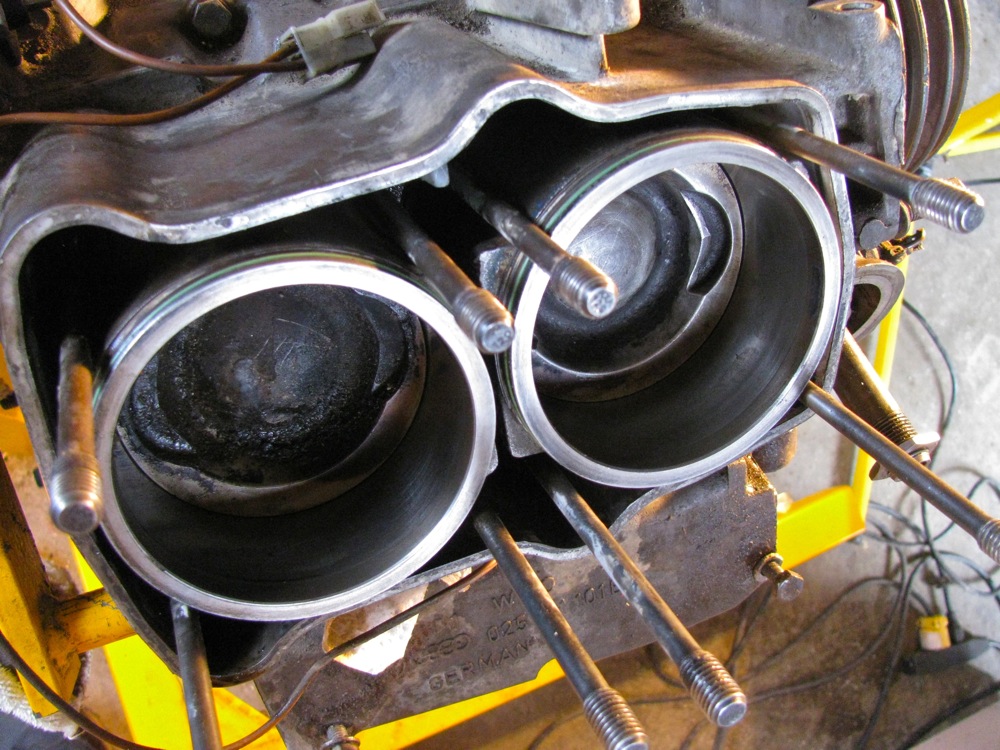
Back on the heads, using a spare cylinder I “lapped” where the cylinder meets the head.

Fine carborundum powder, oil, and twisting the cylinder back and forth. Then I cleaned up the heads, blasted with compressed air, re-installed valves (gave them a little lap love too), then degreased the surface where the rubber gasket seals.

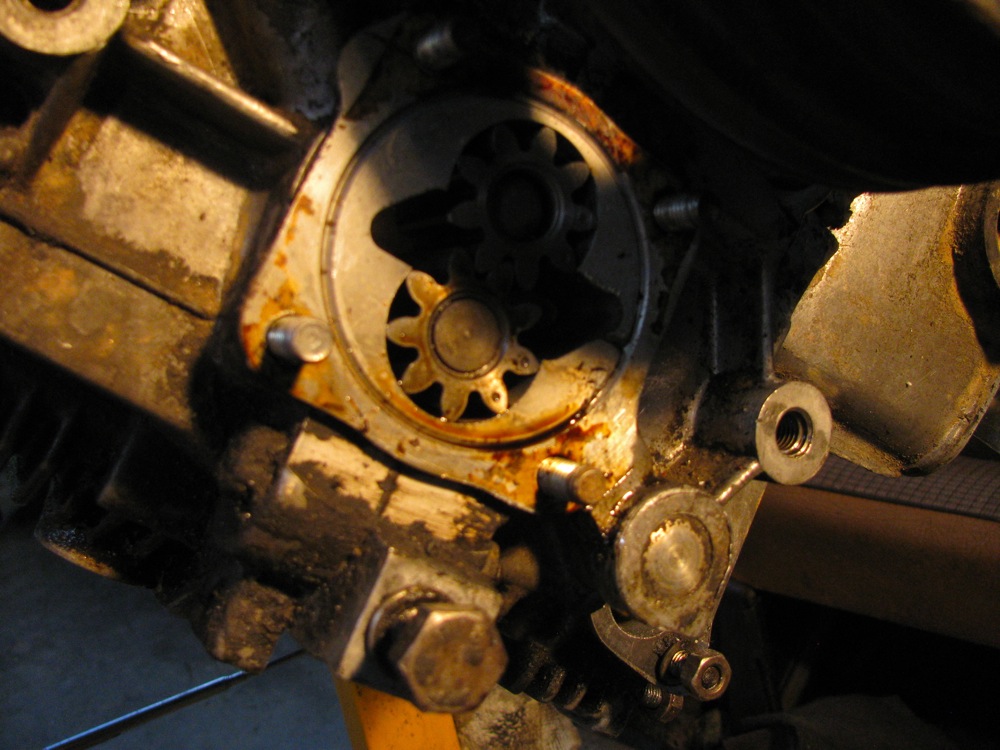
Then on to the oil pump. What stalled me here was trying to remove all of the old paper gasket. The paper was really stuck on and one did not want to scratch up the mating surface. The endplay on the pump measure out to 0.002″ (wear limit is 0.004″) so I decided to use the new thin gasket during re-assembly. Some say to use just some sealant if endplay is close to wear limit. I lapped the pump cover to remove the pump score marks, don’t know how useful that is.
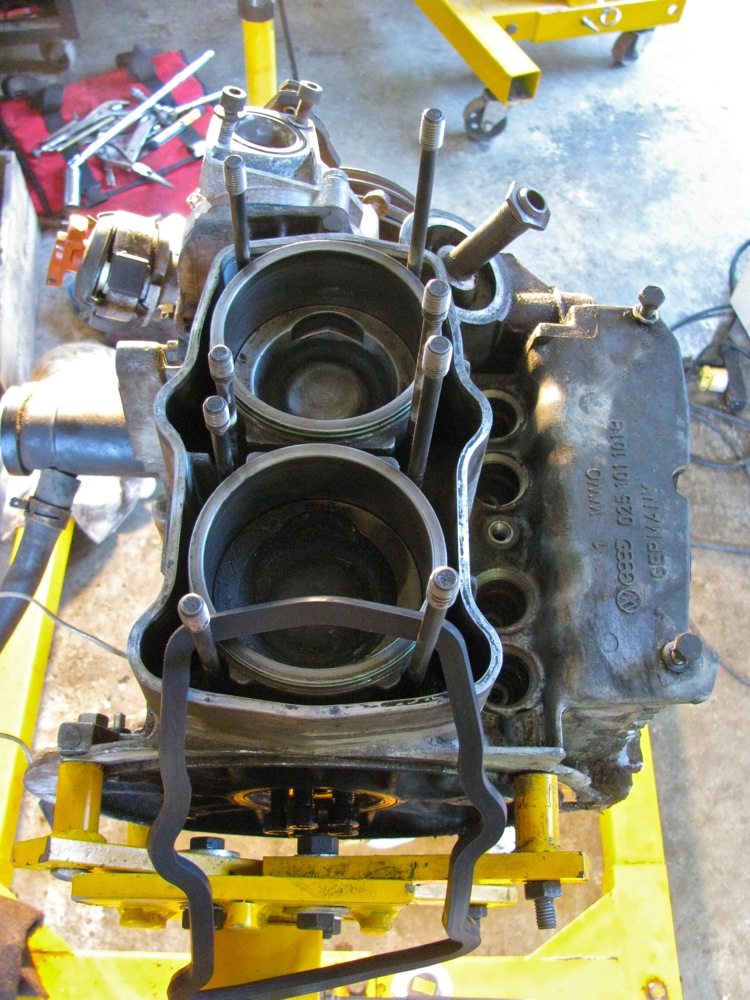
And now the rubber gasket. I used the Reinzosil sealant that came in the gasket rather than “The Right Stuff” (and I do have a tube of that). Why? Well why not? All accounts are that it is good stuff, improved from the original. A thin bead applied to the grooved side of seal and the seal placed on the water jacket. Then a thin bead down the centre of the mating surface.

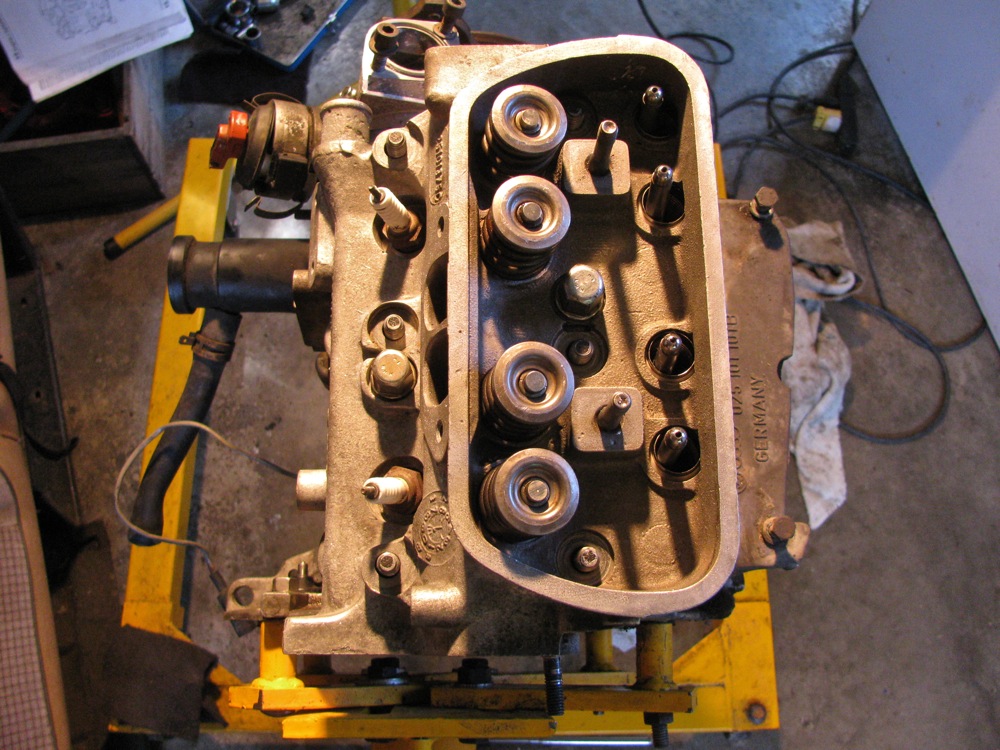
Then the head….
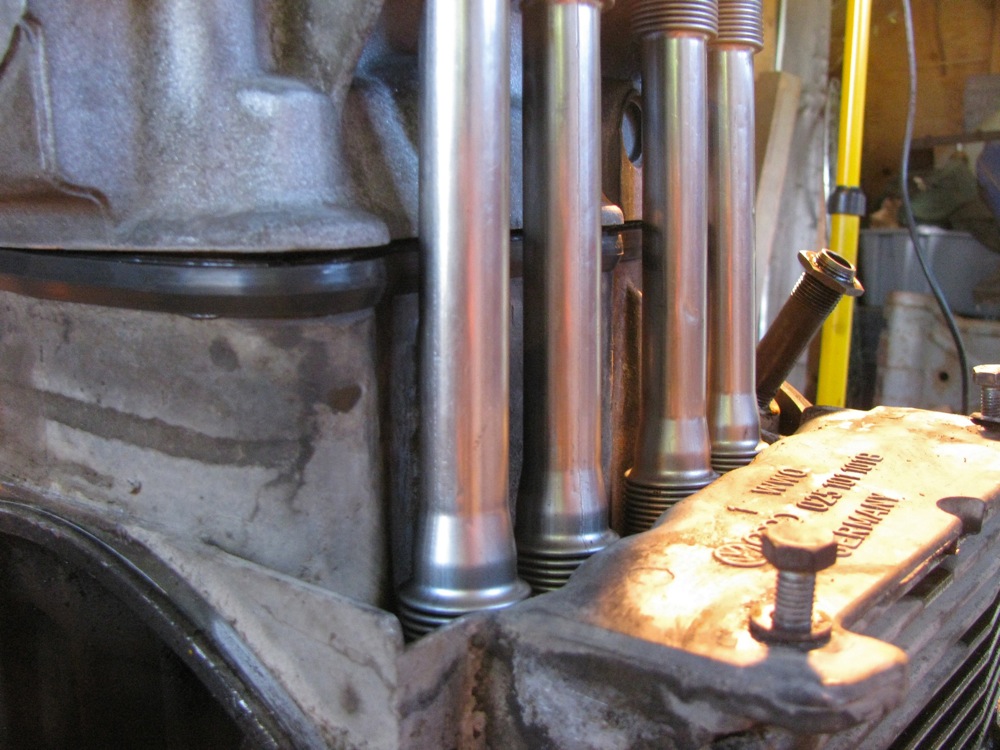
Cleaned up pushrod tubes, checked them for length so they would have good “push” when compressed, put on new seals. Clean and dry holes in case and head.
I used cap nuts on 2 centre bolts to pull the head down (compressing pushrod tubes) enough to get the rest of the cap nuts on. Yellow sealant applied to the head rather than the base of the nuts. It all went rather easily. Torqued the head down in 3 stages – 10, 25, and finally 40 ft/lbs.
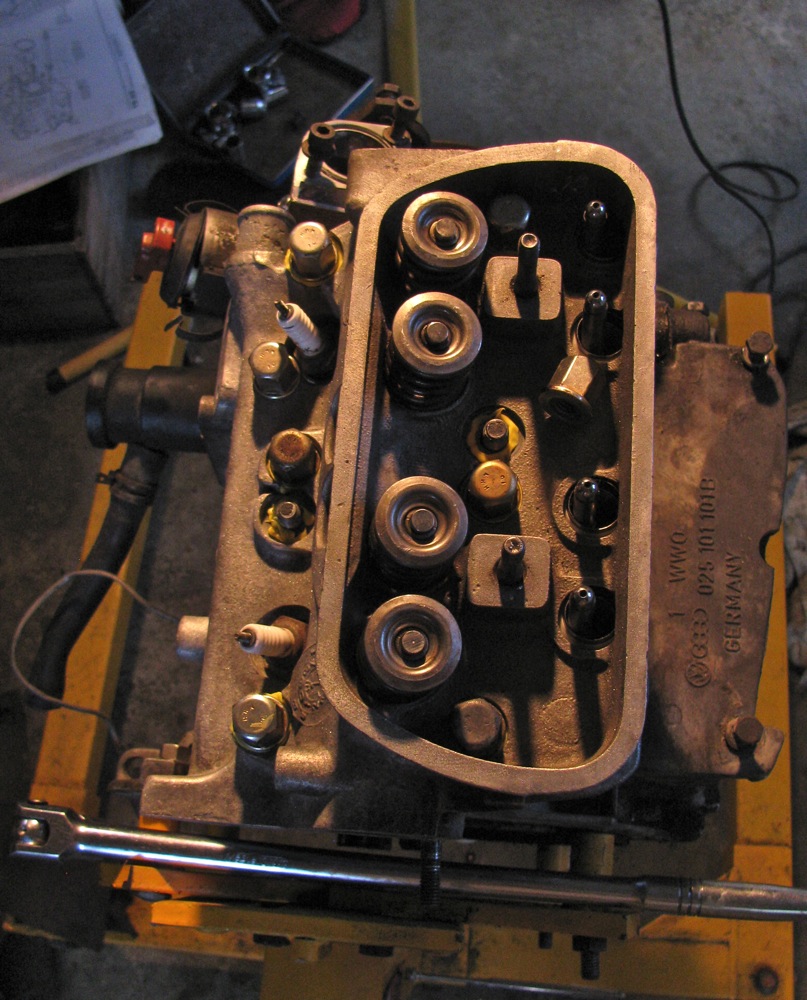
I numbered the cap nuts in torquing down sequence. I was nervous, numbering the caps calmed me down 🙂

And I got the other head on with no drama. I had to check the fit of my new exhaust manifold (Dansk) and it fit up to the heads as if it was made for the job.

Then I started putting things back on. A cleaned up, inside and out, breather tower with new O-ring, new waterpump, and one newly painted coolant pipe.

Enough for this post, I’ll try and catch up on my progress in next post.
Vanagon – Q and D head replacement – progress
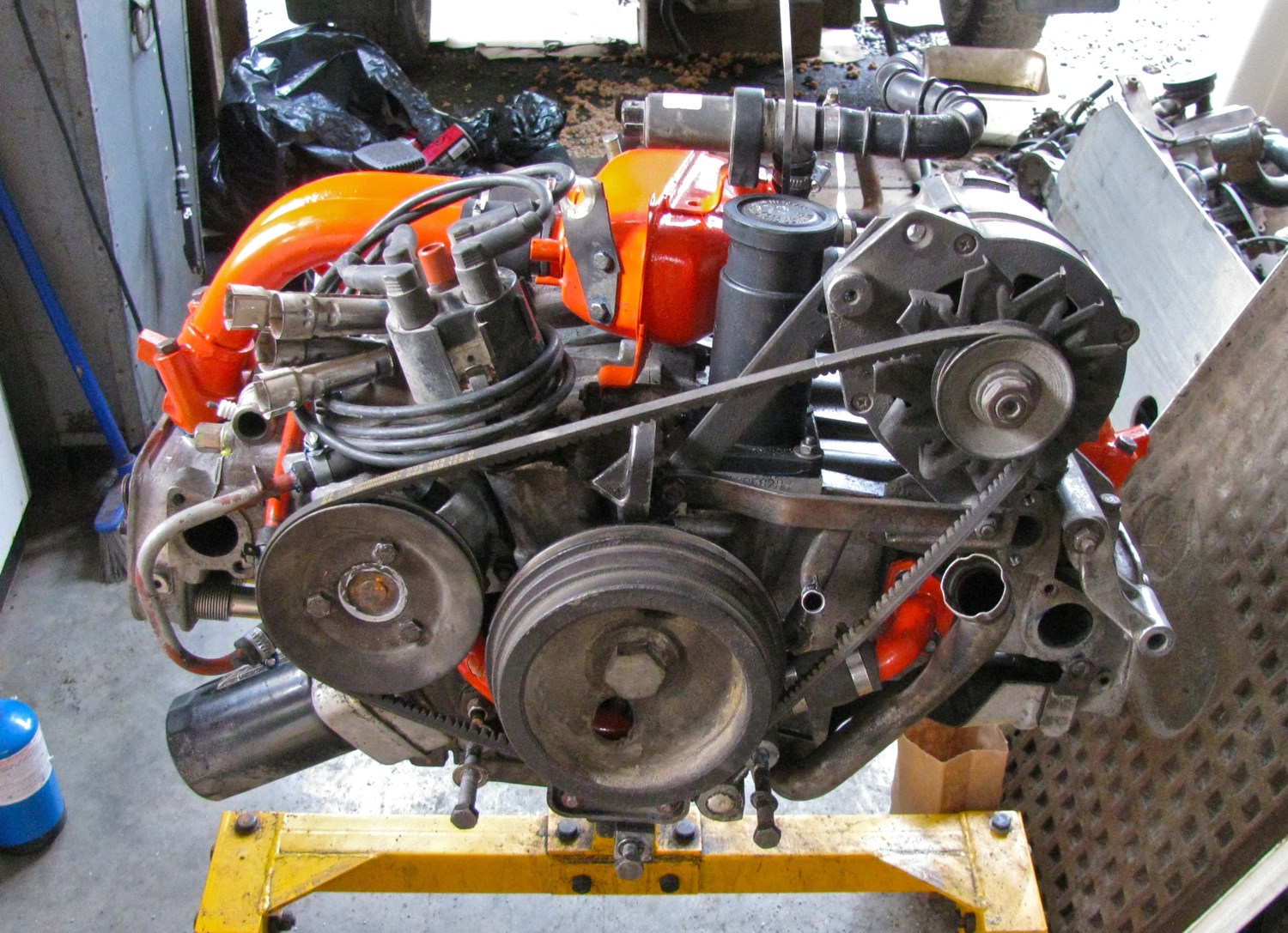
I got somewhere today but realised that there is much more dirty than quick in this chore. I transferred the engine from hoist to stand then set about taking off all the ancillaries.

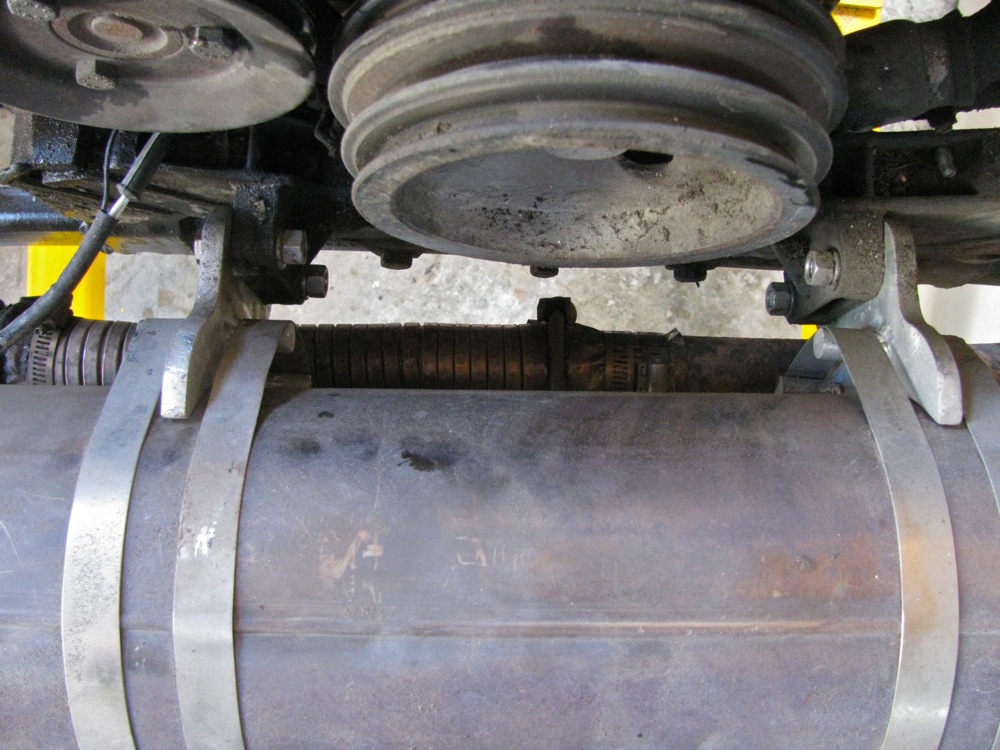
This pic shows the backside of my muffle mounts. Also shows my stainless steel flex hose repair to exhaust pipe (I whacked it badly on a logging road over a year ago).
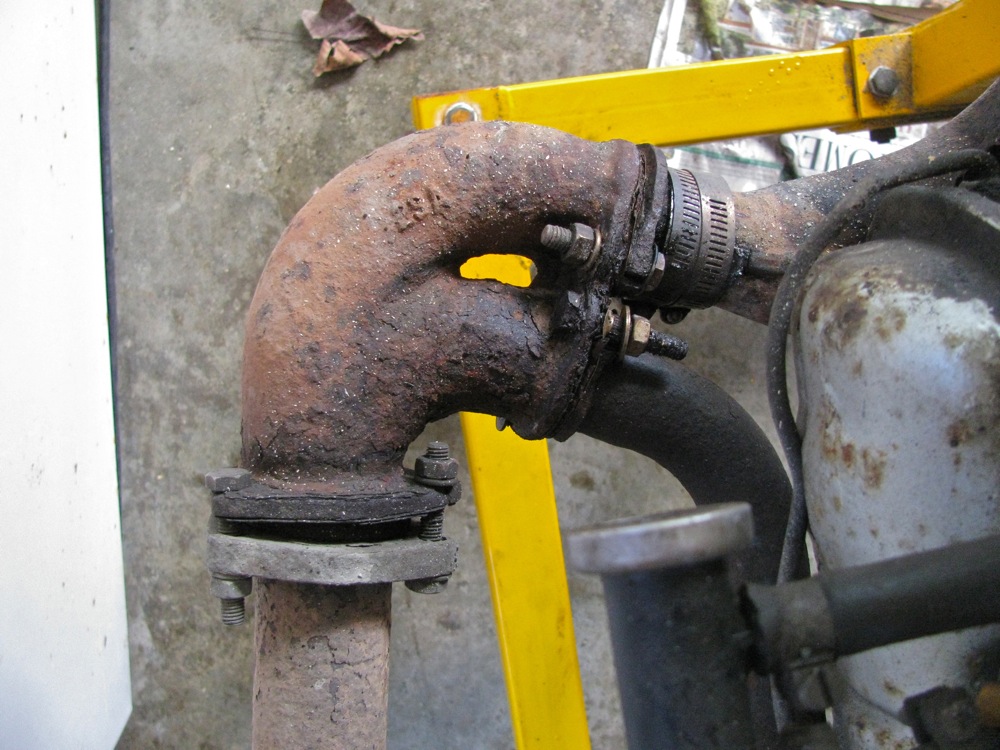
More exhaust shame. I’ve re-kludged the end connection of that pipe many times over the years. Oh frabjous day when the new pipe goes in.
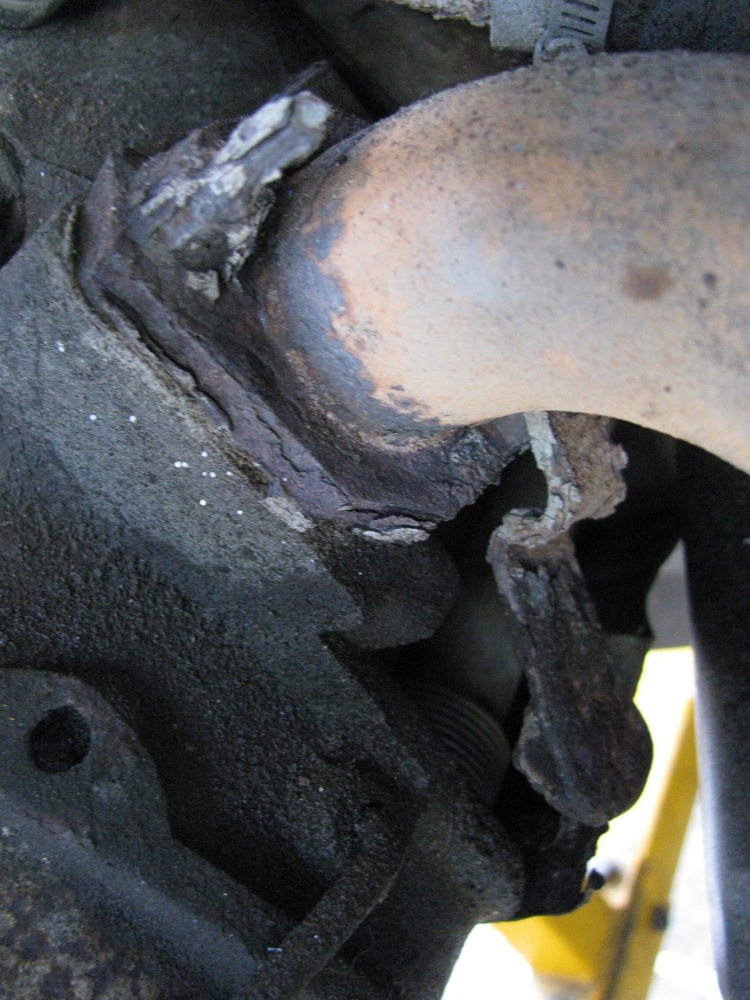
Example exhaust stud.
I mentioned previously that I noticed that my water pump was going fast. The pully and shaft was loose, and here you can see how the shaft looseness has allowed the impeller to score the pump body a bit. I don’t think this will affect the function of the new pump too much. BTW, even with the engine on a stand, getting the water pump off is not easy. I would not like to do it on the van.

The oily side of the engine. Hello, what’s this? Spring loaded pushrod tubes. I don’t think they worked very well, evidence of oil leakage especially on the one closest to camera.
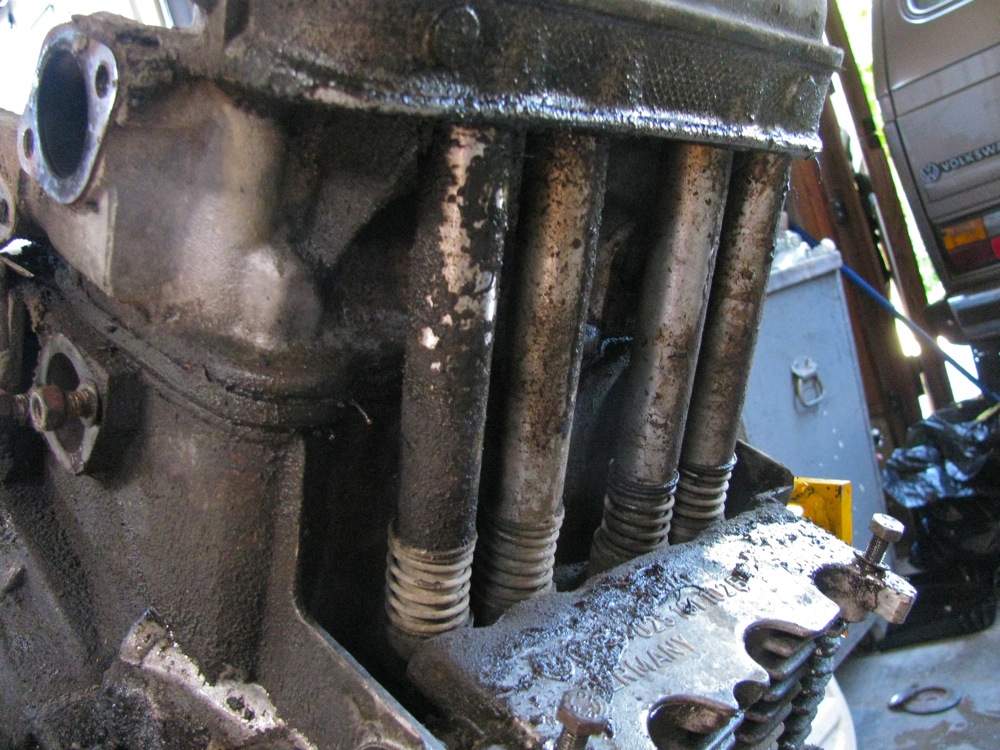
I’ve kept the oil breather tower on during all this, just to cover the hole to the crankcase. I replaced the O-ring at the base of this tower about 2 years ago, but it has been leaking badly. I think I’ll re-install with some oil resistant sealer plus new O-ring.

Another view of that oily head. My god there was a lot of baked on crud to remove. I used a putty knife and old screwdriver to scrape the worst off, then some solvent and brass brush. I wasn’t trying to get the engine pristine, just to be able to work on it without getting angry 🙂

The dry head. Normal pushrod tubes here.

Time to take off a head, starting with the oily one.
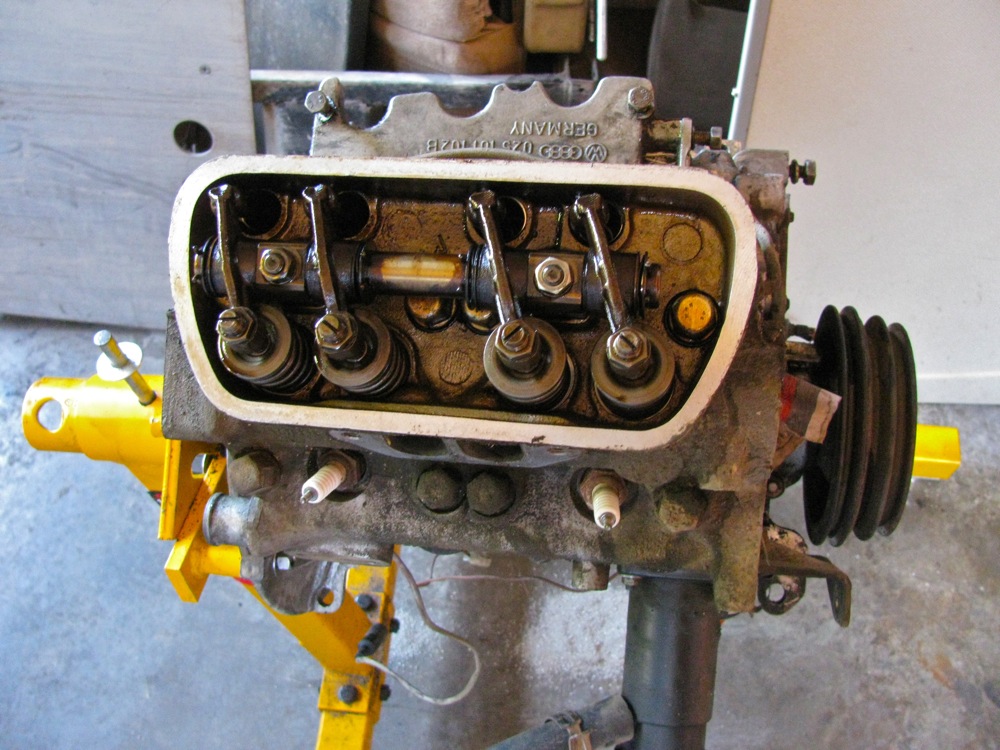
I used some aluminum welding wire and tags to ID the pushrods. Does it *really* matter if they go back int he same hole? I don’t know.
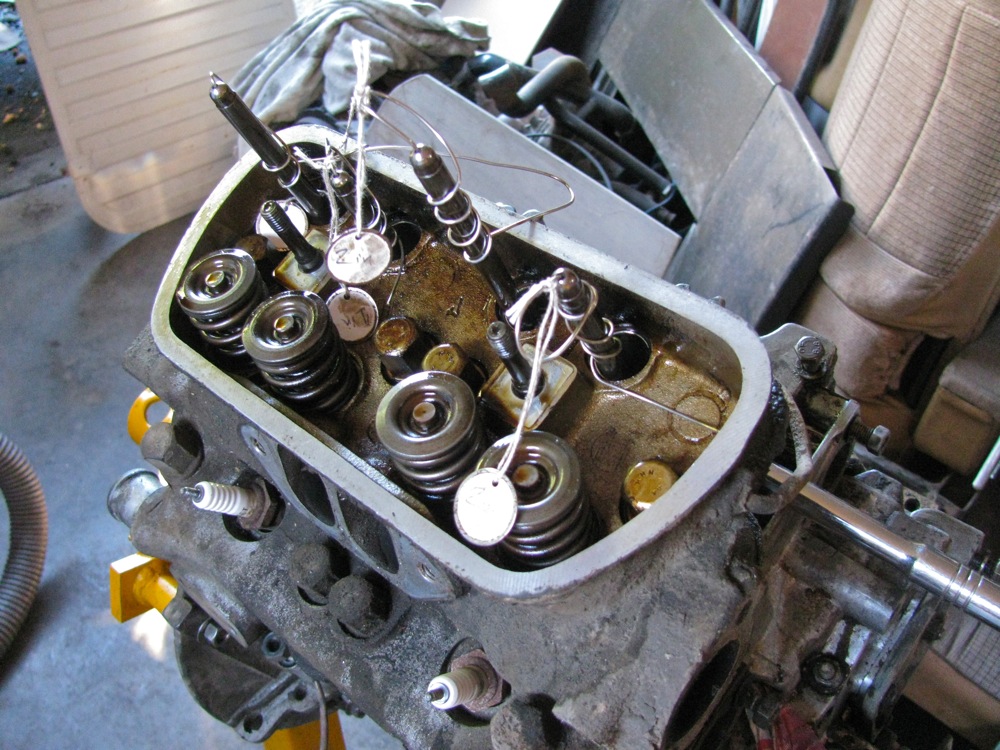
The head nuts removed and the head rapped in various spots with a dead blow mallet. Then I could pry up the head a tad, remove the pushrod tubes and see to my dismay that the cylinders were stuck to the head. It took a fair bit of hitting with a brass drift and hammer to free the cylinders from the head. I only lifted up the head about 7/8″, just enough to get the drift on the cylinders. Prying on those tabs you see in the pic was not effective. I hope the bottom of the cylinders seal again, I believe they do, but… I have the feeling I will pull them and replace the seals down there. Grr.
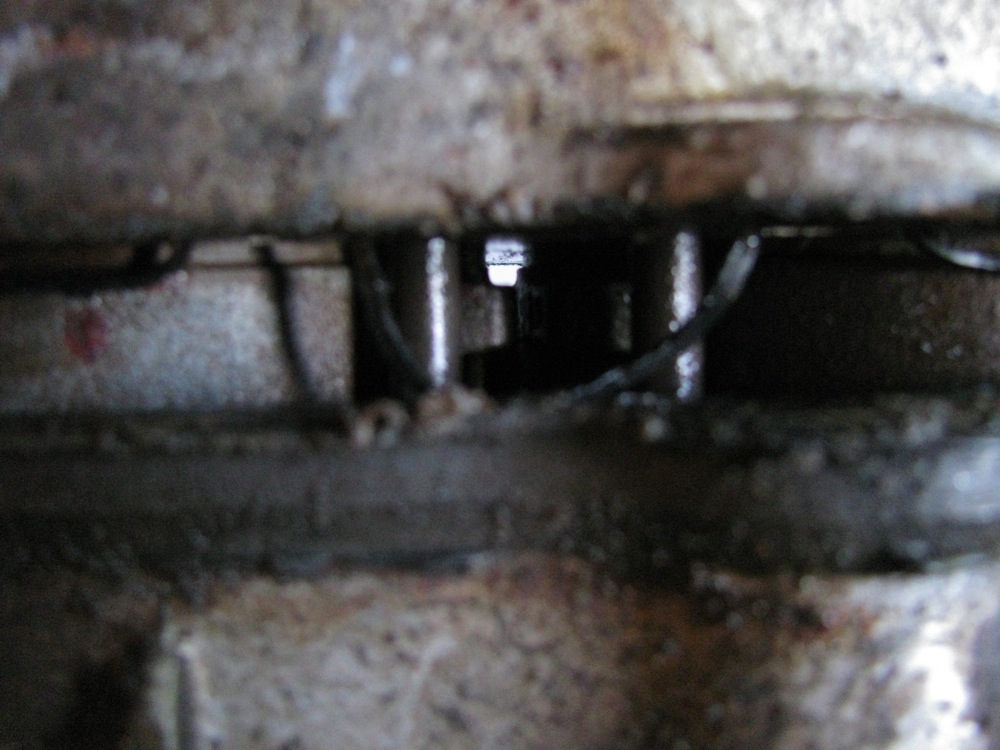
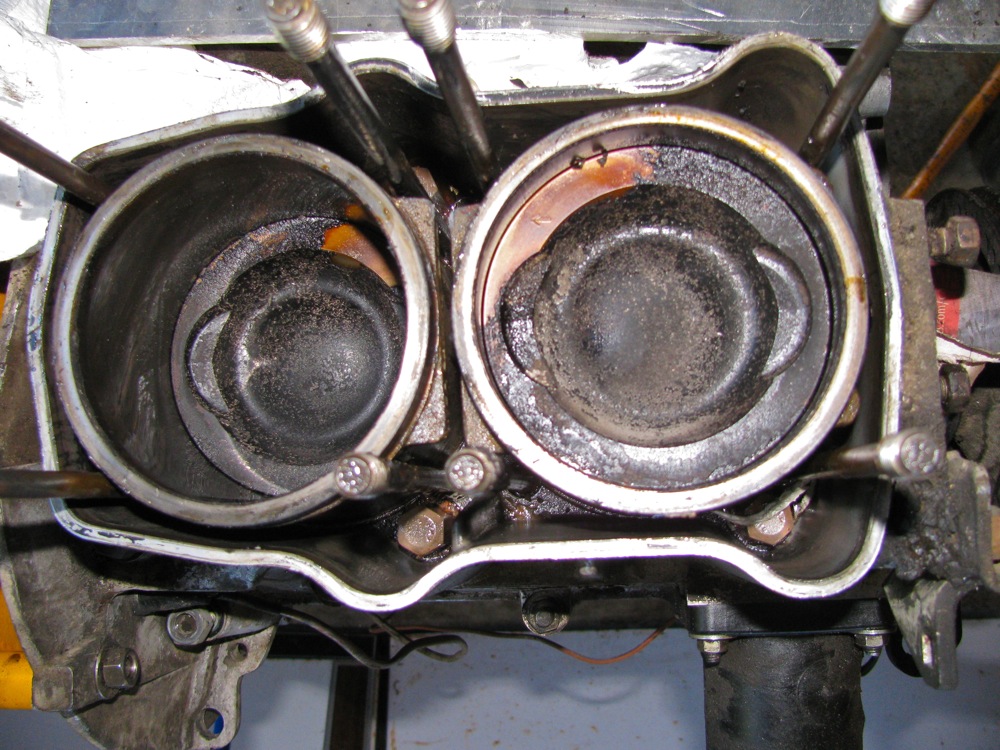
Tops of pistons. I don’t know what normal, good, or bad is supposed to look like. I was happy to see the water jacket edge was not corroded.
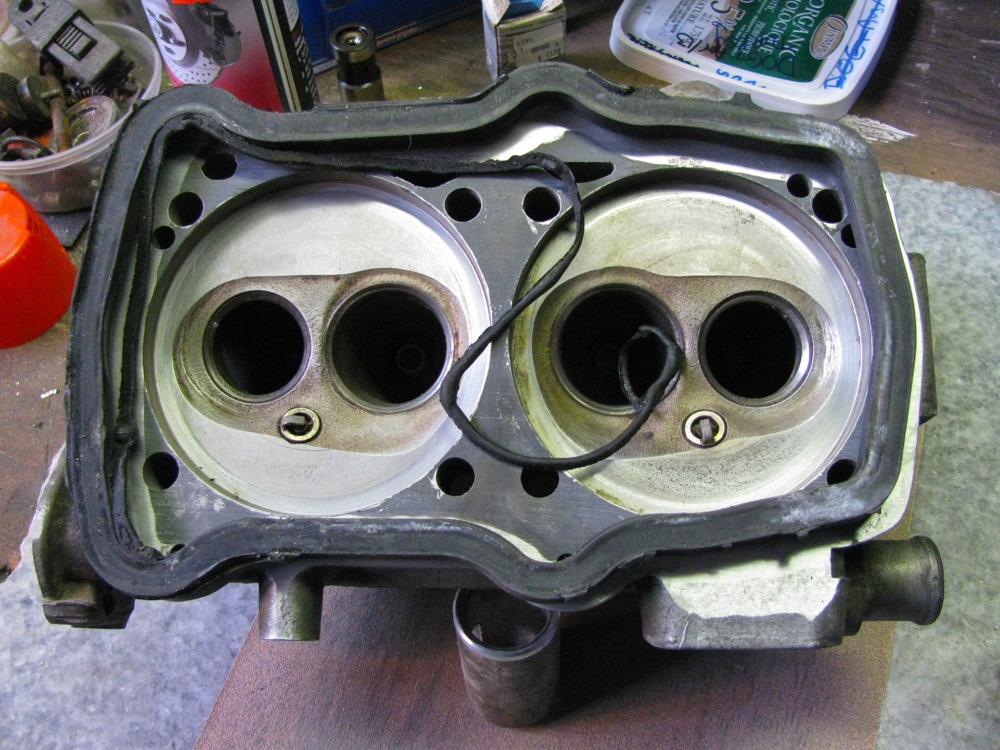
And the head. The black stuff does note really look like sealant. Perhaps it si a mixture of corrosion and Holts Stop Leak. The exhaust valves look different than the ones on my replacement heads. These have a depression in the middle, the others don’t, just a small dimple. Now which type mean sodium filled stems?

Close up of the crud on the head. And do you notice the yellow paint on this head?

Closer look at valves, is that a crack between them?
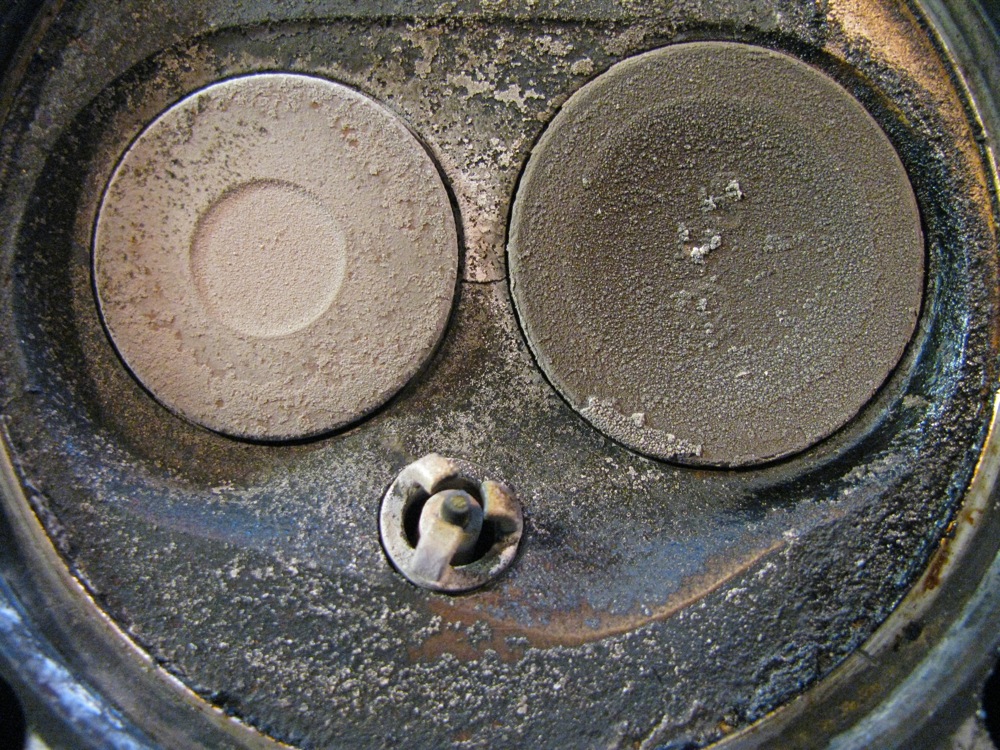
Sure looks like it is.

Well there you have it, today’s work. I’m not getting it done as quickly as I thought I would (doh, when will you learn? Ed.), but it is getting done. Tomorrow I hope to get other head off and then start on the re=assembly. Will be so nice to put some clean parts on the beast.
Vanagon – Q and D* head replacement – engine out
*Quick and Dirty
Took me a while to do it yesterday. I had to clean up some of my mess to make room in the workshop, and I got confused and stalled by what to do with the heat shield that runs across the rear of the engine compartment about the muffler. I didn’t notice right away that the holes in it for the screws holding it to the van were actually slots, not holes. And I had one screw that would not come out (I ended up die grinding the head off). Turns out the shield comes off with the engine – so there is no need to spend time trying to take off the oil filler tube (plastic part does pull off with a little help from heat gun), or to take off the metal coolant pipe that runs from water pump to T-stat. I thought I had to do all that to gain some space rear ward so I could pull the engine back and off the tranny.
What’s that you say? I thought you were pulling tranny and engine as a unit? I did plan on that, then I realised that if I allowed the tranny to drop 4 inches or so (as described in Bentley manual), I could reach the spots on the tranny that I wanted to deal with (starter electrical connections and diff lock light switch). Leaving the tranny in meant I didn’t have to fuss with CV joints or clutch slave cylinder bleeding. But after all the time I spent trying to get the engine back off the tranny I am not sure I saved any time at all.
A couple of other excuses – no lift/hoist and tight working space. Ok, I agree, lame.
Anyway, the dirty oily thing is out and hanging on the hoist (engine was lowered by hoist and pulled out from under van as it was resting on hoist base). Today begins with shop clean up and transferring engine to work stand.
Here is the engine pretty well ready to be removed.
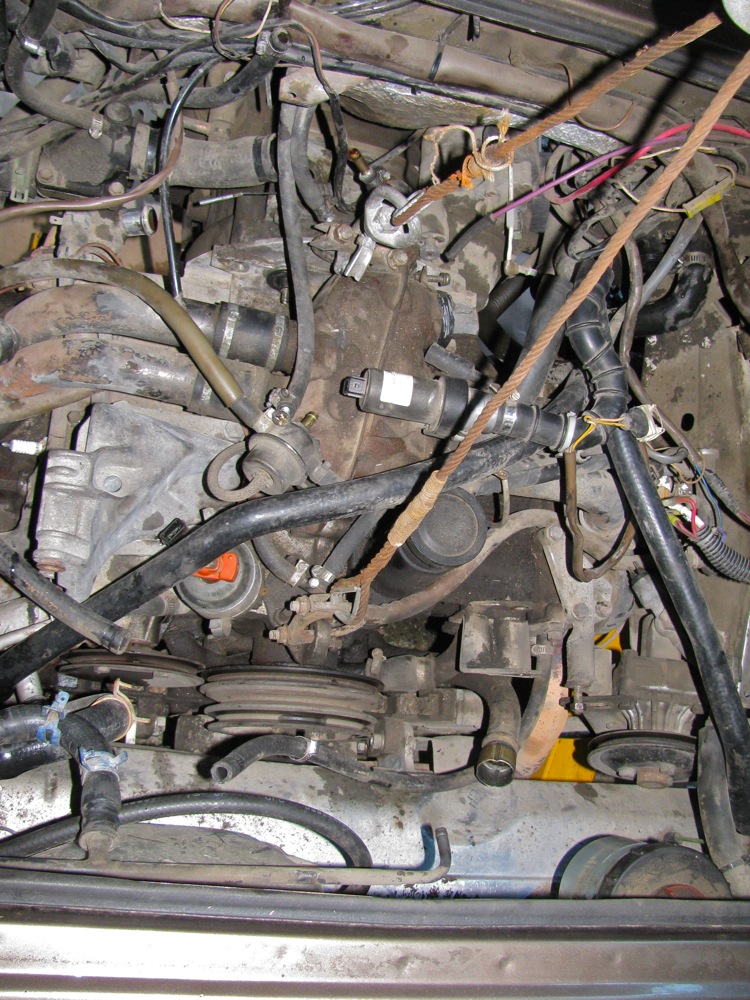
And out.

Tranny is resting on blocks in this shot and van rear is raised high to allow engine to come sliding out. No stress that I could see on tranny connections, but van lowered back down after pic taken. I was concerned about stress on CV joints, but I don’t think I’ve subjected them to any great angle.

Vanagon – quick and dirty head reconditioning
In my last one before last post I mentioned that I had been given a Subie 2.5 engine from good friend Simon. The engine needs to be gone over carefully before using and because I work so slowly and also because I am still not 100% convinced about putting a subie engine in the van (don’t start, I know my feelings are irrational) it won’t be going in my van any time soon. But I need to fix things on my current WBX engine, namely a rotten exhaust and a weeping headgasket (cold weather weep on one side).
I have a spare WBX, of unknown provenance, and I decided to take the heads from it, clean them up, and pop them on my current WBX. At the same time I can replace the parts of the exhaust system that have rusted away and also replace some seals and gaskets.
So I took the heads off that spare engine and noted that one head had some pitting and corrosion, the other looked like it was a newish addition. Both heads checked out ok in regards to valves and valve guide tolerance. I set about filling the pitted head with some JB Weld.
Here is the pitted head after a quick fly past with a sand blaster.
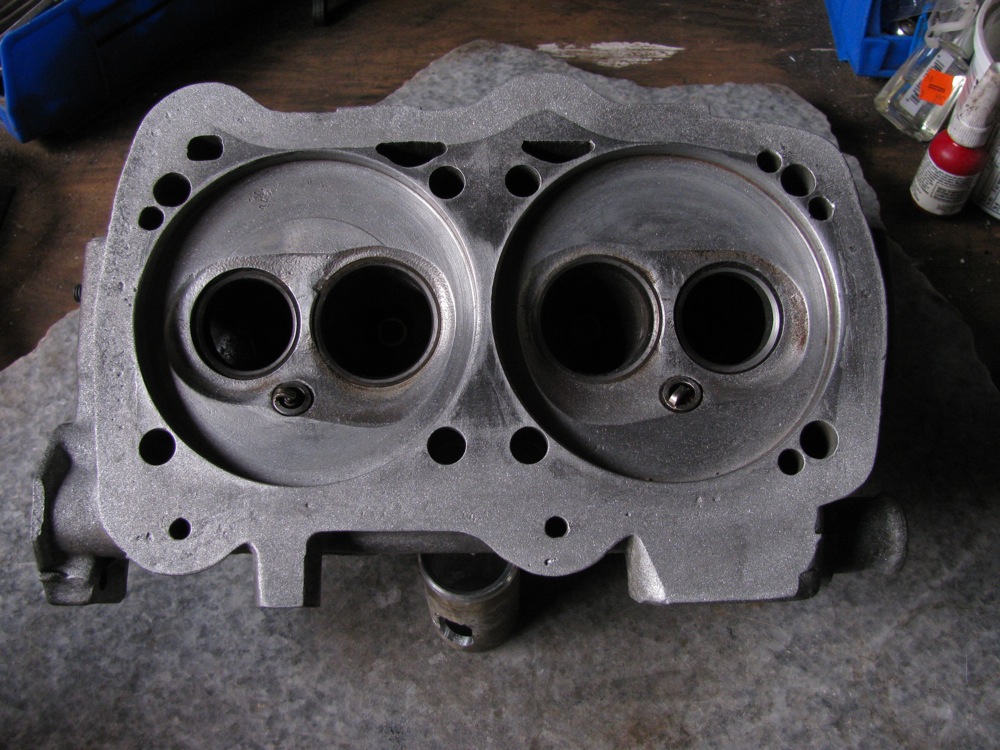
JB Weld smeared on the pitted areas.

Head weighted down on parchment paper on a marble slab.

After the JB Weld had cured.

100 grit sandpaper glued to marble slab and head being “lapped”
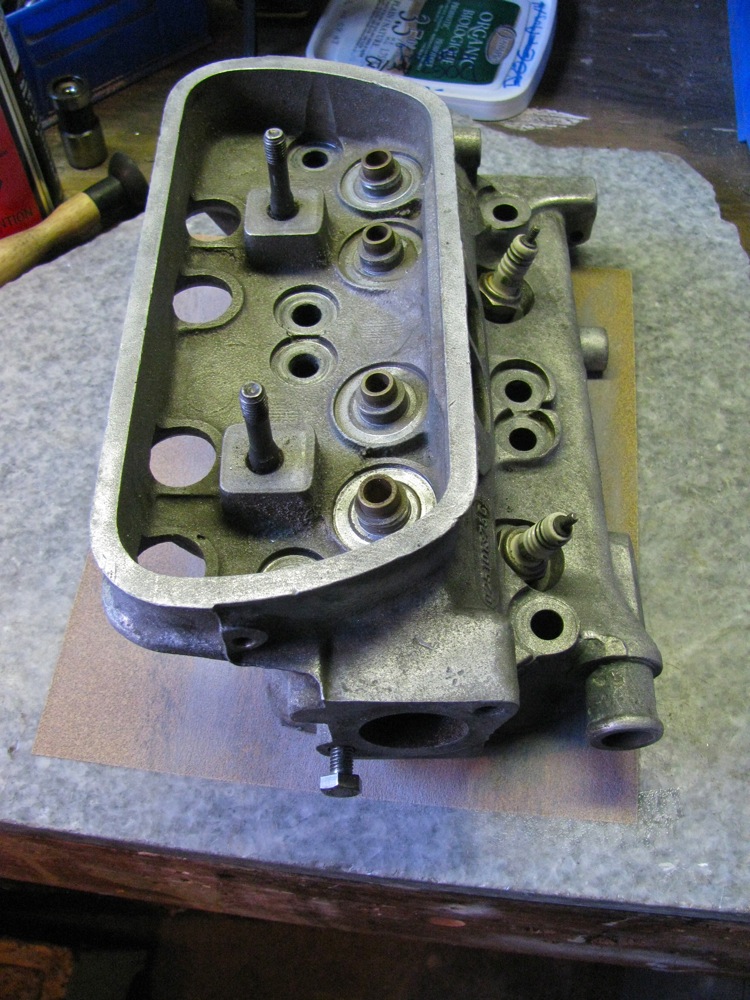
The result.
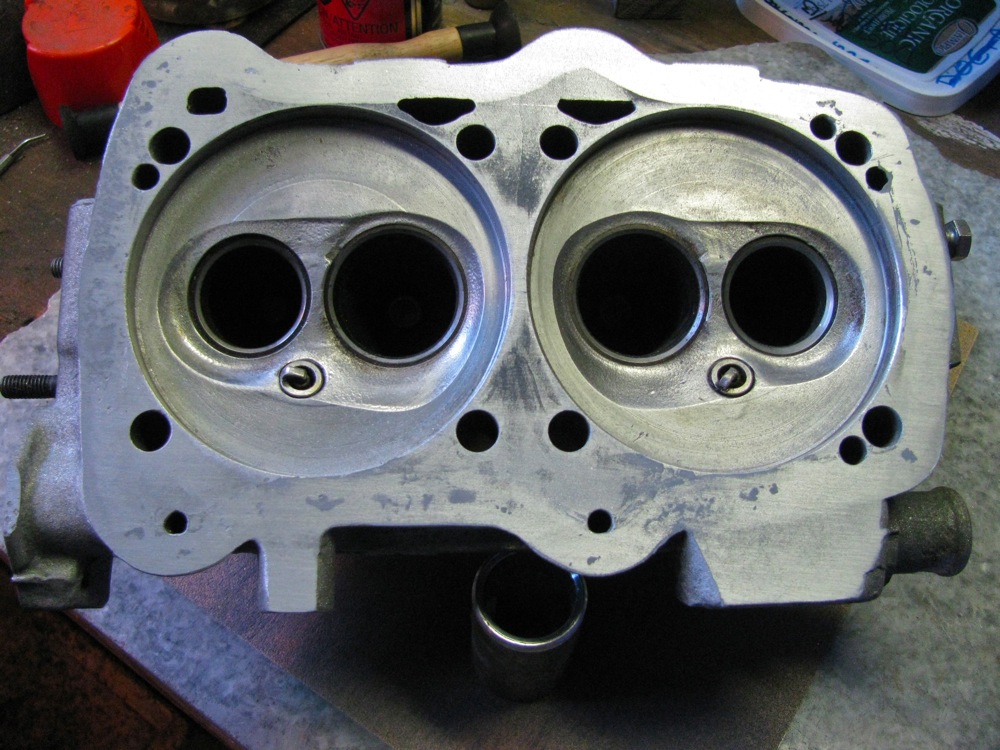
All the pits now filled with JB Weld. Even the ones in the pic that still look unfilled.
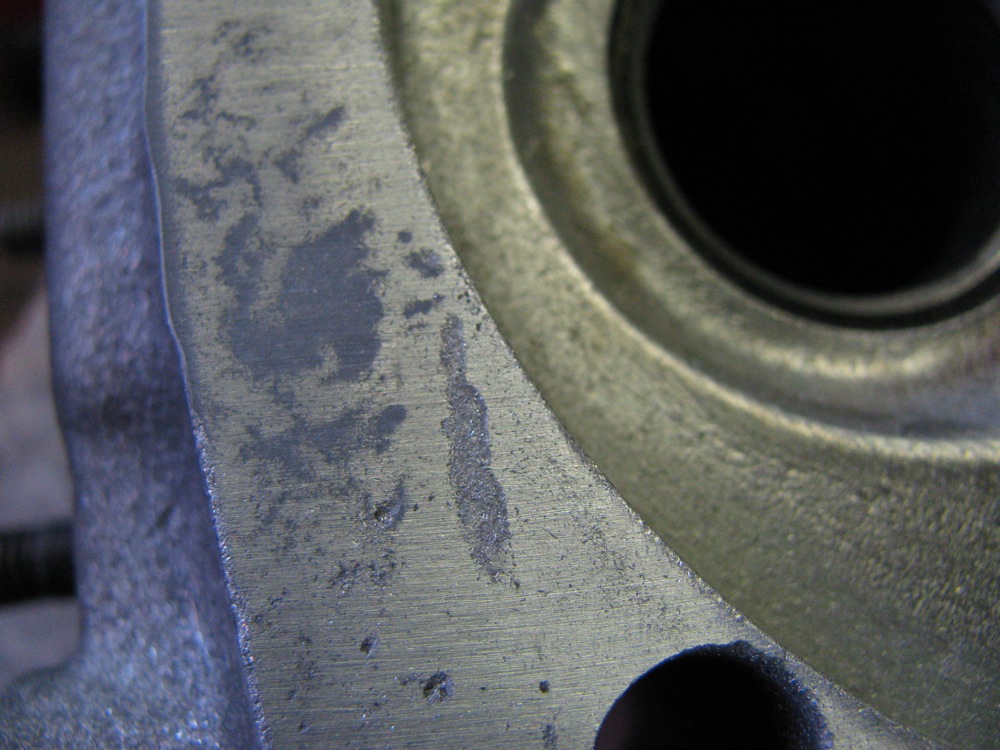
The other head, looking pretty nice.
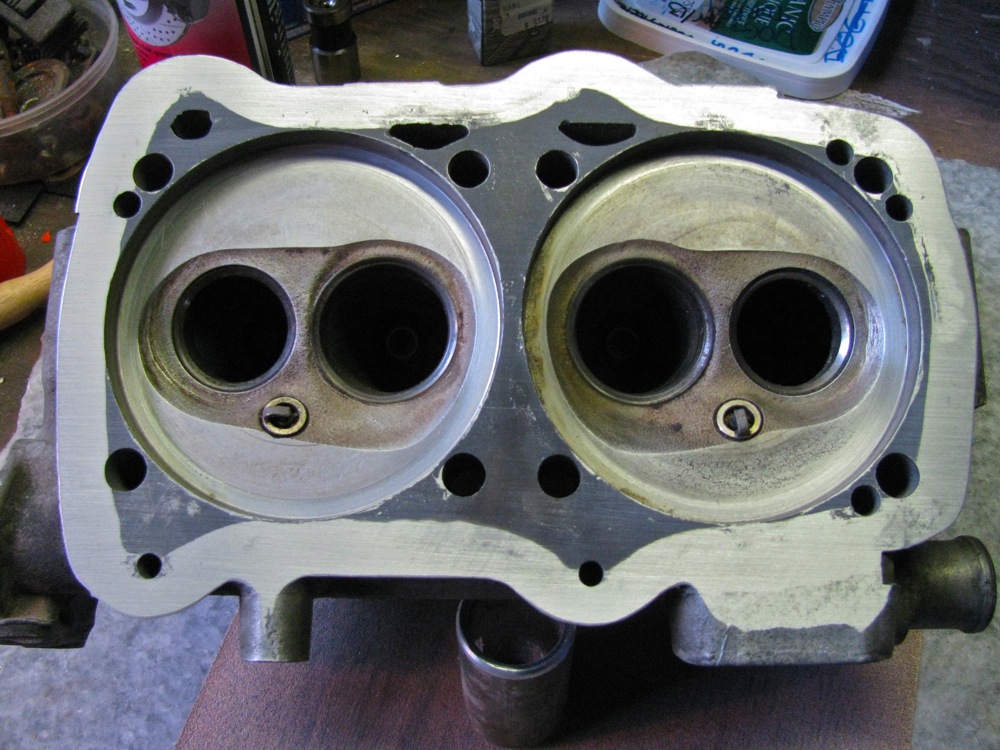
And with its old gasket. A lot of sealant squeeze out, note that the sealant had blocked hole on upper left hand side.

Gasket flipped, squeeze out apparent, as is the “cast” that blocked the hole, now on the lower left hand side.
I’m taking the rest of the week off work (well work is slow anyway) to drop my engine and tranny and get these heads and the the rest of the needed stuff on.
Vanagon – small finds at the auto wreckers
Posted by albell in vanagon, vanagon mods on May 15, 2013
I had the afternoon off so I drove up to Malahat Autowreckers to see if there were any new Vanagons in stock. And indeed there were, 2 1990 MY passenger vans that were not completely stripped. One was a weekender, driver’s side jump seat and table still intact. Both had something I had not noticed on a Vanagon before, an aluminum sill plate on the sliding door entrance. I bought one, here it is.

The part number is 255 853 558. I think it is available from VW Classic parts, “scuff plate – sill panel- Einstiegleiste”,
Back side:

I also managed to find a couple of undamaged cup holders.

And some fairly new looking front door inside latch plates (they really get ratty, especially the brown ones), and a couple of surrounds.

A few relays and clips rounded out the shopping spree.
Vanagon – misc. updates
Posted by albell in vanagon, vanagon engine swaps, vanagon mods on May 14, 2013
I haven’t been posting much recently, work and garden chores have been taking my time. One good thing about the work time is that my welding is slowly improving. Helps having a good teacher and access to the best equipment. One day I might be able to make a good aluminum weld that is more than one inch long.
But some things are happening on the vanagon front. First off, I replaced the LED light strip on the rear of the lower cabinet, doing away with the pierced moulding experiment. Mainly due to the fact that 6 LED elements failed on the initial install, but also I didn’t like how I drilled the holes. The LED strip is in an anodized aluminum channel


Staying with LEDs, I installed a couple of feet of strip above the footwells of the front seats. They are wired to go on with the doors opening. Not the greatest mod in the world, but fun to do.


When I was younger I thought that ski boxes, or coffins as I dismissively called them, were stupid. But what do you know, I’ve changed my mind and I found a really old school Thule Combi-Box 250 for sale for $50 and I bought it. So why the change of attitude towards these things? In a word, chairs. Yup, I’m fed up with stowing the folding camp chairs behind the back seat. Now they will go up top, and the fishing rods too. I haven’t mounted the box to the van yet, I still have to make some modifications to my roof rack attachments so I can get the box on the right spot on the roof.

The bigger news is that I was given a 2008 Subaru EJ25 motor. Good friend Simon had it in his ’91 syncro and it had been making a brapping clstter upon acceleration. All kinds of things were tried to stop the noise, none of them worked and the final opinion that it was perhaps a rod bearing. So he swapped in another engine and gave me the suspect one.
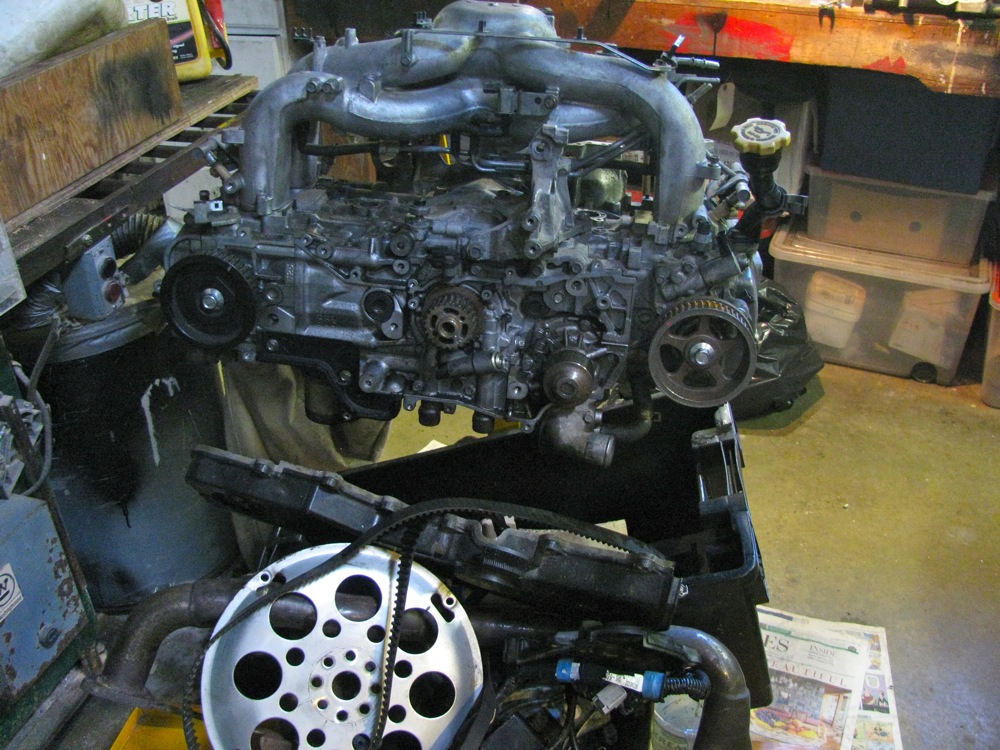
The generous gift has put me on the spot about future engine transplant. I really have a soft spot for VW inline 4 engines. I had one in my ’82 van (1800 Digifant) that ran flawlessly from 1994 to 2009 (van got T-boned and written off). I’ve been nursing the idea of a 2.0 litre I4 in the syncro. I have all the parts needed except one of the big ones – a diesel gastank. The starter in the 12 ‘o’clock position with the diesel bellhousing so it needs a differently moulded fuel tank to clear the starter. Those tanks are not so common over here on the northwest coast of North America so I haven’t been very quick to get an I4 installed. My dawdling and initial lack of interest in my stock WBX engine has resulted in me not doing much about keeping my current motor in good shape. Bothe the front and rear exhaust manifold need replacement, but the studs.bolts holding them on to the head are really rusted and decayed. I know that they will be hell to remove. Plus I have a slight coolant leak on one head (happens during cold part of winter) so it means some sort of head work even without the exhaust problem.
But then again I have a spare WBX engine that I have been just dicking around with. Why don’t I take the heads off it and see if they are good enough to use on the van’s engine? That way I can replace the exhaust manifold and head leak relatively quickly and keep the WBX in my van running long enough for me to get the Subie engine attended to (or get and I4 built up :)).
I had to drill out a couple of the exhaust studs on the spare heads, nothing, not even oxy-acetylene heat would budge the buggers. One of the drilling out operations went awry and I had to fill the hole by tig welding then re-drill and tap.
So far the heads look usable. One head has pitting, the other does not, just a hint of some corrosion beginning.
The two heads, I took a wire brush to one, and removed one set of valves (valves check out ok, and within spec on fit in valve guides).

Close ups of the pitted head.
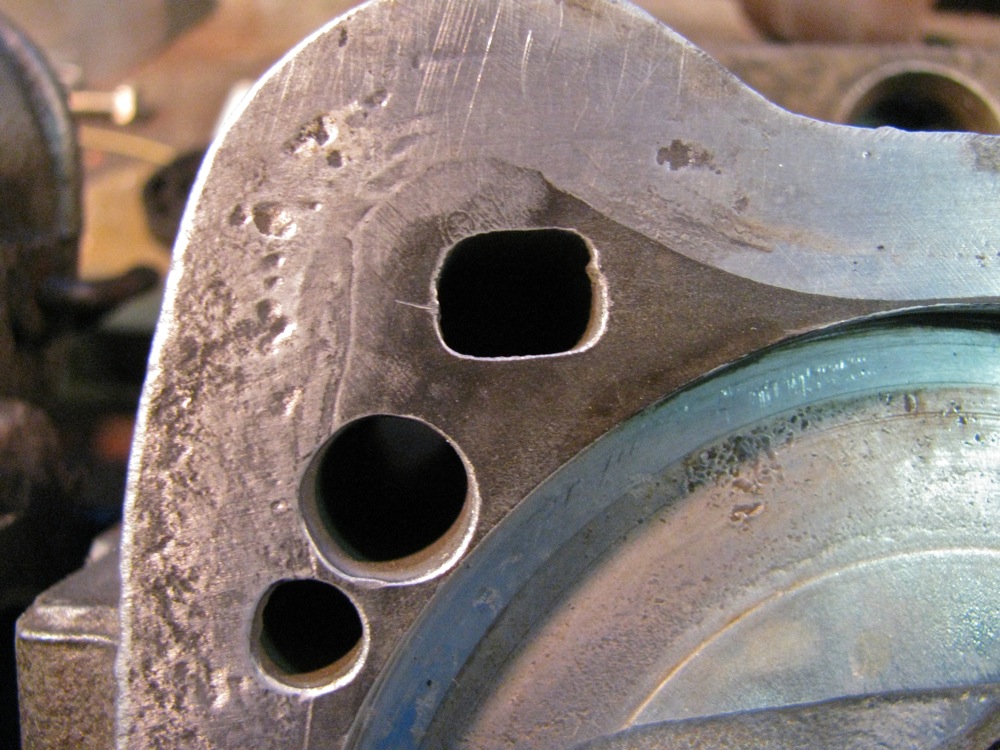
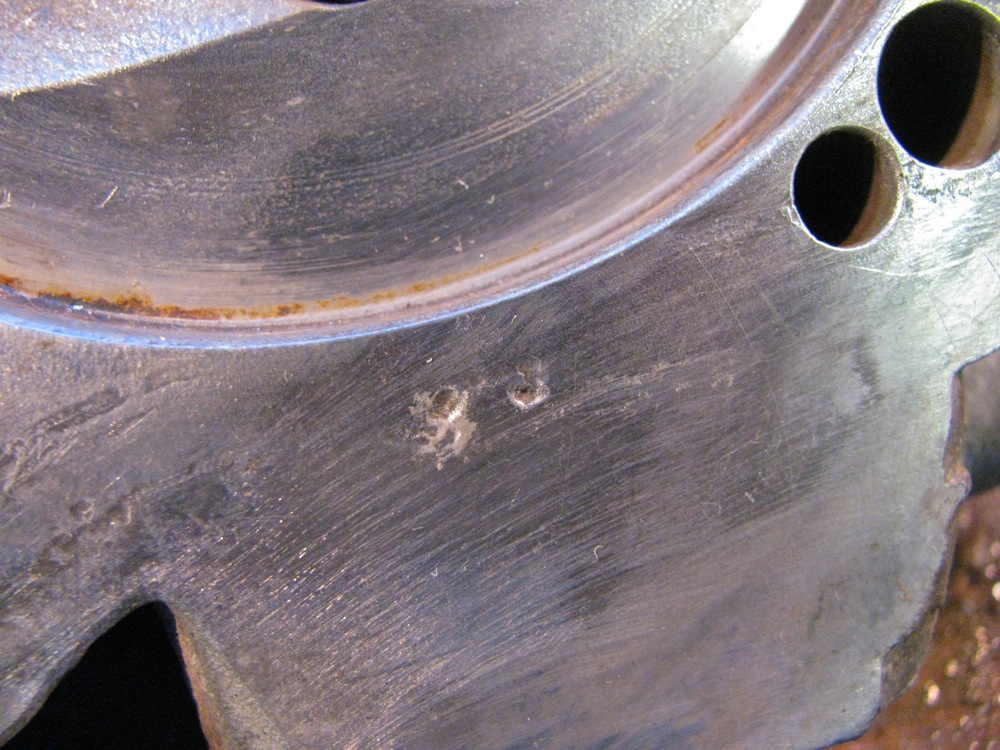
Doesn’t look like any crack between the valve seats.
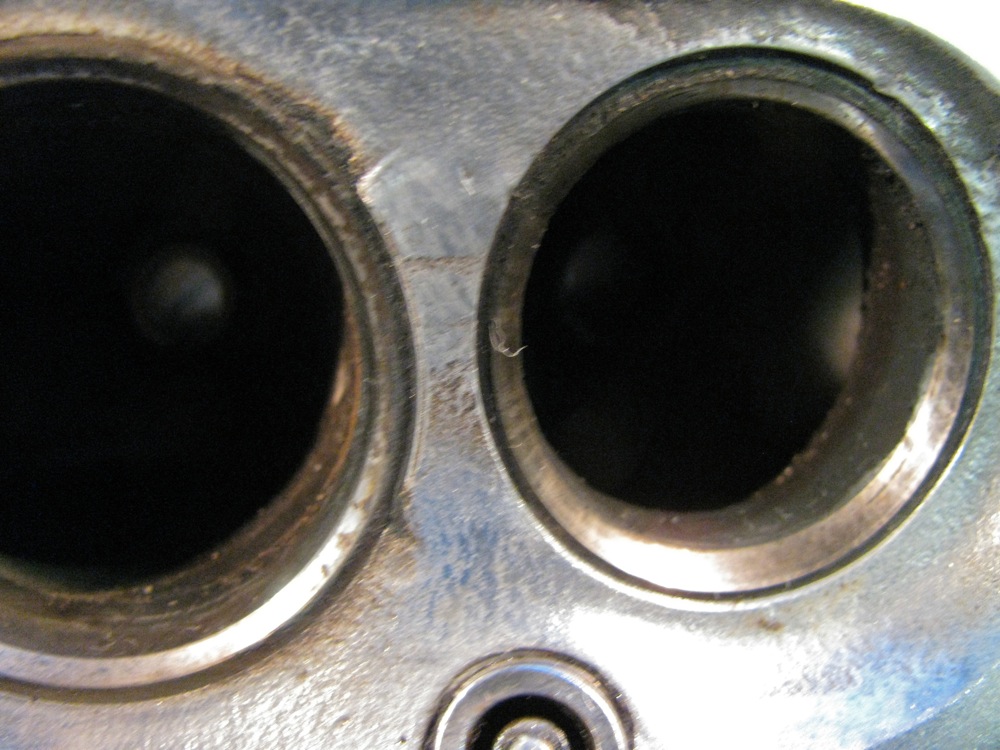
But is that a casting mark or a closed crack? I don’t think it is anything to be worried about.
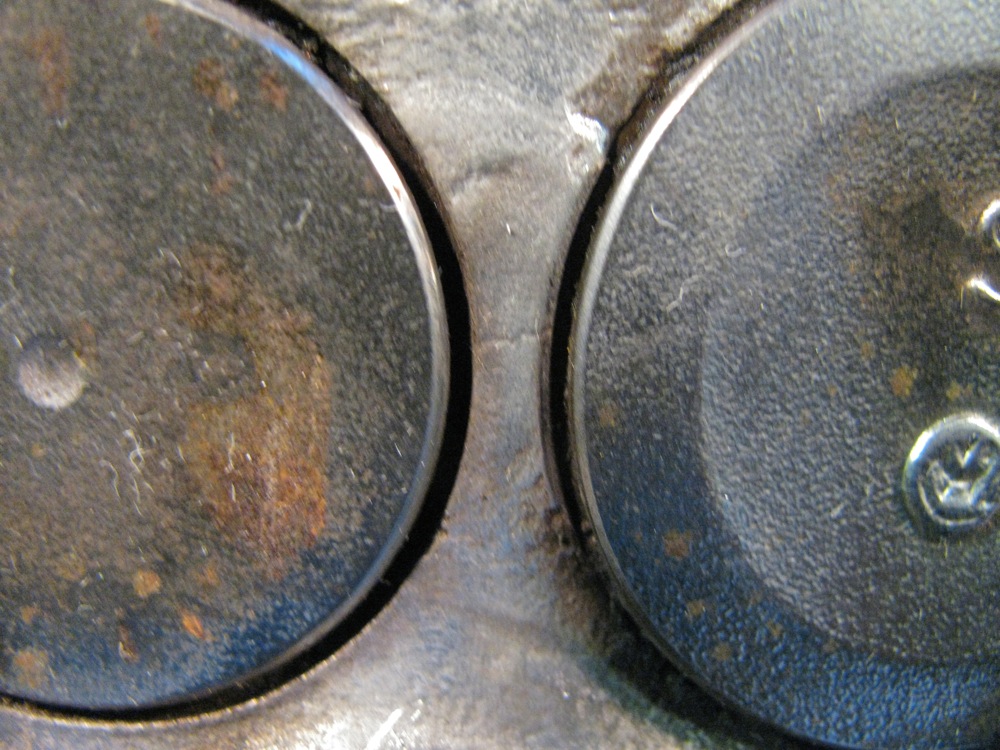
The start of some corrosion on the un-pitted head.
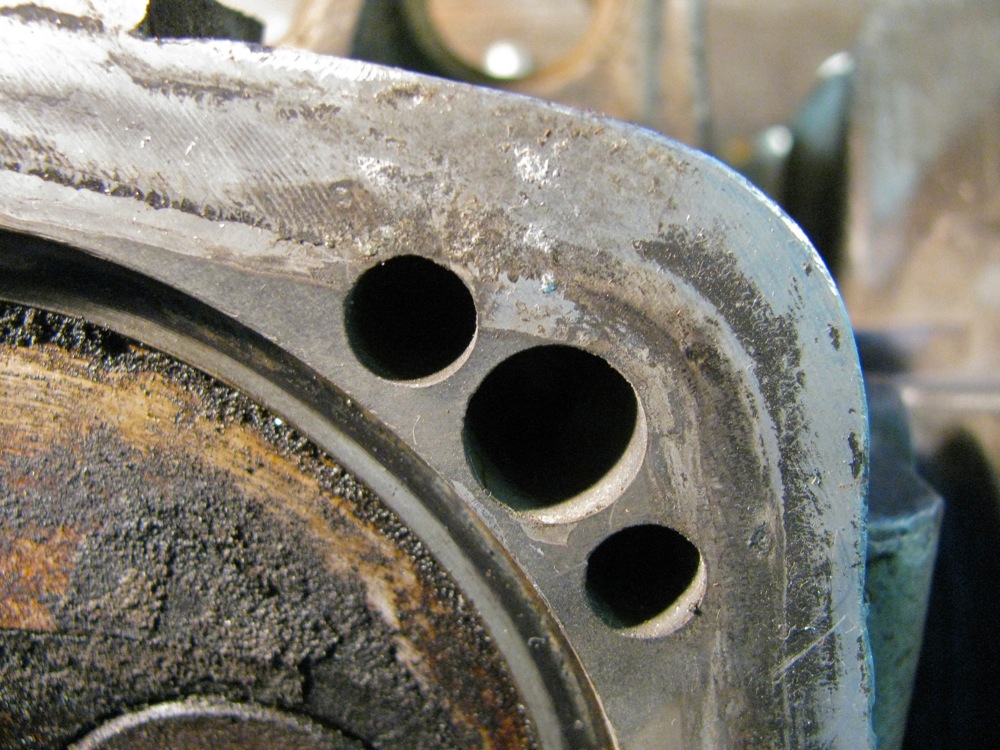
And example of what the rest of the sealing surface looks like.

So I’ve got these heads, a gasket kit, a new front exhaust manifold and a used rear manifold. The plan is to drop the engine and tranny (I want to fix the diff lock light switch on the tranny, easier if tranny is out) and swap over the heads etc. I hope to do this in the next couple of weeks.
 shooftie